What environment is suitable for growing roselle?
Roselle (Hibiscus sabdariffa) is a tropical and subtropical short-day crop. It loves light and warmth and is intolerant of early frost, growing best at 25°C to 30°C. Generally, roselle (Hibiscus sabdariffa) is sown from March to May and harvested from September to November, with a whole growth period of 160-200 days and an effective accumulated temperature of about 500-550°C. It has certain requirements for temperature, humidity, light, soil conditions and so on.
Soil for the growing environment of roselle (Hibiscus sabdariffa)
Roselle (Hibiscus sabdariffa) has a taproot system with well-developed lateral roots and deep rooting. It is drought-tolerant but not waterlogging-tolerant, and widely adaptable. It grows well in sandy loam of medium or below-medium fertility and in soil with a pH range of 6-8; planted in fertile land it has many branches, thick calyces and high yield, but it tends to grow excessively and lodge, which affects yield; in soil that is too thin, poor or heavy, it grows poorly and is prone to physiological diseases such as albino seedlings. During the growing period, poor drainage makes it susceptible to root rot, and the roots rot and the plant dies. If it encounters rainy weather at harvest, the calyces are prone to mould, directly affecting yield and quality.
Roselle (Hibiscus sabdariffa) has wide soil adaptability and can be cultivated on plains, hills and mountains. It can be grown successfully in red-yellow soil, purplish-grey clay, gravelly sandy soil and clay soil, with semi-weathered yellow soil being best. Roselle can be intercropped between rows with short-stature crops such as peanuts and beans, or in young, non-bearing orchard plots. In the same piece of land, continuous cropping for two years is generally best; continued replanting makes it prone to disease.
Temperature for the growing environment of roselle (Hibiscus sabdariffa)
As temperature rises, seed germination time shortens and the germination rate increases. The optimum temperature for seed germination is 20-25°C; germination begins at a daily average temperature of 16°C; vegetative growth requires above 22°C; and growth tends to stop at 10°C. The peak of vegetative growth in plant height and stem thickness occurs in July-August, when high temperature and high humidity reach the conditions suitable for roselle growth.
Humidity
With waterlogging during the growing period and highly fertile soil, it is prone to bacterial wilt and southern blight, with an incidence rate as high as over 40%; on dry mountain land, or even newly reclaimed mountain land, it rarely develops the disease.
Light for the growing environment of roselle (Hibiscus sabdariffa)
Roselle (Hibiscus sabdariffa) is a strong-light plant. Planted under dense forest shade, or under dense planting at a spacing of 1×0.5m, the plants are tall with thin stems, few branches and low yield. Sunshine hours have a clear effect on the budding and flowering period.
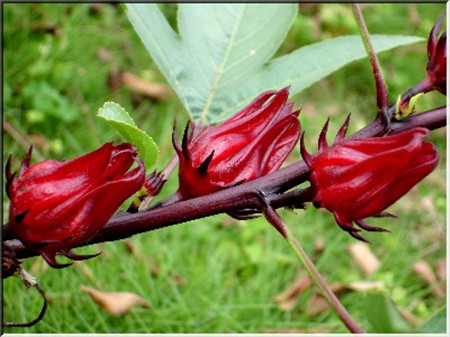
How to grow roselle: the growth habits of roselle
I believe many friends have heard of roselle. Every part of roselle is a treasure: the seeds can be pressed for oil and have high medicinal value, and are also edible; the stems can be used for beverages and fuel. So how do you grow roselle? And what are its growth habits? Let's take a look together.
I. How to grow roselle
1. Soil requirements: Roselle is a plant that fears waterlogging but not drought, so it is best to choose a sunny site with deep soil and good drainage, planted in sandy loam. Apply 1000-1500 kg of farmyard manure or 100 kg of organic compound fertiliser per mu.
2. Planting density: According to soil fertility, the plant and row spacing is (0.6×0.8) cm, and it is best to sow 1300-1500 plants per mu. One kilogram of roselle seed can plant more than 2 mu.
3. Sowing time: Soak the seeds for 12 hours before sowing. Sowing from mid-to-late April to early May is more suitable. For dibbling, put 3-4 seeds per hole; for raising seedlings and transplanting, transplant in time when the seedlings are 15 cm tall.
4. Water and fertiliser management: Roselle does not need large amounts of water and fertiliser, but for land with poor fertility and seedlings growing poorly, appropriate topdressing should be applied. Drench each mu with 20 kg of compound fertiliser and 8 kg of urea to promote seedling growth; before flowering, apply 30 kg of compound fertiliser and 20 kg of potassium sulphate per mu to meet the needs of flowering.
5. Seedling-stage handling: When the seedlings grow to 10-15 cm, thinning should be carried out, removing weak and diseased seedlings, keeping only one strong seedling per hole and pulling the rest to fill gaps. Thinning must not be too late, otherwise it affects seedling growth. When the seedlings are 80 cm tall, pinching should be carried out to encourage strong branches, more flowers and plump calyces.
6. Cultivation and weeding: When the plants are 30 cm tall, combine topdressing with earthing up and carry out 2-3 timely intertillage operations. In summer, remove weeds by hand; in the rainy season, pay attention to digging ditches for drainage to prevent seedling death and the occurrence of root rot.
7. Pest and disease control: Roselle is fairly resistant to insect pests and generally has few pests or diseases. To be safe, after sowing, when seedlings emerge in 5-7 days, spray 50 ml of 2.5% lambda-cyhalothrin per mu to control pests. Control of root and crown rot: when it occurs, use 5 g of 5% Baoding and 30 ml of 2% kasugamycin in 15 kg of water to drench the roots twice. Pesticides must be sprayed before flowering; spraying pesticides is strictly prohibited during the flowering period, so as to avoid pesticide residues remaining in the calyces and affecting product quantity.
II. Growth habits of roselle
Roselle is distributed in Taiwan, China, Fujian, Guangdong, Guangxi, Yunnan and other provinces and regions, and in tropical and subtropical areas. Roselle is a tropical and subtropical short-day crop. It loves light and warmth and is intolerant of early frost, growing best at 25°C-30°C. Generally, roselle is sown from March to May and harvested from September to November, with a whole growth period of 160-200 days and an effective accumulated temperature of about 500-550°C. It has certain requirements for temperature, humidity, light, soil conditions and so on.
The above ishow to grow roselleand an introduction to the growth habits of roselle. Roselle not only has high ornamental value, but its edible, medicinal and economic value are all very good as well.
Roselle
Other names for roselle
Roselle is also called roselle, roselle hibiscus, roselle mallow, mountain sorrel, roselle kenaf, red golden plum and red plum fruit.
Growth habits of roselle
Roselle likes light and prefers a relatively warm environment, generally between 25°C and 30°C, where it grows better. Roselle is relatively drought-tolerant, and when growing roselle you should take care to avoid waterlogging, so as to prevent pests and diseases.
In addition, roselle is relatively adaptable, and when growing it you can choose sandy soil or clay soil.
The flower language of roselle
The flower language of roselle is the feeling of being in love.