How to grow a ponytail palm? Detailed guide to care methods and precautions
Propagation methods
The ponytail palm is mostly propagated by sowing, but no seeds have been seen to form when grown in China, and seeds are mostly imported from its place of origin. When sowing, sow the seeds in a substrate mixed with leaf mold and river sand, and keep it moist, but not too wet, otherwise it will cause rot. At a temperature of 20-25°C and in a semi-shaded environment, it will germinate after 2-3 months. In addition, plants that have grown for many years sometimes produce small offsets at the base of the stem, and the offsets can also be cut apart and propagated by cuttings. But you must pay attention to disinfecting the wounds to avoid rot.
During the growth of young ponytail palm plants, fertilizer and water management should be strengthened, applying dilute liquid fertilizer frequently and in small amounts, and increasing potassium fertilizer to help the stem swell and become firm. It likes sunlight and can be exposed to direct sun all year round; even in the hot summer, continuous exposure under the blazing sun will not scorch the leaves. But it is not cold-tolerant, and in the north it needs to be brought indoors before Frost's Descent, placed in a warm, sunny spot. The room temperature should preferably be around 10°C; if it is below 5°C, cold protection and warmth measures must be taken to prevent cold damage. In temperate regions it can be moved outdoors between Qingming and Grain Rain, while in cold regions it should be after Start of Summer. Because the ponytail palm is relatively drought-tolerant, it should not be watered too much, otherwise the roots rot easily. In spring and autumn, water only when the soil is dry and let it dry between waterings; in summer keep it moist; in winter water again when the soil is dry. During the growing season, when cultivated outdoors, apply a dilute liquid fertilizer once every half month; when cultivated indoors, it is best to apply granular fertilizer to avoid polluting the air. For pot cultivation, use fertile sandy soil, prepared with equal parts garden soil, leaf mold and coarse sand. Repot and change the soil every spring or after autumn to maintain the permeability of the potting soil. Whether potting up or repotting, it is best to expose the swollen base above the soil for people to admire.
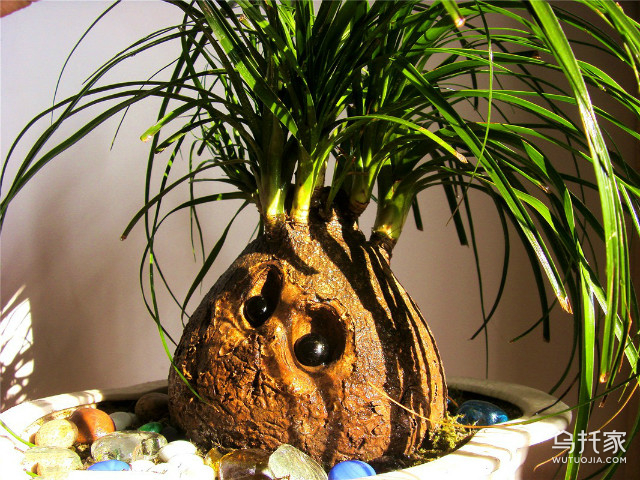
Ponytail palm
The ponytail palm, also known as the elephant's foot tree, belongs to the family Ruscaceae and is a foliage plant native to the hot, dry regions of Mexico. Because its base swells up and closely resembles a wine bottle, it is named the ponytail palm. In the wild, the ponytail palm can reach 10 m tall and is a rather spectacular plant. Of course, after entering the home, the height of a potted ponytail palm is only one tenth of that. Its branches and leaves are not especially dense, but they are extremely slender, somewhat similar to weeping willow, with emerald-green veins drooping naturally, very poetic. It is a plant that makes people wait expectantly, simply because seeing it bloom requires waiting ten years, but before that, its appearance also has ornamental value.
So how exactly should the highly ornamental ponytail palm be grown, and what precautions are there? Below, they will be introduced one by one for everyone.
Ponytail palm care methods and precautions
First, let's introduce its care methods from these seven aspects: soil, sunlight, humidity, water, fertilizer, pests and pruning.
1. Soil: It is tolerant of drought and poor soil, so loose sandy soil and humus soil should be used as the growing medium. Note that soil with good drainage should be chosen to prevent waterlogging. It is recommended to choose fertile garden soil and coal cinder, mix them together at a ratio of 3:1, then add a small amount of soybean cake or chicken manure as base fertilizer.
2. Sunlight: It likes sunlight. If it lacks sunlight, its leaf growth will be affected, and the whole plant will not grow robustly. Therefore, in spring and autumn, it should be placed in a spot with plenty of light as much as possible. Because summer temperatures are often too high, shading is needed, and in all four seasons the pot should be rotated once every month so that it can receive sunlight evenly.
3. Humidity: It likes moisture and should grow in an environment with a relative humidity of 70-80%, otherwise the leaves will turn yellow and fall off.
4. Water: Because it is especially drought-tolerant, even if it is not watered for half a year it will not be affected. Therefore, follow the principle of preferring dry over wet, and absolutely avoid water accumulation, otherwise it easily causes rot of the fleshy roots and stem. In late autumn when the temperature drops, watering should be reduced to improve the plant's cold resistance at once.
5. Fertilizer: Except in winter, the other three seasons are the peak growing seasons for the ponytail palm, and it needs to be fertilized once every half month to ensure sufficient nutrients. Remember to add fertilizers such as phosphorus and potassium fertilizer when fertilizing. Note that fertilization should be temporarily stopped in winter.
6. Pests: Leaf spot disease is the great enemy of the ponytail palm. To prevent it, spray diluted Bordeaux mixture once every two weeks. If damage from mirid bugs, whiteflies and scale insects occurs, use a 40% omethoate emulsifiable concentrate at 1500 times dilution to spray and kill the pests.
7. Pruning: Note that in winter, prune away the relatively weak, dead, and pest- or disease-affected branches and leaves. Note that if the branches and leaves are too dense, pruning is also needed.
The easy-to-care-for ponytail palm is truly good news for nine-to-five office workers. If you have recently been thinking about growing plants, you might consider growing a ponytail palm.
How to grow a ponytail palm, ponytail palm care methods and precautions / note the five key points
I. How to grow a ponytail palm
1. Soil
Growing a ponytail palm has very high requirements for soil. It is best to choose sandy soil and humus soil with good drainage. Use one part coal cinder mixed with three parts garden soil, plus a small amount of chicken manure as base fertilizer; in this way the first step of the early stage is basically complete.
2. Fertilizer
Fertilizer can be said to be an indispensable part of growing a ponytail palm. Apart from winter, the other three seasons can be said to be the seasons of vigorous growth for the ponytail palm. In these three seasons, it is best to fertilize the ponytail palm once every two to three weeks. Generally, applying liquid fertilizer or compound fertilizer is enough, as this can promote the swelling of its base. Also, a reminder: no fertilization is needed in winter.
3. Water
The ponytail palm is a plant with very strong vitality and is especially drought-tolerant. Even if it is not watered for three to five months, it can still grow normally. Remember never to let water accumulate, and master the degree well, maintaining the principle of preferring dry over wet, because watering too much will cause the roots and stem to rot.
4. Humidity
Humidity here refers to the climate. Regarding how to grow a ponytail palm, climate is also one of the key aspects, because too low humidity will cause adverse reactions in the growth of the ponytail palm; for example, the leaves may lose their luster, turn yellow, or fall off.
5. Sunlight
Everyone knows that sufficient sunshine is an essential condition for the growth of most plants, and the ponytail palm is no exception. It likes to grow in places with sufficient sunshine. If there is insufficient sunshine, it will grow very small and weak, not robust.
II. Ponytail palm care methods and precautions
1. Summer / note shading
Although the ponytail palm is a plant that very much likes sunlight, because the summer weather is dry and the sunlight is too strong, it is best to place the ponytail palm in a semi-shaded spot, and give it a proper misting every day, generally 2-3 times a day. If you want to understand the ponytail palm care methods and precautions, this point must be kept firmly in mind.
2. Winter / control water
Winter is the dormant period of the ponytail palm, so there is no need to water it. In this season, it is best to move the ponytail palm indoors for cultivation. If it is inconvenient to put it indoors, you can wrap it in plastic film, and at noon open the film to let it breathe.