How to grow bleeding heart (Dicentra spectabilis)? Detailed guide to growing methods and precautions
Propagation methods
Commonly done by division or by cutting the rhizome into sections. In autumn, dig out the underground parts, separate the rhizomes naturally along their segments, and plant them separately. Alternatively, cut the rhizome into sections, each with a bud eye, insert them into sand, and plant them in pots once rooted. For seed propagation, seedlings grown from seed need 3 years before they can bloom. During the growing period, give plenty of fertilizer and water; move the plant as little as possible during the flowering period so that dropping flowers do not affect its ornamental value. After flowering, the above-ground parts wither; the rhizome can be dug up and potted, keeping the temperature at 15°C and the environment moist, and flowers can be seen again in about 70 days.
There are three propagation methods for bleeding heart: the first is the most commonly used division method. In early spring in February, before the new buds swell and the new leaves have unfolded, take the plant out of the pot, shake off the soil around the roots, and use a sharp knife to cut off the tillering young stems with fibrous roots around the root base; plant two or three of them in one pot, cover with soil to 2 to 3 cm above the old soil line, water, and place in a shady spot; after new leaves grow, manage as usual, and it can bloom in the same year.
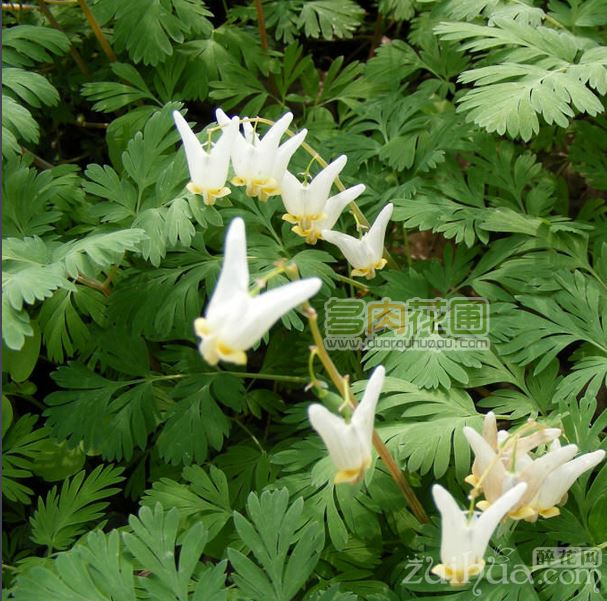
Its scientific name is Dicentra cucullaria. The flowers are white with yellow tips, borne on flowering stems, swaying in the wind, much like upside-down Dutchman's breeches, hence the common name Dutchman's breeches. It is native to open woodlands of eastern and central North America. The leaves are gray-green, growing from white underground tubers; the flower stalks rise above the leaves and also emerge directly from the underground stem. It grows well in shaded, windless wild gardens.
Bleeding heart growing methods and precautions
Each bud of the bleeding heart is like a string of lanterns, hanging all over the branches, very endearing. The bleeding heart has beautiful foliage, exquisite flowers and brilliant colors, and is a good material for potted plants and cut flowers. So how do you grow bleeding heart? What are the growing methods? Let's learn about bleeding heart growing knowledge together.
I. How to grow bleeding heart
Bleeding heart, also known as rabbit peony, is a perennial herbaceous plant of the Papaveraceae family. The rhizome is fleshy. The plant height is 30-60 cm. The leaves are opposite, ternately compound, somewhat like peony leaves. The raceme is terminal, with flowers drooping to one side; there are 4 petals, the two outer ones larger, united into a heart-shaped sac, in pink, yellow, white, etc. The tips curl back to both sides; the two inner petals are slender with protruding tips, white. The flowering period is April to May.
Provide appropriate shade in hot summer; it likes to be grown in semi-shade and grows well there. The roots are fleshy and somewhat drought-tolerant, so the potting soil must not be waterlogged for long periods. Water moderately during the growing period, keeping the potting soil in a semi-moist state. Control watering at low temperatures in winter. During consecutive rainy days, take care to prevent water from accumulating in the pot. The foliage is beautiful and the flowers exquisite; in gardens it can be planted in clumps or used in flower border arrangements; because it is very shade-tolerant, it is suitable for planting under trees as ground cover and for accenting the shady spots of rock gardens. It can also be potted and used for forced cut flowers.
II. Bleeding heart growing methods
1. Potting soil: Bleeding heart can be grown in the ground or in pots; for home growing it is generally potted, and it is best to use a slightly deep, larger earthenware pot with good permeability. If using plastic or porcelain pots, place a layer of crushed charcoal pieces or crushed hard plastic foam pieces at the bottom of the pot to enhance aeration and drainage. It likes to grow in loam rich in humus; you can use equal parts of leaf mold and garden topsoil mixed as the growing medium, as it grows poorly in both sandy and clay soils.
2. Water and fertilizer: Bleeding heart likes fertilizer. When potting or repotting and changing soil, it is advisable to add some bone meal or decomposed organic fertilizer or nitrogen-phosphorus-potassium compound fertilizer to the growing medium. During the growing period, apply a dilute nitrogen-phosphorus-potassium liquid fertilizer once every 10 to 15 days to make the leaves lush and the flowers abundant; stop fertilizing after the flower buds show color, and do not fertilize during the dormant period.
3. Light and temperature: Bleeding heart originates from Hebei and the Northeast region of China. It likes a semi-shade environment with ample diffused light, is relatively cold-tolerant, and fears the intense heat of midsummer and strong direct sunlight. Therefore, it is best placed under large trees in the courtyard, under grape trellises, on the shady side of tall buildings, or on east- or north-facing balconies. During the summer dormant period, place it in a well-ventilated shady spot where it cannot receive direct light, and often sprinkle water on the nearby ground to raise air humidity and lower the temperature.
4. Pruning and overwintering: To improve the ventilation and light conditions of the bleeding heart and concentrate nutrients, shaping and pruning should also be done after the leaves fall in autumn and winter. Cut off overly dense branches, such as parallel branches, crossing branches, inward-facing branches and diseased or pest-infested branches, so that the plant keeps a beautiful shape. In late autumn and early winter, the potted peony can be buried in the soil with the branches exposed above the ground, and covered with grass or mounded soil for protection through the winter.
5. Flowering control: Bleeding heart can be forced into cultivation. After the leaves fall in autumn, plant it in a pot and place it in a cold room; in mid-December move it to a 12-13°C greenhouse, keeping it moist at all times, and it can bloom in February. After flowering, place it again in a cold room, and replant it in the open ground when early spring arrives.
6. Pest and disease control: Common diseases of bleeding heart include cockscomb leaf spot and leaf spot. Start spraying from the early stage of the disease to prevent the disease from spreading. Commonly used agents include 25% carbendazim wettable powder at 300-600 times dilution, 50% thiophanate at 1000 times, 70% maneb at 500 times, 80% mancozeb at 400-600 times, 50% captan at 500 times, etc. Note that the agents should be used alternately to prevent the pathogen from developing resistance.
The above isbleeding heart growing methodsintroduced; we hope it is helpful for your bleeding heart growing. If you want to learn more about bleeding heart, keep following us.