Detailed Guide to Growing and Caring for the Polka Dot Plant
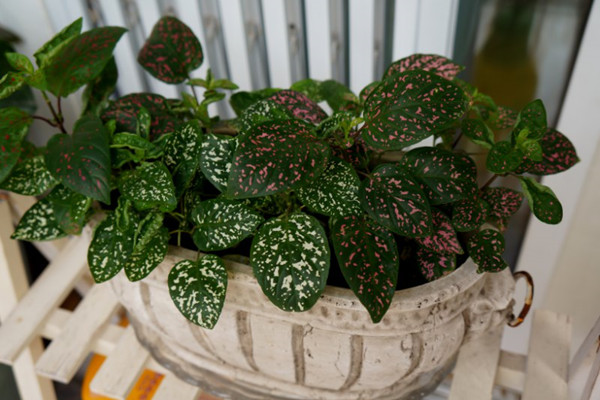
The polka dot plant, also called splash red grass or freckle face, is a plant of the genus Hypoestes, native to Madagascar. It can grow up to 60 cm tall, and about 10-15 cm in a pot. After the branches extend, they become semi-trailing, and the stem nodes root easily. The leaves are opposite, ovate or long-ovate, with short side branches easily growing from the leaf axils. The leaf surface is olive green, covered with pink or white spots, much like paint splashed on by hand, giving it a uniquely elegant style. It can bloom in spring, with inconspicuous light purple flowers, and is usually grown mainly for its foliage. It is suitable for garden accents or as a small potted plant for indoor viewing.
Propagation: Can be done by sowing or cuttings. In South China, propagating by cuttings gives a high survival rate, and seedlings can be raised year-round, but spring and autumn are the best 2 seasons, with an ideal rooting temperature of about 20-25°C. Cut the terminal buds or branches, each segment with 2-3 nodes, and insert them into river sand or a growing medium made of river sand, perlite and fine snake wood shavings, keeping them cool and humid; they will root in about 3-4 weeks. The cuttings can also be inserted directly into the potting soil to grow, with 3-5 stems per 5-inch pot.
How to Grow the Polka Dot Plant
Soil for the Polka Dot Plant
The polka dot plant likes loose, airy, well-drained, deep and fertile soil rich in humus that is slightly acidic.
Temperature for the Polka Dot Plant
The normal growing temperature for the polka dot plant is between 15-18°C, and the wintering temperature must be above 12°C. It is not tolerant of severe cold, so in winter take care to keep it warm, place the polka dot plant indoors, and make sure the room temperature is above 12°C. When summer temperatures are too high, pay attention to shading, cooling and ventilation.
Water for the Polka Dot Plant
The polka dot plant likes a moist growing environment. During the normal growing season, pay attention to the moisture level of the potting soil and water frequently. When summer temperatures are too high, increase the frequency of watering, and at the same time spray water on the leaves to increase air humidity.
Light for the Polka Dot Plant
The polka dot plant likes a warm, humid, semi-shaded environment and likes light, but requires partial shade or partial light; appropriately increasing direct light can make the leaves more glossy.
Fertilizing the Polka Dot Plant
The polka dot plant does not need frequent fertilizing; applying a nitrogen, phosphorus and potassium fertilizer or Taiwan Fertilizer No. 1 quick-acting once a month is enough.
During the growing season, the polka dot plant is prone to stem rot. It can be treated by mixing pentachloronitrobenzene powder and dexon powder with water and pouring it on, or it can be prevented and controlled with carbendazim or thiophanate-methyl.
Precautions for the Polka Dot Plant
Pruning
After the polka dot plant blooms, the branches die along with the flowers, so cut off the dead branches to encourage new branches to grow from the base. When it grows too fast, pinch it back promptly to encourage more branching and make the plant more compact, improving its ornamental value. When the plant is too tall and the lower leaves have withered, prune it again.
Replacing the Potting Soil
When transplanting the polka dot plant, mix some of the original soil into the new pot; half new and half old is best, as this prevents death from environmental shock.
Phalaenopsis Growing Methods Video_ Growing Methods and Precautions
Phalaenopsis, also called the moth orchid or Taiwan butterfly orchid, is a flowering plant in the genus Phalaenopsis of the orchid family, native to subtropical rainforest regions, and is an epiphytic orchid. The white, thick, large aerial roots of Phalaenopsis are exposed around the leaves; they can absorb nutrients from the air and also grow to achieve photosynthesis. Around Spring Festival, long flower stalks emerge from the leaf axils of the Phalaenopsis plant, forming butterfly orchid flowers that dance like butterflies one after another, making it very popular. The butterfly orchid is mainly distributed in Indonesia, Taiwan, China, the Philippines, Thailand, Malaysia and other regions, and has the reputation of being the queen of orchids. Below let us enjoy the video of Phalaenopsis growing methods, as well as Phalaenopsis growing methods and precautions.
[Phalaenopsis Growing Methods Video]
The name Phalaenopsis comes from the ancient Greek for an orchid that looks like a butterfly. It can survive by helping to absorb nutrients from the air, and it is mainly classified within the category of aerial orchids, belonging to one of the larger families among tropical orchids. Taiwan's white Phalaenopsis is famous throughout the world, while in Indonesia, Borneo, the Philippines and Malaysia there are fifty or sixty species of native Phalaenopsis. The flower colors of Phalaenopsis are rich and varied, including white, yellow with spots, pink and many more. Plant breeders have used precious varieties for artificial cultivation to improve Phalaenopsis with various flower shapes and colors, and great achievements have also been made in flower size. Colors such as white, pink, yellow with red spots, red dots and red lines, pure yellow, and white flowers with red can all be seen in Phalaenopsis. Phalaenopsis can be called today's queen of orchids, a delightfully pleasing flowering plant.
[Growth Habits of Phalaenopsis]
Phalaenopsis is native to tropical rainforest regions and likes to grow in warm environments, but it fears the cold. The suitable growing temperature is 15-20°C; in winter it stops growing below 10°C, and the temperature must not fall below 5°C, otherwise the plant will die. The Phalaenopsis genus of the orchid family, native to the tropical regions of Malaysia, is a perennial herbaceous plant, and hot, humid riverbanks and coastal areas are places where Phalaenopsis grows more lushly. However, under high temperature and high humidity, Phalaenopsis can suffer pest and disease damage. The suitable environmental humidity for its growth is 60-80%.
[Phalaenopsis Growing Methods and Precautions]
1. Soil: Phalaenopsis is mainly propagated by sowing, and it is an epiphytic orchid whose aerial roots attach to rocks or tree trunks, mainly absorbing water and nutrients from the air. Phalaenopsis is best grown in loose, airy materials, preferably bark, crushed brick and tile, coconut shell, tree fern root, sphagnum moss, etc., using county committee or ceramsite as the substrate, fixing the seedlings directly in charcoal, and letting Phalaenopsis naturally climb and grow during its growth, with a pH value of 6.5. It is best to mainly use mosses and aquatic plants, and choosing relatively soft soil is best.
2. Temperature: Phalaenopsis has relatively strict temperature requirements. The suitable daytime growing temperature is 15-30°C, and the suitable nighttime temperature is 23°C. If it is lower or higher than this temperature, it will be unfavorable to the growth of Phalaenopsis, and in serious cases it can cause the leaves to turn yellow. When the temperature is high, a fan and water curtain can be used to cool it down; when the temperature is low, a heater can be used to raise the temperature.
3. Humidity: During the vegetative growth stage of Phalaenopsis, a humidity above 90% is the best state, while for promoting flowering the humidity should be kept at 70-80% as the most suitable; after the flowering period the humidity requirement is 50%. Using a water curtain for ventilation or spraying the ground space to wet it are the most suitable measures for regulating humidity.
4. Light: Appropriate light is best for Phalaenopsis. It is a shade-loving plant, but it also needs sufficient light to provide itself with energy, especially during the flowering period, when Phalaenopsis needs sufficient light even more, and direct sunlight should be avoided. Phalaenopsis has very high requirements for air quality, and it is best placed in a ventilated spot for growing, which can effectively prevent pest problems.
5. Fertilizing: During the spring growing season of Phalaenopsis, you can choose to fertilize with a special nutrient solution for Phalaenopsis. In winter, if the amount of fertilizer is reduced, it will affect the next year's flowering. After the couple, prune off the withered flowers, which effectively reduces nutrient consumption, and withered flowers hanging on also do not look very good.
6. Water: Phalaenopsis leaves do not easily store water, so the soil must be given sufficient water. When the new roots of Phalaenopsis are growing vigorously, water more; after the flowering period, during the dormant stage, reduce the amount of watering. In spring and autumn, water once a day at around five o'clock, while in summer when the plant grows vigorously, water a little in the morning and a little in the afternoon. In winter, when the temperature is low and the light is relatively weak, water once every other week. When a cold wave comes, do not water too much; keep the soil dry, which makes it less likely to cause the plant to freeze to death.
[Precautions for Growing Phalaenopsis]
When growing the butterfly orchid, water appropriately, and do not water too frequently, otherwise it will cause the roots of Phalaenopsis to rot. Also pay attention to keeping it warm; too low a temperature will put Phalaenopsis into a dormant state, especially in winter, so be sure to keep it warm. Appropriate fertilizing is extremely rough on the growth of Phalaenopsis; during the growing season, fertilize about once a week, and you can choose to apply a specialized fertilizer. The flower pot for growing Phalaenopsis is also very important; an appropriately large flower pot is more beneficial to the growth of Phalaenopsis.
More related information: Efficacy and effects of egg fruit What is cistanche The effects of clivia Pictures of cynomorium Pictures of white magnolia flowers