How to grow four o'clock flowers? Master these care tips and you can grow them well
Four o'clock flowers can be propagated by spring sowing and can also self-seed; they are usually propagated by seed. The small nutlets are used as the sowing propagation material, and they can be sown directly in the open ground in mid-to-late April. The suitable germination temperature is 15-20°C, and they sprout in seven or eight days. Because it is a deep-rooted flower, it is not suitable to sow in an open-ground seedbed and then transplant. If conditions allow, they can first be sown into tube pots with an inner diameter of 10 cm, and after the seedlings are established, they can be removed from the pots and planted in place.
Four o'clock flowers are propagated by seed, and it is best to sow and raise seedlings in March to April. When the seedlings grow 2-4 leaves, plant them in place, with a plant spacing of 50-80 cm being suitable. After transplanting, pay attention to shading. Four o'clock flowers are easy to manage and easy to grow; just pay attention to appropriate fertilizing and watering. Four o'clock flowers are wind-pollinated flowers, and different varieties cross very easily. If you want to maintain variety characteristics, they should be grown in isolation.
In the north, at the end of autumn, the aboveground part can be cut off and the perennial roots dug up, buried in moist soil in a flowerpot, and placed in a low-temperature room to overwinter. The following spring, continue cultivating them in the open ground; they become established quickly and bloom early. Although perennial-root plants are not as vigorous as seed-grown seedlings, their tuberous roots swell year by year, and after 3 consecutive years they can grow into a brown tuber about 10 cm in diameter, with layered wrinkled skin and a hard texture. In spring, the lower 1/3 of the tuberous root can be planted into a shallow pot, with the upper part of the tuberous root exposed, gradually becoming stem-like and adapting to the external environment. And by shaping it according to its form, it can be made into a natural rock landscape bonsai. Every spring it sends out 1-2 new branches that bloom and set seed. After autumn, cut off the branches, put the tuberous root back into the room in its original pot, and keep the potting soil slightly moist for storage. It can be cultivated continuously for dozens of years; the older the tuberous root, the more rustic and vigorous it appears, with a distinctive charm.
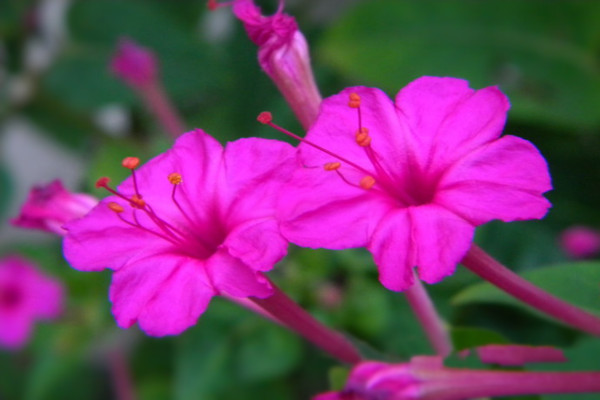
How to plant four o'clock flowers
Seed propagation method for four o'clock flowers
Using seed propagation, it is best to sow and raise seedlings in March to April. Directly sow the seeds on bare ground, and they will germinate in 7 or 8 days. Wait until the seedlings grow 2-4 leaves, then plant them in place, with a plant spacing of 50-80 cm being suitable.
After transplanting, pay attention to shading, and just pay attention to appropriate fertilizing and watering.
Transplanting propagation method for four o'clock flowers
In the north, at the end of autumn, the aboveground part can be cut off and the perennial roots dug up, buried in moist soil in a flowerpot, and placed in a low-temperature room to overwinter. The following spring, continue cultivating them in the open ground.
Four o'clock flowers are robust by nature, highly adaptable, easy to care for and manage, and tolerant of transplanting. Through transplanting propagation, they can be cultivated continuously for decades.
Care tips for four o'clock flowers
Soil
For growing four o'clock flowers, the soil should be loose, fertile, deep, and rich in humus; loam or sandy loam is better.
Water and fertilizer
The daily management of four o'clock flowers is very simple; just spray them with some water on clear evenings. Dry weather makes them prone to aphids; paying attention to moisture retention normally can prevent aphids.
Apply dilute fertilizer 1-2 times on evening every week, which is beneficial for normal growth. It does not matter if you forget to fertilize, because the fallen leaves of four o'clock flowers themselves drop into the soil and are excellent fertilizer.
Four o'clock flower Mirabilis jalapa Linn. Four o'clock flower guide: how to grow four o'clock flowers / how to propagate four o'clock flowers
Four o'clock flower profileFour o'clock flower Mirabilis jalapa Linn.
Cultivation methods and precautions for four o'clock flowers, and an introduction to four o'clock flowers
Four o'clock flower is a perennial herbaceous flower, often grown as an annual, and can reach 1 m in height. It is a tuberous-root plant, with thick fleshy roots, obconical, black or dark brown. The main stem is erect, cylindrical, much branched, hairless or sparsely covered with fine soft hairs, with slightly swollen nodes.
Four o'clock flower leaves are opposite, ovate or heart-shaped, with lighter-colored veins inside. Several flowers are clustered on the involucre, and the calyx is petal-like, trumpet-shaped, in colors such as red, orange, yellow, white, and purple, or with stripes, blotches, or two colors alternating, and fragrant. The fruit is black, ovate, with a wrinkled surface. It is a ribbed tuberous-root plant, with thick fleshy roots, obconical, black or dark brown. The 1000-seed weight is about 109 g. At the root of the flower, the seeds change from an initially pale tender color to black when mature. The endosperm inside the seed is white and fine, and is a natural ideal cosmetic. The root is spindle-shaped, fleshy, with a brown-black surface.
The endosperm inside the seed of four o'clock flower is white and fine, and is a natural ideal cosmetic. The 1000-seed weight is about 109 g. The root is spindle-shaped, fleshy, with a brown-black surface.
Four o'clock flowers are suitable for courtyard cultivation and release a strong fragrance at dusk. The leaves and endosperm can be made into cosmetic powder; the roots and leaves can be used as medicine. It is native to the tropical regions of the Americas and is one of China's invasive alien species. In all parts of northern and southern China, it is often cultivated as an ornamental flower, and it is an ornamental flower.
Morphological characteristics of four o'clock flowers
Four o'clock flowers bloom with small purple flowers in summer and autumn. The leaves are ovate or heart-shaped and opposite. The flowers are fragrant, several clustered on the involucre, opening from evening to early morning, releasing a strong fragrance at dusk, and closing under strong sunlight. The calyx is petal-like and trumpet-shaped. The fruit is ovate, black, with a wrinkled surface and ribs, so the fruit has the elegant nickname "little landmine."
The main stem of four o'clock flower is erect, 50-100 cm tall, with swollen nodes, much branched and spreading. The simple leaves are opposite, ovate or ovate-triangular, with entire margins. The flowers are terminal, with only 1 flower inside the involucre, and no petals. The calyx is petal-like, trumpet-shaped, about 2.5 cm in diameter. The flowers open in the afternoon and wither the next morning; they soon fall off, and the flowers are fragrant.
The petal-like calyx has various colors such as purple-red, pink, red, yellow, and white, as well as variegated colors. Some plants bear two flower colors, commonly red plus yellow; white plus pink.
The simple leaves are opposite; the leaf blades are ovate or ovate-triangular, 3-15 cm long and 2-9 cm wide, with acuminate tips, truncated or cordate bases, entire margins, hairless on both sides, and raised veins; the petiole is 1-4 cm long, and the upper leaves are almost sessile. The flowers are often several clustered at the branch tips; the sepals are petal-like; the style is 1-2 mm long; the involucre is bell-shaped, about 1 cm long, 5-lobed. The lobes are triangular-ovate, with acuminate tips, hairless, with veinlets, and persistent in fruit; the perianth is purple-red, yellow, white, or variegated (white, yellow, and red are its varieties). It is salver-shaped, with a tube 2-6 cm long and a limb 2.5-3 cm in diameter, shallowly 5-lobed; the flowers open in the afternoon and are fragrant. They wither before noon the next day; there are 5 stamens, with slender filaments often extending outside the flower, and spherical anthers; the style is solitary, linear, extending outside the flower. The stigma is capitate.
The root of four o'clock flower is thick and fleshy, obconical, black or dark brown. The stem is erect, cylindrical, much branched, hairless or sparsely covered with fine soft hairs, with slightly swollen nodes. The leaf blades are ovate or ovate-triangular, 3-15 cm long and 2-9 cm wide, with acuminate tips, truncated or cordate bases, entire margins, hairless on both sides, and raised veins; the petiole is 1-4 cm long, and the upper leaves are almost sessile. The flowers are often several clustered at the branch tips; the pedicel is 1-2 mm long; the involucre is bell-shaped, about 1 cm long, 5-lobed, with the lobes triangular-ovate, acuminate at the tip, hairless, with veinlets, and persistent in fruit; the perianth is purple-red, yellow, white, or variegated, salver-shaped, with a tube 2-6 cm long and a limb 2.5-3 cm in diameter, shallowly 5-lobed; the flowers open in the afternoon and are fragrant, and wither before noon the next day; there are 5 stamens, with slender filaments often extending outside the flower, and spherical anthers; the style is solitary, linear, extending outside the flower, and the stigma is capitate. The achene is spherical, 5-8 mm in diameter, leathery, black, with a wrinkled surface; the seed endosperm is white and powdery.
The seeds of four o'clock flower are white, and the cotyledons appear as very fine white powder. The flowers are several and terminal, and may have striped or spotted compound colors; with a jasmine-like fragrance, they feel even more elegant. There is a variety, dwarf four o'clock flower, about 30 cm tall, with small, slender seeds. The achene is spherical, black, with longitudinal ribs and reticulate texture, shaped somewhat like a landmine.
The flowering period of four o'clock flower is June to October, and the fruiting period is August to November.
Ecological habits of four o'clock flowers
Four o'clock flower is native to the tropical regions of South America. It prefers mild and humid climatic conditions and is not cold-tolerant. In winter, the aboveground part dies back, and in the regions south of the Yangtze River the underground part can overwinter safely and become a perennial-root herbaceous flower, sending up new plants again the following spring. Open-ground cultivation requires deep, loose, fertile loam, while for pot cultivation, ordinary flower-growing soil can be used. It grows better in slightly shaded places. The flowers open from evening to early morning and close under strong light. If there is shade in summer, it grows and blooms well; under intense summer heat and strong sun, it often shows leaf drop. It likes a well-ventilated environment. It is often cultivated in all parts of northern and southern China as an ornamental flower, and sometimes escapes into the wild.
It prefers mild and humid climatic conditions and is not cold-tolerant. In winter, the aboveground part dies back, and in the regions south of the Yangtze River the underground part can overwinter safely and become a perennial-root herbaceous flower, sending up new plants again the following spring. Open-ground cultivation requires deep, loose, fertile loam, while for pot cultivation, ordinary flower-growing soil can be used. It grows better in slightly shaded places. The flowers open from evening to early morning and close under strong light. If there is shade in summer, it grows and blooms well; under intense summer heat and strong sun, it often shows leaf drop. It likes a well-ventilated environment, is robust by nature, grows quickly, is not choosy about soil, and is easy to manage. It has a taproot nature, with few fibrous roots, is not tolerant of transplanting, and in summer has the effect of repelling mosquitoes.
Four o'clock flower is native to tropical America. It prefers a warm and humid climate, is not choosy about soil, and is not cold-tolerant. In North China it is grown as an annual, while south of the Yangtze River it is perennial. It likes light, and grows even better in slightly shaded places. Four o'clock flower is robust, grows quickly, and is simple to manage. It is suitable for cluster planting in front of and behind houses, beside hedges and fences, and next to open woodlands. Its seed endosperm can be made into cosmetic powder.
Variety classification of four o'clock flowers
Four o'clock flower family has about 30 genera and 300 species, distributed in tropical and subtropical regions, mainly produced in tropical America. China has 7 genera, 11 species, and 1 variety, among which 3 species are commonly cultivated or have escaped, mainly distributed in South China and Southwest China.
Main tribes and genera
This family is divided into 5 tribes: Mirabileae, Pisonieae, Colignonieae, Boldoeae, and Leucastereae. The first 4 tribes have hairless ovaries, with stamens more or less united into a tube at the base, while the latter tribe has hairy ovaries and separate filaments. Mirabilis, Boerhavia, and Bougainvillea all belong to the tribe Mirabileae.
The main genera are as follows:
1. Pisonia Linn.
2. Ceodes J. R. et G. Forst.
3. Bougainvillea Comm. ex Juss.
4. Mirabilis Linn.
5. Oxybaphus L'Hér. ex Willd.
6. Boerhavia Linn.
7. Commicarpus Standl.
Identification and distinction
Blue jasmine and four o'clock flower are not in the same family or genus as jasmine. Jasmine belongs to the genus Jasminum in the family Oleaceae, an evergreen shrub or vine; blue jasmine belongs to the genus Plumbago in the family Plumbaginaceae, an evergreen semi-climbing or upright shrub; while four o'clock flower belongs to the genus Mirabilis in the family Nyctaginaceae, a perennial herb.
Distribution area of four o'clock flowers
Four o'clock flower is native to the tropical regions of the Americas and has been widely introduced and naturalized in temperate to tropical regions of the world. In all parts of northern and southern China, it is often cultivated as an ornamental flower, and it is an ornamental flower. It sometimes escapes into the wild, and some people also plant it in courtyards (Hunan, Hubei, Jiangsu-Zhejiang regions, etc.)
Distribution in China
It is often cultivated as an ornamental flower in all parts of northern and southern China, and has escaped into the wild in Hebei, Beijing, Shandong, Henan, Shaanxi, Gansu (southern part), Sichuan, Chongqing, Guizhou, Hubei, Hunan, Jiangxi, Fujian, Zhejiang, Shanghai, Jiangsu, Anhui, Guangdong, Hainan, and other places.
Cultivation techniques for four o'clock flowers: planting techniques
This species is simple to cultivate and manage. Sow in early spring, and it blooms and sets seed in summer and autumn. It is tolerant of transplanting, grows quickly, and is robust. South of the Yangtze River it is cultivated as a perennial. In North China it is mostly cultivated as an annual, or at the end of autumn the old roots are dug up, placed indoors at 5°C to overwinter, and planted in the open ground the following spring, where they can still bloom in the afternoon and wither by the next morning.
Four o'clock flower is robust by nature, highly adaptable, and easy to care for and manage. During cultivation, note the following:
Propagation
Four o'clock flowers are commonly propagated by seed. They can be sown directly in the open ground in spring, and after emergence, pay attention to thinning; they can also be raised as seedlings first, and when the seedlings grow 3-4 true leaves, transplant and plant them in place, with a plant spacing of about 1250px. After transplanting, pay attention to appropriate shading and watering.
Care and management
Four o'clock flowers grow easily, and care and management are relatively simple; just fertilize and water appropriately during the growing period.
Collecting seeds
Because four o'clock flowers are wind-pollinated, varieties cross very easily. In order to ensure that the collected seeds can maintain excellent characteristics, different varieties should be grown in isolation.
Four o'clock flowers like a warm climate. The soil should be loose, fertile, deep, and rich in humus; loam or sandy loam is better. Daily management of four o'clock flowers is relatively simple: spray some water on clear evenings, and apply dilute fertilizer 1-2 times on evening every week, which is beneficial for normal growth.
Cultivation and management
Four o'clock flowers like a warm climate. The soil should be loose, fertile, deep, and rich in humus; loam or sandy loam is better. Four o'clock flowers are mostly propagated by seed, and some are also propagated by underground tuberous roots.
In the regions of China south of the Yangtze River basin, sow at the end of March and the beginning of April. In early February, the seedbed should be deeply dug, finely prepared, and leveled, and made into beds 1 m wide. 6-8 m long. Broadcast sowing or drilling can be used. The seeds should be sown evenly, covered with a layer of plant ash mixed with soil about 3 cm thick, watered thoroughly, and kept moist normally. After emergence, dilute liquid fertilizer can be applied to speed up seedling growth. After summer begins, when the seedlings grow to 5-6 cun tall, robust seedlings can be selected and transplanted into flower nurseries, flowerbeds, or flower pots.
Four o'clock flowers are rich in flower colors, highly resistant, and can self-seed and propagate. The flowers open at night and close during the day, and the flowers are fragrant when blooming. They are suitable for placement in places for enjoying the cool in the evening or at night, adding much charm. They can be planted in clusters in front of and behind houses, beside hedges, and along roadsides, or grown in patches around forest edges. Their perennial tuberous-root characteristic can also be used to make stump-style exposed-root potted plants. Daily management of four o'clock flowers is relatively simple: spray some water on clear evenings, and apply dilute fertilizer 1-2 times on evening every week, which is beneficial for normal growth. When cultivated in flower nurseries and courtyards, no pests or diseases have been found for many years.
Cultivation methods for four o'clock flowers: cultivation and growing
Four o'clock flower is robust by nature, highly adaptable, and easy to care for and manage. During cultivation, note the following:
① Propagation. Four o'clock flowers are commonly propagated by seed. They can be sown directly in the open ground in spring, and after emergence, pay attention to thinning; they can also be raised as seedlings first, and when the seedlings grow 3-4 true leaves, transplant and plant them in place, with a plant spacing of about 50 cm. After transplanting, pay attention to appropriate shading and watering.
② Care and management: Four o'clock flowers grow easily, and care and management are relatively simple; just fertilize and water appropriately during the growing period.
③ Collecting seeds: Because four o'clock flowers are wind-pollinated, varieties cross very easily. In order to ensure that the collected seeds can maintain excellent characteristics, different varieties should be grown in isolation.
Cultivation notes
The root of four o'clock flower is a brown tuberous root, shaped like a mountain stone, and is a very good material for stump bonsai. The tuberous root of four o'clock flower swells year by year, and after 3 years it can grow to about 10 cm in diameter, and can be cultivated for decades. As the cultivation time increases, the tuberous root appears more and more vigorous. During cultivation, note the following:
① Overwintering: Four o'clock flowers can overwinter in the open ground in the regions south of the Yangtze River. In the north, measures must be taken: at the end of autumn, dig out the roots of four o'clock flowers and bury them in moist soil in a pot, place them indoors, and cultivate them again the following spring.
② Planting: Plant the lower 1/4 of the four o'clock flower root in a shallow pot, leaving the rest exposed. Under normal care and management, it will take root, grow, and bloom.
Propagation methods for four o'clock flowers
Four o'clock flowers are mainly propagated by sowing. Sow in spring and fruit in autumn, and they have the ability to self-seed and propagate. Alternatively, at late autumn dig up the roots and store them indoors at 5°C, then plant them again the following spring; they can still send up new plants, bloom, and set seed.
Seed propagation
Four o'clock flowers are propagated by seed and can be propagated by spring sowing and can also self-seed. The small nutlets are used as the sowing propagation material. It is best to sow and raise seedlings in March to April. The suitable germination temperature is 15°C to 20°C, and they sprout in seven or eight days. When the seedlings grow 2-4 leaves, plant them in place, with a plant spacing of 50-80 cm being suitable. After transplanting, pay attention to shading.
Four o'clock flowers are easy to manage and easy to grow; just pay attention to appropriate fertilizing and watering. Four o'clock flowers are wind-pollinated flowers, and different varieties cross very easily. If you want to maintain variety characteristics, they should be grown in isolation. In the north, at the end of autumn, the aboveground part can be cut off and the perennial roots dug up, buried in moist soil in a flowerpot, and placed in a low-temperature room to overwinter.
The following spring, continue cultivating them in the open ground; they become established quickly and bloom early. Although perennial-root plants are not as vigorous as seed-grown seedlings, their tuberous roots swell year by year, and after 3 consecutive years they can grow into a brown tuber about 10 cm in diameter, with layered wrinkled skin and a hard texture. In spring, the lower 1/3 of the tuberous root can be planted into a shallow pot, with the upper part of the tuberous root exposed, gradually becoming stem-like and adapting to the external environment. And by shaping it according to its form, it can be made into a natural rock landscape bonsai.
Every spring it sends out 1 to 2 new branches that bloom and set seed. After autumn, cut off the branches, put the tuberous root back into the room in its original pot, and keep the potting soil slightly moist for storage. It can be cultivated continuously for decades; the older the tuberous root, the more rustic and vigorous it appears, with a distinctive charm. This species is simple to cultivate and manage. Sow in early spring, and it blooms and sets seed in summer and autumn. It is tolerant of transplanting, grows quickly, and is robust.
Four o'clock flowers can be propagated by spring sowing and can also self-seed; they are usually propagated by seed. The small nutlets are used as the sowing propagation material, and they can be sown directly in the open ground in mid-to-late April. The suitable germination temperature is 15-20°C, and they sprout in seven or eight days. Because it is a deep-rooted flower, it is not suitable to sow in an open-ground seedbed and then transplant. If conditions allow, they can first be sown into tube pots with an inner diameter of 10 cm, and after the seedlings are established, they can be removed from the pots and planted in place.
Four o'clock flowers are propagated by seed, and it is best to sow and raise seedlings in March to April. When the seedlings grow 2-4 leaves, plant them in place, with a plant spacing of 50-80 cm being suitable. After transplanting, pay attention to shading. Four o'clock flowers are easy to manage and easy to grow; just pay attention to appropriate fertilizing and watering. Four o'clock flowers are wind-pollinated flowers, and different varieties cross very easily. If you want to maintain variety characteristics, they should be grown in isolation.
In the north, at the end of autumn, the aboveground part can be cut off and the perennial roots dug up, buried in moist soil in a flowerpot, and placed in a low-temperature room to overwinter. The following spring, continue cultivating them in the open ground; they become established quickly and bloom early. Although perennial-root plants are not as vigorous as seed-grown seedlings, their tuberous roots swell year by year, and after 3 consecutive years they can grow into a brown tuber about 10 cm in diameter, with layered wrinkled skin and a hard texture. In spring, the lower 1/3 of the tuberous root can be planted into a shallow pot, with the upper part of the tuberous root exposed, gradually becoming stem-like and adapting to the external environment. And by shaping it according to its form, it can be made into a natural rock landscape bonsai. Every spring it sends out 1-2 new branches that bloom and set seed. After autumn, cut off the branches, put the tuberous root back into the room in its original pot, and keep the potting soil slightly moist for storage. It can be cultivated continuously for decades; the older the tuberous root, the more rustic and vigorous it appears, with a distinctive charm.
Seed propagation: In the regions of China south of the Yangtze River basin, sow at the end of March and the beginning of April. In early February, the seedbed should be deeply dug, finely prepared, and leveled, and made into beds 1 m wide and 6-8 m long. Broadcast sowing or drilling can be used for sowing. The seeds should be sown evenly, and the soil temperature should be controlled at about 20°C. For broadcast sowing, the sowing rate per square meter of seedbed is about 300 g, covered with a layer of plant ash mixed with soil about 3 cm thick, watered thoroughly, and kept moist normally. The optimum temperature for seed germination and emergence is about 20°C. They emerge in 6 days. After emergence, dilute liquid fertilizer can be applied to speed up seedling growth. When there is 1 pair of leaves, transplant the seedlings, with a single plant becoming a seedling. Because the seedling-raising period is short, they are generally transplanted once, and the nutrient area per seedling is 64-81 cm2. During the seedling stage they tend to grow leggy; cultivating them on the south side of a greenhouse or inside a plastic tunnel helps control this, otherwise there should be a larger nutrient area and the air temperature should be appropriately lowered. When the seedlings grow to 5-6 cun tall, robust seedlings can be selected and transplanted into flower nurseries, flowerbeds, or flower pots. 5-7 days before planting in place, lower the temperature and increase ventilation to harden the seedlings, and plant them in place after the last frost. The seedlings at planting time should have about 6 pairs of leaves, of which 3 pairs have already sprouted branches in the leaf axils. To raise the above seedlings, spring seedling raising in a greenhouse requires about 50 days.
Technique for using old roots
The tuberous roots of old plants can be repeatedly propagated and used for about 10 years. South of the Yangtze River, the tuberous roots can overwinter safely and become perennial-root flowers. In areas where they cannot overwinter, the roots can be dug up and stored for planting the following year, and after planting the following year they will send up new plants again. Method: after frost, cut the plants off 3-5 cm above the ground, dig out the tuberous roots, dry them in the sun until the surface is dry, then place them in a dry place not exposed to direct sunlight, do not water all winter, and control the temperature at about 10°C.
Cutting propagation
Use foot buds, terminal buds, axillary buds, etc. as cuttings. Among them, foot buds have the strongest growth vigor, are not prone to degeneration, and have strong disease resistance. Use sand, furnace slag, garden soil, etc. as the substrate. After cutting, control the temperature at about 20°C, and they will root in 10 days. After rooting, move them into containers to grow into seedlings.
Disease and pest control for four o'clock flowers
Four o'clock flowers have relatively few pests and diseases. Dry weather makes them prone to aphids; paying attention to moisture retention normally can prevent aphids.
When four o'clock flowers are cultivated in flower nurseries and courtyards, no pests or diseases have been found for many years. Daily management is relatively simple: spray some water on clear evenings, and apply dilute fertilizer 1-2 times on evening every week, which is beneficial for normal growth.
When cultivated in flower nurseries and courtyards, no pests or diseases have been found for many years.
Medicinal or dietary therapy value of four o'clock flowers
The medical information and health dietary therapy information on Huhua Network is for reference only and cannot be used as a basis for diagnosis or medical treatment. For any health problem, consult professional medical staff, and for the treatment of any disease, follow the doctor's advice.
Ultimate flower-protecting mission: To love yourself, start from reality and strictly follow the doctor's advice. For illness, do not be careless, do not delay, do not give up hope, face it bravely, use love to warm the silent world, and use your heart to care for the flower field within.
Medicinal value
Diuretic, clears heat, promotes blood circulation and disperses blood stasis. Treats strangury and turbid urine, leukorrhea, pulmonary tuberculosis with blood vomiting, carbuncles and deep-rooted sores, acute arthritis. Dispels wind, promotes blood circulation. Treats breast carbuncles, white turbid urine. Promotes urination, reduces edema. Treats women's flooding and spotting, leukorrhea, furuncles, injuries, and bone setting. Relieves fever, mild purgative, breaks blood stasis, regulates menstruation. Treats pulmonary tuberculosis with coughing blood. Treats consumptive injury with emaciation, dizziness and blurred vision, five types of strangury, and women's flooding and leukorrhea.
Application value
Four o'clock flowers bloom with small purple flowers in summer and autumn. The leaves are ovate or heart-shaped and opposite. The flowers are fragrant, several clustered on the involucre, opening from evening to early morning, releasing a strong fragrance at dusk, and closing under strong sunlight. The calyx is petal-like and trumpet-shaped. The fruit is ovate, black, with a wrinkled surface and ribs, so the fruit has the elegant nickname "little landmine." They can be planted in clusters in front of houses, behind houses, beside hedges and fences, and next to open woodlands, releasing a strong fragrance at dusk. In garden green spaces they can be planted in clusters or patches, or dotted in the courtyards of residential communities. Besides ornamental use, the roots, leaves, and flowers of four o'clock flowers can be used as medicine to treat diarrhea. The leaves and endosperm can be made into cosmetic powder (because the seed embryo can be ground fine after drying to make cosmetic powder, it is also called guanfen flower).
The roots and leaves can be used medicinally, with effects of clearing heat and detoxifying, promoting blood circulation and regulating menstruation, and nourishing. The white powder of the seeds can remove facial spots, moles, and acne.
Chemical composition
The root contains amino acids, organic acids, and a large amount of starch. The flowers contain various yellow pigments such as betaxanthins.
Pharmacological effects
The root is also called "into-the-earth rat" and is irritating to the skin and mucous membranes. The flowers emit a rich fragrance at night, which can anesthetize and repel mosquitoes. The water extract of the related plant Mirabilis multiflora has antitumor effects in preliminary animal screening tests.
Functions and indications
Diuretic, clears heat, promotes blood circulation and disperses blood stasis. Treats strangury and turbid urine, leukorrhea, pulmonary tuberculosis with blood vomiting, carbuncles and deep-rooted sores, acute arthritis. Dispels wind, promotes blood circulation. Treats breast carbuncles, white turbid urine. Promotes urination, reduces edema. Treats women's flooding and spotting, leukorrhea, furuncles, injuries, and bone setting. Relieves fever, mild purgative, breaks blood stasis, regulates menstruation. Treats pulmonary tuberculosis with coughing blood. Treats consumptive injury with emaciation, dizziness and blurred vision, five types of strangury, and women's flooding and leukorrhea.
Usage and dosage
Internal use: decoct in water, 15-25 g (25-50 g if fresh).
External use: mash and apply.
Selected formulas
① Strangury and turbid urine, leukorrhea: White-flowered four o'clock flower root 1 to 2 liang (peeled, washed, sliced), Poria 3 to 5 qian. Decoct in water and take before meals, twice daily. Fujian Folk Herbal Medicine
② Treating leukorrhea: White rouge flower root 1 liang, white hibiscus 5 qian, white peony 5 qian. Stew with meat and eat. Guiyang Folk Medicinal Herbs
③ Treating flooding and spotting: Red rouge flower root 2 liang, red cockscomb root 1 liang, vertigo herb 1 liang, rabbit-ear wind 5 qian. Stew with pig trotters and eat. Guiyang Folk Medicinal Herbs
④ Treating acute arthritis: Fresh four o'clock flower root 3 liang. Decoct in water and take. If the body is hot, add tofu; if the body is cold, add pig trotters. Chinese Herbal Medicine Manual
⑤ To treat carbuncles and back sores: take one fresh root of four o'clock flower. Peel and wash clean, add a little brown sugar and mash into a paste, apply to the affected area, changing twice a day. "Fujian Folk Herbal Medicine"
Special Attention
Among commercial gastrodia (Tianma) products, the roots of four o'clock flower or dahlia are often carefully processed and sold as counterfeit gastrodia, which not only causes economic losses but also seriously threatens personal safety. The key points of distinction are as follows:
Gastrodia is the dried tuber of the orchid plant Gastrodia elata. It is long-elliptical or flat-round, with a red-brown dried bud at one end (commonly called "parrot's beak") and a round navel-shaped scar at the other end, and sometimes dotted ring-like transverse striations are visible on the surface; the cross-section is horn-like and bright, spring gastrodia has hollow spaces while winter gastrodia has none, the odor is faint, the taste is sweet, rarely with a peculiar smell, slightly sweet and mildly bitter when chewed, with a slight mushy sensation.
Four o'clock flower root (rouge flower root) is the root of the Nyctaginaceae plant Mirabilis jalapa. It is long-conical (mostly already flattened), with longitudinal grooves and sunken star-like or small hole-like fibrous root scars, and the cross-section is uneven, slightly showing ring layers. The taste is bland with a throat-prickling sensation.
Medical Classics
Root (four o'clock flower root): sweet, bitter, neutral. Promotes urination and clears heat, invigorates blood and disperses stasis. Used for strangury with turbid urine, leukorrhea, pulmonary tuberculosis with cough, and joint pain.
Leaves: sweet, neutral. Used for carbuncles and boils, scabies and ringworm, and wounds.
Endosperm: can remove facial freckles, moles and acne.
[Miao medicine]Shuifen, Houbenglian: the whole plant treats irregular menstruation, diabetes, traumatic injuries, prostatitis, adnexitis, cervicitis, mastitis, carbuncles, and amenorrhea; the fruit is ground into powder and mixed with water for external application to treat skin ulcers. "Xianglan Kao".
[Yi medicine]Baihei: the root treats cancers of the digestive system. "Yunnan Provincial Gazetteer". The whole plant treats oral thrush and tongue sores, damp-heat pouring downward, swollen and painful joints, breast carbuncles and boils, white turbidity and damp strangury, irregular menstruation, traumatic injuries, and blood stasis with swelling and pain. "Ailao".
[Dai medicine]Nuowainiang (Xishuangbanna Dai): the whole plant and root treat colitis, abdominal distension, diarrhea, and mucous stools; the stems and leaves treat sores, ulcers, swellings and boils; Mawanghan (Dehong Dai): the root treats irregular menstruation, leukorrhea, and pediatric hepatitis. "Dianyao Lu". Nuowainiang: the root, stem and leaves treat colitis, abdominal distension, diarrhea, mucous stools, and sores, ulcers and swellings. "Banna Dai Medicine". Nuowainiang: the flowers are used for colitis, abdominal distension, diarrhea, mucous stools, and sores, ulcers and swollen nodes. "Dai Medicine Record". Mowanhan (Dehong Dai): the root and leaves treat urinary tract infections, diabetes, edema, prostatitis, scabies and ringworm, traumatic injuries, sores, ulcers and swelling pain, and chronic shin ulcers; the seed endosperm treats facial spots and moles, acne, and yellow watery blisters on the skin that rupture and discharge yellow fluid; Mowanha, Nuowainiang (Xishuangbanna Dai): the root treats abdominal distension, diarrhea, mucous stools, colitis, and sores, ulcers and boils. "Yunnan Provincial Gazetteer". Nuowainiang (Xishuangbanna Dai): the whole plant and root treat colitis, abdominal distension, diarrhea, and mucous stools; the stems and leaves treat sores, ulcers, swellings and boils, with fresh material mashed for poultice or decocted in water for external washing; Mawanghan (Dehong Dai): the root treats irregular menstruation, leukorrhea (from the white-flowering type), and pediatric hepatitis (from the yellow-flowering type). "Dianyao Lu".
[Bai medicine]Baifanghuju: the seed endosperm treats facial spots and moles, acne, and yellow watery blisters on the skin that rupture and discharge yellow fluid. "Yunnan Provincial Gazetteer"; the root and leaves treat urinary tract infections, diabetes, edema, prostatitis, scabies and ringworm, traumatic injuries, sores, ulcers and swelling pain, and chronic shin ulcers. Baifanhuku: the root and whole plant clear heat and drain dampness, invigorate blood and regulate menstruation, and resolve toxins and reduce swelling; the root treats irregular menstruation, leukorrhea, tonsillitis, urinary tract infections, prostatitis, and diabetes. "Dianyao Lu". Baifanhuku: the root and whole plant treat irregular menstruation, leukorrhea, tonsillitis, urinary tract infections, prostatitis, diabetes, carbuncles with swelling and pain, fractures, traumatic injuries, boils, and eczema. "Dianyao Lu".
[De'ang medicine]Bogao: functions the same as those recorded for the Bai people. "Yunnan Provincial Gazetteer".
[Benglong medicine]Functions the same as those recorded for the Bai people. "Yunnan Provincial Gazetteer". Bogao: the whole plant and root treat colitis, abdominal distension, diarrhea, and mucous stools; the stems and leaves treat sores, ulcers, swellings and boils, with fresh material mashed for poultice or decocted in water for external washing. "Dianyao Lu".
[Lisu medicine]Aimomoqi: the whole plant and root treat tonsillitis, irregular menstruation, prostatitis, and urinary tract infections; the whole plant is used externally for mastitis and traumatic injuries. "Nujiang Medicine".
[Shui medicine]Malaomu: the root treats diabetes. "Shui Medical Medicine".
[She medicine]The root and flowers treat tonsillitis, irregular menstruation, leukorrhea, prostatitis, urinary tract infections, rheumatic joint pain, carbuncles with swelling and toxin, boils, coughing of blood, and impetigo. "She Medical Medicine".
[Maonan medicine]Gongwabaifen: the tuberous root treats traumatic sprains and fractures. "Guangxi Medicine Compilation".
[Zhuang medicine]Chouyahua: the tuberous root treats irregular menstruation. "Guangxi Medicine Compilation".
[Yao medicine]The tuberous root treats headache. "Guangxi Medicine Compilation".
[Mulao medicine]The tuberous root treats diabetes, urinary tract infections, and excessive leukorrhea. "Guangxi Medicine Compilation".
[Hani medicine]Wujiwuxiao'ayan: the root treats tonsillitis, irregular menstruation, and urinary tract infections. "Hani Medicine".
[Dong medicine]Nugs cuix fenx, Mal Bial sagx: the root and whole plant mainly treat irregular menstruation and excessive leukorrhea. "Dong Medical Science".
[Uyghur medicine]Baihemanasibite: the root is used for general weakness, soreness and weakness of the limbs, poor appetite, neurasthenia, palpitations and shortness of breath, consumptive cough, chronic diarrhea, urinary tract stones, diabetes, uterine bleeding, clearing damp mucus, and arthritis; combined with other medicines it treats hair loss. "Uyghur Medicine Gazetteer".
[Wa medicine]Four o'clock flower, Fenguogen: the root treats irregular menstruation, lower back pain, fractures, and traumatic injuries. "Chinese Wa Medicine".
[Achang medicine]Four o'clock flower: the root treats tonsillitis, irregular menstruation, and prostatitis. "Dehong Medicine Record".
[Tujia medicine]Tuhongshen (tu gong sen): the root treats consumptive disease, leukorrhea, and infantile fetal toxin. "Tujia Medicine".
[Jino medicine]Weiwei'abo: the root stewed with meat treats edema; the tender stems and leaves are applied externally to treat mumps, mastitis, carbuncles and boils, and scabies and ringworm. "Jino Medicine".
[Gelao medicine]Laosuobao'ao: the root of the white rouge flower treats leukorrhea.
Traditional Chinese Medicinal Use
Four o'clock flower: Inheritance of flower color in Mirabilis jalapa
Pharmacological effects: the root contains resin, which is irritating to the skin and mucous membranes. The flowers release a rich fragrance at night, which can anesthetize and repel mosquitoes. The water extract of the related plant Mirabilis multiflora showed antitumor activity in preliminary animal screening tests.
Medicinal material properties: irregularly conical, slightly curved, branched or unbranched, 6-12 cm long, 1.5-4 cm in diameter, surface pale yellowish-white or grayish-yellow, with longitudinal groove lines and fibrous root scars sunken into shallow pits, with residual stem base at the apex. Texture firm, not easily broken, cross-section uneven, yellowish-white or pale yellowish-brown, starchy, with scattered needle-hole-like dots visible, and horn-like when steamed. Odorless, bland taste, with a throat-prickling sensation when chewed. Those that are large, with the outer skin completely removed, pale yellowish-white on the surface, and firm in texture are considered best.
Nature and flavor: sweet, bitter
Functions: enters the Kidney and Bladder meridians. Clears heat and drains dampness, invigorates blood and disperses stasis. Used for damp-heat strangury with turbid urine, leukorrhea, irregular menstruation, edema, pulmonary tuberculosis with coughing of blood, carbuncles and back sores, traumatic injuries, and blood stasis with swelling and pain.
Common dosage 9-15 g. Appropriate amount for external use. Contraindicated in pregnant women. Incompatible with iron.
Effects of four o'clock flower root: promotes urination, clears heat, invigorates blood and disperses stasis. Treats strangury with turbid urine, leukorrhea, pulmonary tuberculosis with vomiting of blood, carbuncles and back sores, and acute arthritis.
① "Gangmu Shiyi": dispels wind, invigorates blood. Treats breast carbuncles and white turbidity.
② "Kunming Medicinal Plant Investigation Report": promotes urination, reduces edema.
③ "Guizhou Folk Formula and Medicine Collection": treats profuse uterine bleeding and leukorrhea in women, boils and sores, injuries, and bone setting.
④ "Nanning City Drug Record": clears heat, mild laxative, breaks stasis, regulates menstruation. Treats pulmonary tuberculosis with coughing of blood.
⑤ "Sichuan Chinese Medicine Record": treats consumptive injury with emaciation, dizziness and blurred vision, the five types of strangury, and uterine bleeding and leukorrhea in women.
Effects and Uses of Four O'clock Flower: Ornamental Value
Four o'clock flower is a flowering plant with low-maintenance management and relatively high ornamental value, and is one of the good landscaping plants. Among them there is a rose-red variety with very high ornamental value. The flower colors are rich, the plant is highly resistant, and it can self-sow and propagate. The flowers open at night and close by day, and are fragrant when blooming, making them suitable for placement in spots for enjoying the cool in the evening or at night, adding much charm. It is often cultivated as an ornamental flower across northern and southern China, and is an ornamental flower.
Container Cultivation Uses
It can be planted in clusters in front of and behind houses, beside hedges, and along roadsides, or cultivated in patches around forest edges; its tuberous roots' perennial characteristics can also be used to make tree-stump-style exposed-root bonsai.
Mosquito-Repelling Effect
Four o'clock flower prefers a well-ventilated environment, is robust, grows quickly, is not choosy about soil, and requires little management. It is suitable for courtyard cultivation and releases a rich fragrance at dusk. It has a taproot, few fibrous roots, and does not tolerate transplanting; in summer it has a mosquito-repelling effect.
Medicinal Value
The root and leaves can be used medicinally, with effects of clearing heat and resolving toxins, invigorating blood and regulating menstruation, and nourishing and tonifying; the white powder of the seeds can remove facial spots, moles and acne.
Landscape Uses of Four O'clock Flower
Four o'clock flower blooms small purple flowers in summer and autumn; the leaves are ovate or heart-shaped and oppositely arranged. The flowers are fragrant, clustered in several on the involucre, opening from evening to early morning, releasing a rich fragrance at dusk, and closing under the blazing sun. The calyx is petal-like and trumpet-shaped. The fruit is ovoid, black, with a wrinkled surface and ridges, so the fruit has the elegant nickname "little landmine".
Four o'clock flower can be planted in clusters in front of houses, behind houses, by hedges and fences, and beside sparse woods, releasing a rich fragrance at dusk. In garden green spaces it can be planted in clusters or patches, or dotted in the courtyards of residential communities.
Cultural Background of Four O'clock Flower: Origin of the Names
1. Four o'clock flower (Zimoli). It gets its name because its flowers are purple-red and its fragrance is like jasmine.
2. Night-blooming jasmine (Yelaixiang). Four o'clock flower blooms in the evening and is pleasantly fragrant, so in some northern places it is also called "Yelaixiang".
3. Rouge flower (Yanzhihua). Legend says that when Chang'e flew to the moon, she accidentally knocked over her rouge box, and the rouge scattered across the human world, blooming into gorgeous four o'clock flowers. Moreover, women in the past liked to pick the flowers of four o'clock flower, press and extract the juice, and apply it to their lips as rouge, so the four o'clock flower is also called rouge flower.
4. Cooking flower, bathing flower. When four o'clock flower blooms, it happens to be the dusk hour when rural women light the fire to cook and help children bathe, so it is called cooking flower or bathing flower. Legend says the cooking flower was transformed from a playful child who played until dark and lost his way; it wants to tell children lingering outside in the wild that when they see the cooking flower bloom, it means the sky is about to darken, mother has already started cooking, and they must hurry home to bathe and eat.
5. Landmine flower. The fruit of four o'clock flower is ovoid, black, with wrinkled markings on the surface, and looks like a small landmine, hence it is also called "landmine flower".
6. White powder flower. The seeds of four o'clock flower are rich in white endosperm, which becomes powdery white after drying and can be used on the face, hence the name white powder flower.
Episode in Dream of the Red Chamber
Baoyu hurried to the dressing table, opened a Xuande kiln porcelain box, inside which was a row of ten jade hairpin flower sticks, and picked one to hand to Ping'er. He also said with a smile: "This is not lead powder; it is made from ground four o'clock flower seeds mixed with ingredients." When Ping'er poured it into her palm and looked, she indeed saw it was light, white, red and fragrant, beautiful in all four aspects, and it also spread evenly on the face and could moisturize, unlike other powders that felt rough and sluggish. ----- Chapter 44, "An Unexpected Misfortune: Xifeng Spills Vinegar; Joy Beyond Expectation: Ping'er Makes Up"
Guo Moruo - Four O'clock Flower
Four o'clock flower is also called rouge flower.
The flowers bloom all over the plant, each like a small trumpet.
Children pick off the flower tubes and pull out all the stamens,
holding them between their lips to play, the sound crisp yet muffled.
The flower juice can tint the lips a little; the black seeds contain white powder,
and country girls especially welcome this.
Cosmetic products born naturally like us,
if you adopt us, you will meet the goals of greater, faster, better and more economical.
Preface to "Evening Meal Flower Collection"
Beijing people call the evening meal flower "wild jasmine", which really flatters it. It can be said to have nothing to do with jasmine, and it certainly does not belong to the same family; the branches, leaves and flower shapes are all dissimilar. Lumping it together with jasmine may be because it has a faint delicate fragrance - yet it does not resemble the smell of jasmine either. Only the word "wild" does it truly deserve. It almost does not need to be planted. Casually drop a few seeds into the soil, and it will prominently grow into a large clump. After setting seeds and dropping them into the soil, the next year it will grow even larger clumps; as long as there is a bit of open ground, it will fill it all up without the least courtesy. It is not afraid of drought, not afraid of waterlogging, needs no watering, no fertilizing, does not get sick, and I have never seen it produce insects. What kind of flower is this? Yet if it is not a flower, then what is it? You cannot exactly call it a crop, a vegetable, or a medicinal material. Although Wu Qijun said its seeds have a bag of white powder inside the black skin that is edible, the leaves can be used as a vegetable like Indian aster, and folk doctors use its root to treat vomiting of blood, I have not seen anyone eat it or take it. Then let us still count it as a flower.
"Evening Meal Flower"
The evening meal flower is the wild jasmine. Because it blooms at dusk, and blooms most profusely around evening meal time, it is also called evening meal flower.
Wild jasmine grows everywhere and reproduces extremely easily. It is two to three chi tall, with dense branches and leaves, and a vigorous one can shade five to six chi. Its flowers are like jasmine but larger and longer, and their colors are varied and change easily. Its seeds are like beans, deep black with fine lines, containing a white pulp inside, which can be made into powder, so it is also called powder bean flower. Dried in the sun it can be used as a vegetable, similar to Indian aster. A large root is like a fist, black and hard, and folk doctors use it to treat vomiting of blood.
Wu Qijun: "Illustrated Investigation of Plant Names and Realities"
At the foot of the front gable wall grew a dense row of evening meal flowers. Wang Yuying sat in this narrow courtyard, in front of the evening meal flowers, doing needlework.
Every day after school, Li Xiaolong passed by the gate of Wang Yuying's house. He always saw Wang Yuying (he had looked at the Chen family's pomegranates, and also at the sign "Double-cellared Sesame Oil, Supplied to Zhuang Customers", and he would also look at the Xia family's flowers and trees). The evening meal flowers were blooming vigorously, straining outward with all their might, as if mad, shouting, blooming themselves into the evening air. Deep green, impossibly abundant green leaves; crimson, rouge-like, impossibly abundant red flowers; very lively, yet also very desolate. Without a sound, in front of the deep green leaves and the tangled red flowers, sat a Wang Yuying.
This was Li Xiaolong's dusk. If there were no Wang Yuying, dusk would not be dusk.
Lin Qingxuan Prose - Four O'clock Flower
Toward those plants that change their posture with the sequence of the seasons, or open and close at fixed times as time shifts, or react immediately when touched by external force, I always hold a mood of curiosity and joy.
The sunflowers planted in the garden or the portulaca by the country path - what force makes them turn with the sun? Is it merely a sensitivity to light? Like the water lilies spread flat on the pond, by day they assume the most graceful posture, so why at night do they sleep into a shy ball shape? And the epiphyllum is just the opposite of the water lily: it always waits until the deep, quiet night before opening its smiling face and releasing its fragrance. Night-blooming jasmine, osmanthus, and orange jasmine - the darker the night, the more one can savor their subtle fragrance. There are also mimosa and Venus flytrap, which, as soon as they are shaken, nod silently like a shy girl. And Cordyceps sinensis: clearly in winter it is an insect, yet in summer it becomes a plant.
In biology books we can find an experimentally based reason to explain these plant variations, but to me these reasons are all insufficient. I believe that in the unseen, there must be some spiritual dimension that we cannot find, and in that spiritual dimension perhaps these plants all have an invisible heart. Among the plants that can change posture and appearance, the one most closely related to me is the four o'clock flower.
Behind my childhood home there was a large patch of land that had never been artificially cultivated, often blooming with beautiful flowers: small yellow or red flowers of clover, yellow or white round flowers of white leadtree, morning glories of various colors, and once autumn arrived, it was also full of reed flowers swaying in the wind... Among these flowers of all shapes and colors, purple little four o'clock flowers grew mixed in everywhere.
Four o'clock flower is the most ordinary wildflower in the countryside. They grow in whole patches and clumps, unremarkable in appearance, yet among all the greenery they have a distinctive charm. In the countryside, the name of four o'clock flower is "cooking flower", because it stays tightly closed on dewy mornings, at noon when the sun is at its height, and in the star-filled dark night; it opens only for a short period, when the evening sun is about to set, when farm families have finished a day's work and cooking smoke curls upward, only then does it seem suddenly to release all its worries and bloom happily.
Every rural woman cooks at this time, so it is called "cooking flower".
This annual, biennial or perennial herb has very strong vitality and especially strong reproductive capacity. If one four o'clock flower is planted in the wild, after a year the ground will be full of four o'clock flowers; its flowering period is also very long, from spring all the way to autumn, so how many flowers one four o'clock flower can bloom in a year is impossible for anyone to count.
What is most regrettable is that it blooms only at dusk each day, but this is also what makes it most beloved. A botanist once called it "the timer of agricultural society". When it opens, country children all know that the setting sun is about to go down and red clouds will soon fly across the horizon.
In my childhood, I often played with my brothers on the wasteland behind the house. When we saw the four o'clock flowers open, we knew it was time to go home for dinner. When Mother let us play outside, she often reminded us: "When you see the cooking flowers in full bloom, you must come home." We obeyed Mother's words, and often every day only after seeing the four o'clock flowers bloom did we step along the path under the setting sun back home; by coincidence, when we got home, it was already dark.
Since childhood I have been a bit foolish, unable to understand why four o'clock flower must choose to bloom at dusk. Someone sat many times watching the ground full of four o'clock flowers in bud, watching how they slowly propped open their petals and came out to see the sunset scenery. I asked Mother, and she said: "The cooking flower was transformed from a playful child who played until dark and lost his way. It wants to tell you wild children not to play until dark before going home."
Mother's words were beautiful, but I did not believe them. I always thought that four o'clock flower, like people, must love beautiful scenery. In this world, what is better than the scenery at dusk? Therefore it chose dusk.
Four o'clock flower is a very important flower in my childhood, so I planted one in a flowerpot. It grew very well, but unfortunately in the city, probably because it cannot see the beautiful dusk scenery of the fields, it opens almost all day long. The four o'clock flower in my pot may, after the ruthless baptism of city noise, have forgotten its ancestors' best choice of the dusk rosy clouds.
Every day when I see the four o'clock flower I planted, I think sadly that not only are city people prone to losing their own hearts, even the hearts of plants are lost without knowing it.
Other Names for Four O'clock Flower
Caomoli, shaotanghua, moniuhua, yanzhihua, yewanhua, dileihua, guanfenhua, chaolaihua, yejiaojiao, xizaohua, fendouhua, wanchahua.
Four o'clock flower (Caohua Pu), rouge flower (Caohua Pu), powder bean flower (Illustrated Investigation of Plant Names and Realities), evening meal flower (Shanghai), zhuangyuan flower (Shaanxi), clove leaf, bitter clove, wild clove (Southern Yunnan Materia Medica), evening meal flower (Beijing), wild jasmine (Beijing), night-blooming jasmine (Hebei) [Evening Meal Flower Collection].
Flower Language of Four O'clock Flower: Four O'clock Flower Flower Language
1. Chastity, simplicity, exquisiteness, conjecture, suspicion, mature beauty, timidity, cowardice.
2. Pure, chaste, simple, exquisite
3. Charming.
4. Expresses loyalty and respect.
Jasmine flowers convey intimacy and love of sensory feeling. Four o'clock flower gets its name from its purple-red flowers, but its flower colors are rich, commonly red, yellow, white, and variegated. When it blooms in summer, a single plant is densely covered with many four o'clock flowers of different colors, very lovely and beautiful.
Four O'clock Flower Pictures