What kind of plant is the Albuca namaquensis? An article to introduce you to the Albuca namaquensis
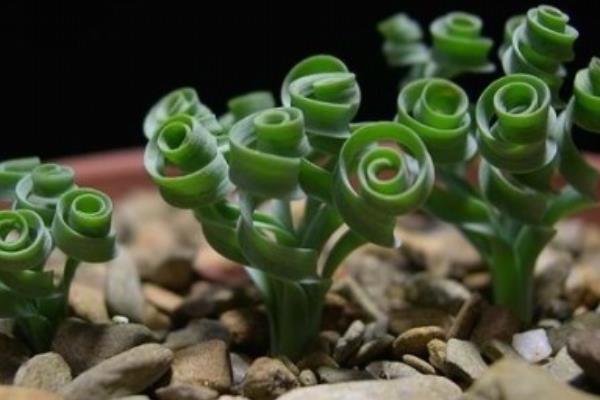
Albuca namaquensis, also known as the spiral grass, gets its name because its leaves twist and coil, resembling a spring. It is a small potted ornamental plant newly introduced in recent years, with a unique form and rustic bulbs. Depending on the variety, the leaves may look like springs, like kelp drifting in water, like curled long hair, or like wrought-iron artworks, with smooth and elegant lines full of variation, and the flowers are elegantly understated and fresh. It is suitable for growing in small pots and placing as an accent on windowsills, desks and other places, unusual and interesting.
Albuca namaquensis is native to South Africa. It likes a cool, humid environment with plenty of sunlight, fears damp heat, tolerates partial shade and also tolerates drought, and has a certain degree of cold resistance. It has the habit of going dormant in the high summer temperatures and growing during the cool seasons from autumn to spring.
When does the Albuca namaquensis bloom?
The flowering period of the Albuca namaquensis is from February to April each year. Its flowers generally open when there is relatively ample light, and close at night, opening by day and closing by night.
Generally, a single flower of the Albuca namaquensis will continue to bloom for about 5 days, but in rainy weather or weather with insufficient light, it is also relatively difficult for the Albuca namaquensis to bloom.
Will the Albuca namaquensis die after blooming?
The Albuca namaquensis will not die after blooming, but it will enter dormancy. After the Albuca namaquensis blooms, the above-ground parts will gradually wither, and the bulb enters summer dormant growth. The withered parts can be cut off, and the bulb together with the flowerpot can be placed in a cool, humid place, with occasional watering to keep the soil slightly moist. The bulb will continue to swell. When autumn comes, new leaves will sprout, and at that point it can be brought back to the windowsill and given normal care.
Growth habits of the Albuca namaquensis
The Albuca namaquensis likes cool conditions and fears heat. Its growing period is from September each year to April of the following year. In winter, the temperature should be kept at around 10°C to 20°C. In this environment the plant can continue to grow, and normal fertilizer and water management can be carried out. If watering is controlled to make the plant go dormant, it can overwinter safely indoors as long as the temperature is not below 0°C.
In mid-to-late May, as the temperature rises, the above-ground leaves gradually wither and the plant enters a dormant state. The dried leaves can be removed, and the bulb can be left in the original pot to spend the summer. The flowerpot should be placed in a dry, ventilated place with no standing water. By the end of August to early September, as the weather turns cooler, new buds will grow from the bulb, and normal management can gradually be resumed.
It is worth noting that during summer dormancy, the plant does not need to go without water for the entire summer; it can be kept slightly moist. Although the leaves have withered, the underground bulb will still grow. Do not pour water into the center of the withered leaves. After a summer, the bulb will grow quite a bit larger.
The role of the Albuca namaquensis
1. Pairing the Albuca namaquensis with home decor styles
The Albuca namaquensis is a common potted ornamental plant in home cultivation, and can also be used at the front of flower beds or as a companion flower, for flower arranging. It is a common small-to-medium-sized household potted plant, mostly used to beautify the home and decorate interiors. Placed on a desk it can make a working person feel refreshed, or placed on a living room balcony it can fill the home with vitality. The Albuca namaquensis has a certain ornamental effect. Placing its pot beside a computer or television can absorb radiation and reduce the absorption of substances such as indoor formaldehyde, thereby purifying the air.
2. Feng shui applications of the Albuca namaquensis
1. Placement in the bedroom
The Albuca namaquensis is suitable for placement in the bedroom. The bedroom environment is quiet and more cozy. If an Albuca namaquensis is placed there, to a certain extent it can make the relationship between husband and wife more harmonious, and the body and mind tired from a day's work can be well relaxed.
2. Placement in the living room
Placing an Albuca namaquensis in the living room requires choosing the direction based on the position of the front door, so that the living room is filled with strong positive energy, increasing the family's wealth luck and making the family harmonious and well.
3. Placement in the hall
A living room with the entrance facing west must be bright. The west belongs to metal in the five elements, so plants belonging to metal and earth can be potted, and the Albuca namaquensis is precisely the most suitable type of plant. It can add the positive energy of the metal attribute and have a favorable effect on the family's respiratory and cardiopulmonary health.
3. Ornamental value of the Albuca namaquensis
Since the Albuca namaquensis spread around the world, it has become a model of horticultural and home cultivation, and is regarded as a treasure among indoor foliage flowers, deeply loved by flower enthusiasts around the world. It has a unique shape, grows and reproduces quickly and beautifully, and is one of the most ideal plants for indoor potting, as well as a good material for making and decorating bonsai.
The Albuca namaquensis itself should be relatively fragile. It uses all its life's energy and inspiration to shape its form, yet it has not built itself a very strong body, so once it blooms it is very likely to cause considerable nutritional depletion to itself, and it needs a period of dormancy to recover its condition.
Albuca namaquensis Albuca namaquensis picture guide: how to grow the Albuca namaquensis / how to propagate the Albuca namaquensis
Albuca namaquensis profileAlbuca namaquensis
How to grow the Albuca namaquensis and points to note: an introduction to the Albuca namaquensis
Albuca namaquensis, also known as the spiral grass, gets its name because its leaves twist and coil, resembling a spring. It is a small potted ornamental plant newly introduced in recent years, with a unique form and rustic bulbs. Depending on the variety, the leaves may look like springs, like kelp drifting in water, like curled long hair, or like wrought-iron artworks, with smooth and elegant lines full of variation, and the flowers are elegantly understated and fresh. It is suitable for growing in small pots and placing as an accent on windowsills, desks and other places, unusual and interesting.
Morphological characteristics of the Albuca namaquensis
The sentinel flower is a perennial bulbous succulent plant of the genus Albuca in the family Hyacinthaceae (Hyacinthaceae). The plant has a round or irregular bulb, and its bulb is composed of layer upon layer of thick fleshy scales. The epidermis of the underground part is yellowish-white, and the part exposed above the soil becomes greenish-white after sun exposure. The fleshy leaves emerge from the top of the bulb, linear or band-shaped, initially growing upright and later gradually twisting and coiling, much like a spring. Some varieties also have white bristles on the leaves. The flower stalk emerges from the leaf cluster, with a raceme inflorescence. The small flowers hang downward, with the front of the petals pale yellow and the back yellow-green. Some varieties have an elegant fragrance. The flowers generally open when there is ample sunlight and close in the evening, thus opening by day and closing by night. A single flower can remain open for about 5 days. If it encounters rainy weather or the cultivation environment has insufficient light, it is difficult for it to bloom. The flowering period is from March to April.
Ecological habits of the Albuca namaquensis
Albuca namaquensis is native to South Africa. It likes a cool, humid environment with plenty of sunlight, fears damp heat, tolerates partial shade and also tolerates drought, and has a certain degree of cold resistance. It has the habit of going dormant in the high summer temperatures and growing during the cool seasons from autumn to spring.
Cultivation techniques of the Albuca namaquensis
Cultivation and management
Habits: The Albuca namaquensis likes cool conditions and fears heat. Its main growing period is from September to April of the following year. In winter it should be kept at a temperature of 10°C to 20°C. In this environment the plant can continue to grow, and normal fertilizer and water management can be carried out. If watering is controlled to make the plant go dormant, it can overwinter safely indoors as long as the temperature is not below 0°C. In mid-to-late May, as the temperature rises, the above-ground leaves gradually wither and the plant enters a dormant state. The dried leaves can be removed, and the bulb can be left in the original pot to spend the summer. The flowerpot should be placed in a dry, ventilated place with no standing water. By the end of August to early September, as the weather turns cooler, new buds will grow from the bulb, and normal management can gradually be resumed. It is worth noting that during summer dormancy, the plant does not need to go without water for the entire summer; it can be kept slightly moist. Although the leaves have withered, the underground bulb will still grow. Do not pour water into the center of the withered leaves. After a summer, the bulb will grow quite a bit larger.
Temperature: It can overwinter safely as long as the temperature is not below 5°C.
Light: The Albuca namaquensis likes light, and during the growing period it should be given ample light. If there is insufficient light, the leaves will become thin and weak, and the degree of curling will be poor, making it hard to bring out the unique charm of the Albuca namaquensis. Plants grown in a sunny spot have low, sturdy leaves that coil and twist, giving high ornamental value. However, after April, a shade net should still be set up to avoid scorching sun exposure and prevent the leaf tips from drying out.
Water and fertilizer: The Albuca namaquensis likes a humid environment. During the growing period, the soil should be kept moist but not waterlogged. If there is long-term drought and lack of water, although the plant will not die, its growth will stall, the leaves will turn yellow, and they may even wither; while long-term waterlogging of the potting soil will cause the bulb to rot. The plant can be sprayed with water frequently to increase air humidity and prevent the leaf tips from drying out. In summer, to avoid flooding during the rainy season, the flowerpot can be placed on a rack or a platform of a certain height, and attention should be paid to controlling watering to prevent bulb rot caused by standing water, but the potting soil should not be allowed to dry out completely either, lest the bulb dry out. From October to April of the following year is the plant's vigorous growth period. Apply a decomposed dilute liquid fertilizer or compound fertilizer once a month to provide sufficient nutrients and make the plant grow vigorously. After the flower stalk emerges in spring, spray a 0.5% potassium dihydrogen phosphate solution 2 to 3 times to promote flowering.
Pollination: After the Albuca namaquensis blooms, different plants should be selected for artificial pollination so that the plants bear fruit. After the seeds mature, take care to harvest them and do not let them scatter; if seeds are not wanted, promptly cut off the remaining flower stalks after flowering to avoid consuming excessive nutrients.
Repotting: The Albuca namaquensis is generally repotted once a year at the end of August. The potting soil should be fertile and loose, rich in humus, and have good drainage and aeration. It can be mixed from 3 parts leaf mold or peat soil and 2 parts vermiculite or sandy soil, with a small amount of bone meal added. When repotting, cut off the rotten root system. When planting, expose about 1/3 of the bulb above the soil surface. After planting, water thoroughly and place in a sunny spot for care. Afterward, take care to keep the soil moist, and before long new leaves will grow from the top of the bulb.
Propagation methods of the Albuca namaquensis
The Albuca namaquensis can be propagated by division or sowing.
Division: This can be done in conjunction with repotting in autumn. The method is to break off the small bulbs that sprout around the large bulb and plant them separately in culture soil; they can survive whether they have roots or not.
Sowing: This method is suitable for mass propagation and is carried out in autumn. After sowing, cover with a thin layer of soil and cover with a piece of glass to keep the soil and air moist, giving a relatively high germination rate. After sowing and during the seedling stage, in order to avoid washing the seeds or young seedlings out of the soil when watering, the "seep irrigation" method should be used for watering: place the flowerpot in a water basin so that water slowly seeps through the drainage holes at the bottom of the pot to moisten the soil.
Pest and disease control of the Albuca namaquensis
The Albuca namaquensis does not have many pests and diseases. The main pests include snails and nematodes in the soil, which harm the bulb. When planting, the soil can be treated at high temperature to kill pests and eggs in the soil, or pesticides such as carbofuran can be mixed into the culture soil. However, because carbofuran is a highly toxic pesticide with very poor degradability, improper use will cause harm to the environment, so it must be used with great caution.
The main disease of the Albuca namaquensis is bulb rot caused by long-term waterlogging due to poor soil permeability. In addition, there is drying of the leaf tips caused by factors such as dry air and long-term lack of water in the soil, which can be prevented by improving the cultivation environment.
Albuca namaquensis pictures