How to grow Jerusalem cherry in pots? Detailed guide to pot cultivation methods
When Jerusalem cherry is planted in the ground, conditions such as water, fertilizer and light are all favorable for the plant's normal growth, flowering and fruiting, so it can grow lush branches and leaves and bear abundant red berries even without careful management. In pots, however, due to the limitations of the growing container and the constraints of climatic factors, too much water can easily cause root rot, leaf drop or flower drop, while soil that is too dry can easily cause the plant's root system to shrink, the plant to wither and lose its leaves, making normal flowering and fruiting difficult. Especially during the flowering period, if the potting soil alternates between dry and wet unpredictably and the fertilizer concentration is uncontrolled, it is very easy for the plant to only flower without setting fruit, or to flower but bear little fruit.
For potted Jerusalem cherry, use a loose, fertile, well-drained sandy loam rich in organic matter, with 5% composted cake fertilizer or chicken and duck manure added. After the seedlings are transplanted into pots, spraying with Xinhua lipid film can effectively prevent above-ground moisture loss, reduce transpiration of the seedling, isolate pests and diseases, shorten the recovery period, and help the plant quickly adapt to the new environment and grow healthily.
After the seedlings have passed the recovery period and survived, carry out normal watering, just enough to keep the potting soil moist, and loosen the soil and apply fertilizer once every half month. Provide plenty of light, and when the plant reaches about 10 cm tall, pinch off the growing tips to encourage branching. Spraying Cuhuawang No. 3 can convert the plant's vegetative growth into reproductive growth, inhibit excessive growth of the main shoot, and promote flower bud differentiation. When the plant enters the bud stage, stop fertilizing and control watering at the same time, and try not to spray water, so as to avoid washing away the pollen. Spraying Zhuangguodiling thickens the fruit stalk, increases nutrient transport, and prevents flower and fruit drop. When the fruits grow to the size of mung beans, resume watering with cake fertilizer solution and increase the amount of water, while also giving appropriate foliar spraying. When the fruits reach 0.5 cm to 0.6 cm in diameter, appropriately thin out the overly dense small fruits, and remove diseased and pest-damaged fruits, so that the fruits on the potted plant are evenly distributed and uniform in size, thereby enhancing the ornamental value of the potted plant.
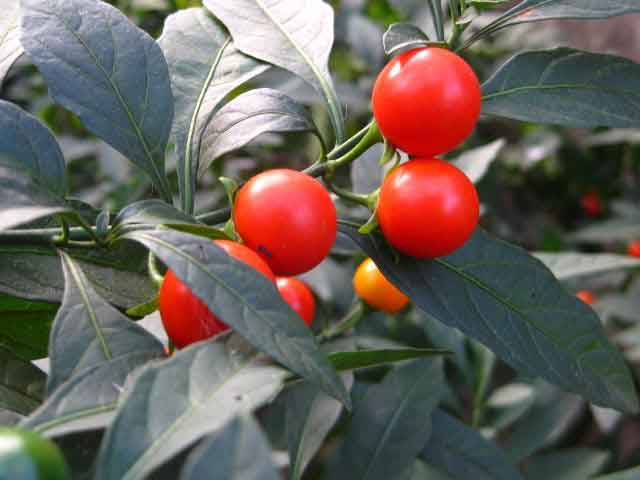
Potted Jerusalem cherry is prone to anthracnose during high summer temperatures. It mainly damages the leaves, but can also damage the stems. There are two types of symptoms: one occurs on the leaves, with round lesions appearing in the early stage of the disease, changing from round reddish-brown to grayish-white, then to dark brown, and producing black dots arranged in concentric rings, which are the pathogen's acervuli. This disease occurs on the leaf margins and leaf tips, and in severe cases the leaves wither, turn black and die. The pathogen is a fungal disease, and the fungus overwinters as mycelium in host residues or in the soil. Old leaves begin to show symptoms from late April to early May, the disease develops rapidly from June to July, is more severe during the rainy season, and new leaves begin to show symptoms from August. When potted flowers are placed too close together and the leaves overlap, the disease spreads easily, but disease resistance varies among varieties.
How to grow Jerusalem cherry in pots? How do you care for potted Jerusalem cherry?
A reader from Ninghai County, Zhejiang wrote in to ask: Jerusalem cherry planted in the ground grows lush branches and leaves and bears abundant fruit even without management, while potted Jerusalem cherry, despite careful management, only flowers and bears little fruit. I wonder what the reason is? How should it be managed?
Answer: Jerusalem cherry is an upright small shrub in the Solanaceae family, native to the tropics of Eurasia. When Jerusalem cherry is planted in the ground, conditions such as soil, water, fertilizer and light are all favorable for the plant's normal growth, flowering and fruiting, so it can grow lush branches and leaves and bear abundant red berries even without careful management. In pots, however, due to the limitations of the growing container and the constraints of climatic factors, too much water can easily cause root rot, leaf drop or flower drop, while soil that is too dry can easily cause the plant's root system to shrink, the plant to wither and lose its leaves, making normal flowering and fruiting difficult. Especially during the flowering period, if the potting soil alternates between dry and wet unpredictably and the fertilizer concentration is uncontrolled, it is very easy for the plant to only flower without setting fruit, or to flower but bear little fruit. For potted Jerusalem cherry, use a loose, fertile, well-drained sandy loam rich in organic matter, with 5% composted cake fertilizer or chicken and duck manure added. During the growing season, loosen the soil and apply fertilizer once every half month. When the plant reaches about 10 cm tall, pinch off the growing tips to encourage branching. When the temperature reaches above 30°C, it can be moved to a well-ventilated greenhouse or under tree shade with about 40% shading. When the plant enters the bud stage, add 0.2% monopotassium phosphate to the organic fertilizer solution applied, which can promote abundant bud formation and flowering. During the flowering period, stop fertilizing and control watering at the same time, and try not to spray water, just enough to keep the potting soil moist, so as to avoid washing away the pollen and also prevent flower and fruit drop.
When the fruits grow to the size of mung beans, resume watering with cake fertilizer solution and increase the amount of water, while also giving appropriate foliar spraying. From fruit set to before the fruits color up, apply quick-acting phosphate fertilizer 2 to 3 times, such as watering with a 0.2% monopotassium phosphate solution, which can help make the fruits more brightly colored. When the fruits reach 0.5 cm to 0.6 cm in diameter, appropriately thin out the overly dense small fruits, and remove diseased and pest-damaged fruits, so that the fruits on the potted plant are evenly distributed and uniform in size, thereby enhancing the ornamental value of the potted plant.
Pot cultivation methods for Jerusalem cherry
When Jerusalem cherry is planted in the ground, conditions such as soil, water, fertilizer and light are all favorable for the plant's normal growth, flowering and fruiting, so it can grow lush branches and leaves and bear abundant red berries even without careful management. In pots, however, due to the limitations of the growing container and the constraints of climatic factors, too much water can easily cause root rot, leaf drop or flower drop, while soil that is too dry can easily cause the plant's root system to shrink, the plant to wither and lose its leaves, making normal flowering and fruiting difficult. Especially during the flowering period, if the potting soil alternates between dry and wet unpredictably and the fertilizer concentration is uncontrolled, it is very easy for the plant to only flower without setting fruit, or to flower but bear little fruit.For potted Jerusalem cherry, use a loose, fertile, well-drained sandy loam rich in organic matter, with 5% composted cake fertilizer or chicken and duck manure added. After the seedlings are transplanted into pots, spraying with Xinhua lipid film can effectively prevent above-ground moisture loss, reduce transpiration of the seedling, isolate pests and diseases, shorten the recovery period, and help the plant quickly adapt to the new environment and grow healthily.
After the seedlings have passed the recovery period and survived, carry out normal watering, just enough to keep the potting soil moist, and loosen the soil and apply fertilizer once every half month. Provide plenty of light, and when the plant reaches about 10 cm tall, pinch off the growing tips to encourage branching. Spraying Cuhuawang No. 3 can convert the plant's vegetative growth into reproductive growth, inhibit excessive growth of the main shoot, and promote flower bud differentiation. When the plant enters the bud stage, stop fertilizing and control watering at the same time, and try not to spray water, so as to avoid washing away the pollen. Spraying Zhuangguodiling thickens the fruit stalk, increases nutrient transport, and prevents flower and fruit drop. When the fruits grow to the size of mung beans, resume watering with cake fertilizer solution and increase the amount of water, while also giving appropriate foliar spraying. When the fruits reach 0.5 cm to 0.6 cm in diameter, appropriately thin out the overly dense small fruits, and remove diseased and pest-damaged fruits, so that the fruits on the potted plant are evenly distributed and uniform in size, thereby enhancing the ornamental value of the potted plant.
Potted Jerusalem cherry is prone to anthracnose during high summer temperatures. It mainly damages the leaves, but can also damage the stems. There are two types of symptoms: one occurs on the leaves, with round lesions appearing in the early stage of the disease, changing from round reddish-brown to grayish-white, then to dark brown, and producing black dots arranged in concentric rings, which are the pathogen's acervuli. This disease occurs on the leaf margins and leaf tips, and in severe cases the leaves wither, turn black and die. The pathogen is a fungal disease, and the fungus overwinters as mycelium in host residues or in the soil. Old leaves begin to show symptoms from late April to early May, the disease develops rapidly from June to July, is more severe during the rainy season, and new leaves begin to show symptoms from August. When potted flowers are placed too close together and the leaves overlap, the disease spreads easily, but disease resistance varies among varieties.
Control methods:
1. Disease control:
①. Select excellent disease-resistant varieties.
②. In the early stage of the disease, cut off diseased leaves and burn them promptly to prevent the pathogen from spreading, avoid placing plants too close together and overhead watering, and always maintain good ventilation and light.
③. In the early stage of the disease, spray 50% carbendazim wettable powder at 700-800 times dilution or 75% chlorothalonil at 500 times dilution.
2. Pest control:
The main pest of Jerusalem cherry is aphids, which are small, green or black, and often gather in groups on the tender branches and leaves of many flowers to suck nutrients.
Control method: spray with 40% omethoate emulsifiable concentrate at 2000 times dilution or 50% dichlorvos emulsifiable concentrate at 1500-2000 times dilution.