How to grow Calibrachoa? Detailed planting methods
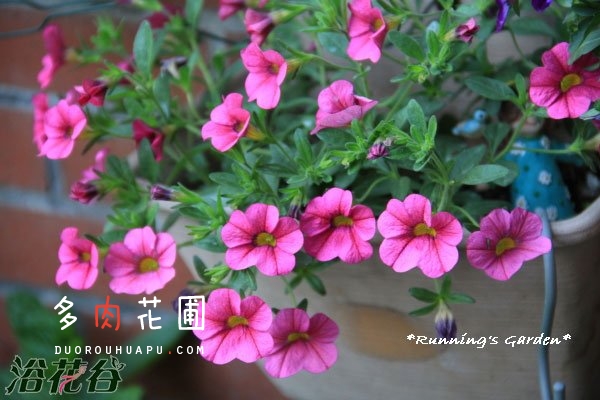
Calibrachoa is also known as small-flowered petunia. Calibrachoa is easy to grow, produces a large number of flowers, and easily fills a pot, so many flower lovers like to grow it. Below are the key points for growing Calibrachoa:
1. Calibrachoa is relatively intolerant of transplanting and recovers slowly after root damage, and may even die on you, so it is best to transplant only after the roots have filled a small pot. Be careful not to damage the roots when transplanting. After transplanting, it needs one week to recover (place it in a shady spot and mist the leaves morning and evening), then gradually transition it to a full-sun environment.)
2. Calibrachoa does not like heavy fertilizer. Base fertilizer should be applied sparingly. If you have worm castings, you can mix them into the soil (about 1/3) for use. During the growing season, it is also better to apply light fertilizer frequently.
3. Calibrachoa likes sun and also tolerates partial shade. Good sunlight promotes vigorous branching and more flowers. In the hot summer season, replenish water in time. If dehydration causes the stems and leaves to wilt, besides watering in time, it is best to mist the leaves to replenish water.
4. Common pests and diseases of Calibrachoa include stem blight, aphids, and whiteflies. Once stem blight is found, immediately prune off the diseased branches. Aphids and whiteflies should be dealt with early using the corresponding insecticides. Do not wait until sooty mold is triggered before spraying.
5. Generally, for pots such as 2981 and 3035, planting three plants is more suitable. Of course, one plant is also fine. With proper pinching, one plant can still form a beautiful flower ball, but plants of different colors have somewhat different characteristics, so when mixed planting, it is best to consider how to combine them.
or use them as an edging when mixed planting;
★Blue Calibrachoa is upright; pinching can promote branching and control plant shape. It is very good for potted planting and hanging baskets;
★Pink Calibrachoa and light purple Calibrachoa have thick, hard stems. Pinch them more appropriately to control plant shape. They are better for potted planting;
★Fischer Calibrachoa branches well and has softer stems. It can be used in hanging baskets or pots.
6. Calibrachoa can be grown as a perennial. During growth, dehydration may cause the basal leaves to wither and the stems to become woody. You can wait until after flowering and then perform hard pruning, leaving only about 10 cm of stems and branches. It can still send out new branches and will not affect the next bloom.
1. Calibrachoa is relatively intolerant of transplanting and recovers slowly after root damage, and may even die on you, so it is best to transplant only after the roots have filled a small pot. Be careful not to damage the roots when transplanting. After transplanting, it needs one week to recover (place it in a shady spot and mist the leaves morning and evening), then gradually transition it to a full-sun environment.)
2. Calibrachoa does not like heavy fertilizer. Base fertilizer should be applied sparingly. If you have worm castings, you can mix them into the soil (about 1/3) for use. During the growing season, it is also better to apply light fertilizer frequently.
3. Calibrachoa likes sun and also tolerates partial shade. Good sunlight promotes vigorous branching and more flowers. In the hot summer season, replenish water in time. If dehydration causes the stems and leaves to wilt, besides watering in time, it is best to mist the leaves to replenish water.
4. Common pests and diseases of Calibrachoa include stem blight, aphids, and whiteflies. Once stem blight is found, immediately prune off the diseased branches. Aphids and whiteflies should be dealt with early using the corresponding insecticides. Do not wait until sooty mold is triggered before spraying.
5. Generally, for pots such as 2981 and 3035, planting three plants is more suitable. Of course, one plant is also fine. With proper pinching, one plant can still form a beautiful flower ball, but plants of different colors have somewhat different characteristics, so when mixed planting, it is best to consider how to combine them.
★White Calibrachoa grows with creeping stems and branches vigorously. It is suitable for hanging basket cultivation, or as an edging when mixed planting;
★Blue Calibrachoa is upright; pinching can promote branching and control plant shape. It is very good for potted planting and hanging baskets;
★Pink Calibrachoa and light purple Calibrachoa have thick, hard stems. Pinch them more appropriately to control plant shape. They are better for potted planting;
★Fischer Calibrachoa branches well and has softer stems. It can be used in hanging baskets or pots.
6. Calibrachoa can be grown as a perennial. During growth, dehydration may cause the basal leaves to wither and the stems to become woody. You can wait until after flowering and then perform hard pruning, leaving only about 10 cm of stems and branches. It can still send out new branches and will not affect the next bloom.
How to grow Calibrachoa
Key growing points
Transplanting
Calibrachoa transplants poorly. If the roots are damaged, it takes a long time to recover, and in severe cases it is difficult to save. Therefore, the best time to transplant is after the roots have filled a small pot, and when transplanting you must be careful to avoid damaging the roots.
After successful transplanting, it needs one week to recover. First place it in a shaded spot, mist the leaves morning and evening, and then move it to a full-sun environment for growing on.
Fertilizing
Calibrachoa does not need much fertilizer for growth. Base fertilizer can be prepared in a smaller amount and can be mixed at a ratio of worm castings to soil of 1:3. During the growing season, light fertilizer should also be applied, and the frequency of application can be increased.
Light and water
Calibrachoa grows relatively well in a sunny environment, and can also grow normally in partial shade.
Sufficient sunlight helps promote branching and increase the number of flowers. In high summer temperatures, pay attention to replenishing water. If dehydration causes the stems and leaves to wilt, the leaves also need to be supplied with water.
Pests and diseases
Common pests and diseases of Calibrachoa include stem blight, whiteflies, and aphids.
When stem blight is found, immediately prune off the diseased branches. For aphids and whiteflies, effective insecticides should be sprayed in time. Do not wait until the pest problem worsens before treating it.
Pot selection
In a general flower pot, planting three Calibrachoa plants is enough, because Calibrachoa has a huge number of flowers. Planting one is also fine.
A reasonable pinching method can make even a single plant grow into a beautiful flower ball. If you choose Calibrachoa of different colors for planting, you need to consider exactly how to combine them according to the different plant characteristics.
Every flower lover surely wants the sight of Calibrachoa flowers spilling over the edge of the pot, so go ahead and diligently plant one. I believe that before long, beautiful Calibrachoa flowers will bloom one after another in your home.