How to grow nasturtium? Detailed guide to cultivation methods and precautions
Sowing
Sowing period: March to June, called spring sowing. Flowering period August to December.
Sowing in late August or early September in autumn is also possible, called autumn sowing. This way, nasturtium will bloom around New Year's Day and the Spring Festival.
Sowing and seedling raising: the optimal germination temperature is 18-20°C. Sow in individual spots, cover with about 1 cm of soil, water thoroughly and keep moist; germination occurs in 7 days. When 2-3 true leaves appear, pinch out the growing tip and pot up, arranging the leaves and branches properly to improve ventilation so the flowers are exposed.
How do you make nasturtium bloom around New Year's Day and the Spring Festival? Sow in late August or early September in autumn, and when the seedlings grow 2-3 true leaves, transplant them into medium-sized flower pots, place them in a sunny spot outdoors, and carry out routine watering management.
After “Frost's Descent”, move it indoors and place it in a spot with plenty of sunlight, keeping the temperature at 15°C-25°C, and never below 8°C. Usually pay attention to rotating the pot so the plant grows full and attractive. Watering should be moderate; too dry and the leaves turn yellow, too wet and it easily rots. Apply a 0.5% monopotassium phosphate solution once every 10 days; do not apply too much nitrogen fertilizer, to avoid leggy growth.
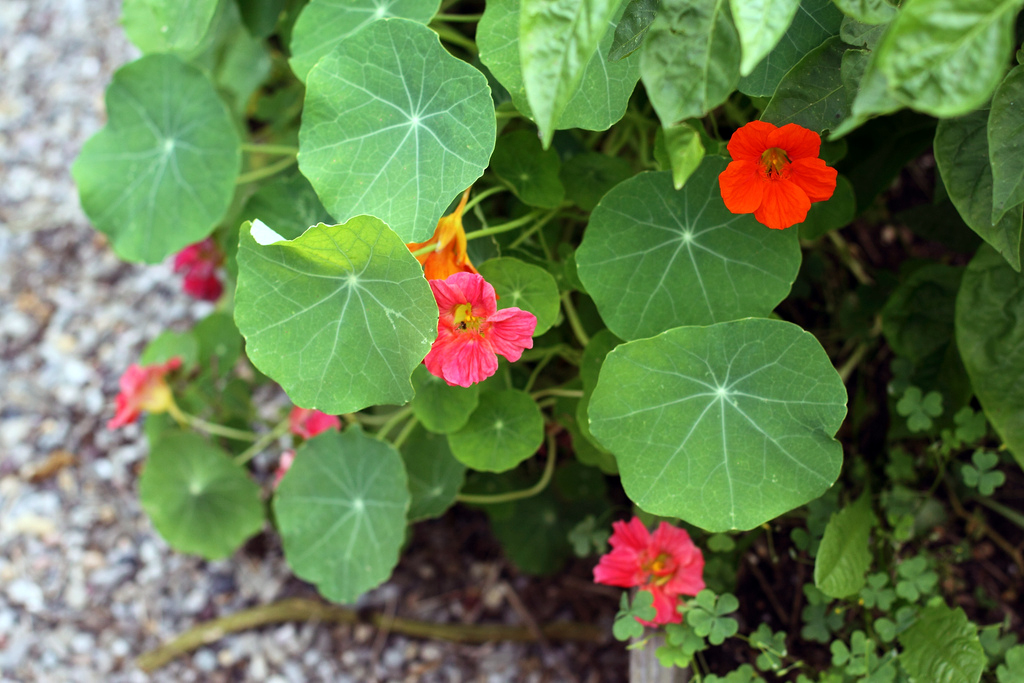
Propagation
Propagation is by sowing or cuttings. Sowing is done in a greenhouse from August to October; before sowing, soak the seeds in warm water at 40-45°C for 24 hours, keep at 18-20°C after sowing, and seedlings emerge in 7-10 days; plant them in pots in May of the following year. Cuttings are taken from April to June; choose young stems as cuttings, remove the lower leaves, shade them after planting, keep them moist, and they root in 2-3 weeks.
As the stems and vines grow, bamboo strips should be set up as supports in time and the branches and vines tied up. Apply fertilizer once every 10-15 days, and maintain sufficient water and fairly high air humidity throughout the growing period.
Each flower has 8 stamens and 1 pistil, and among these the 8 stamens do not mature at the same time. And only after all the pollen has been shed does that pistil mature and extend to the trumpet-shaped opening of the flower.
It can be propagated by cuttings or sowing. Take cuttings from April to June; under conditions of 12-15°C, they root in 15-20 days. Before sowing, soak the seeds in warm water at 40-50°C for 24 hours, cover with 1 cm of soil after sowing, place in partial shade, and they germinate in 7 days; after the seedlings have grown for one month, transplant them before the stems and vines extend. For pot cultivation, set up supports and tie the stems and vines in order into a fan shape, umbrella shape, spherical shape, etc. The flowers and leaves are strongly hydrotropic. Watering must not be excessive. It is often harmed by whiteflies and red spider mites.
Nasturtium cultivation methods and precautions
Nasturtium cultivation methods
Pot soil
For nasturtium cultivation, sandy loam rich in organic matter should be used, with a pH of 5-6. Generally, during the growing period, fertilize once every 3-4 weeks, and after each fertilization loosen the soil in time to improve aeration and facilitate root development.
Water and fertilizer management
Watering: nasturtium likes moisture and fears waterlogging; keep soil moisture at about 50%. During the growing period, water little but often; in spring and autumn water once every 2-3 days, in summer water every day, and in the evening spray water on the leaves to maintain fairly high humidity.
Fertilizing: during growth, generally apply once a month a 20% concentration of decomposed soybean cake water;
during the flowering period, stop applying nitrogen fertilizer and instead apply 0.5% superphosphate or decomposed chicken and duck manure water, once every half month;
after the flowers fade, apply once a 30% decomposed soybean cake water as a top dressing, to replenish the nutrients consumed by flowering.
In summer, when the weather is hot, stop fertilizing. At the end of autumn, apply one more application of a compound overwintering fertilizer to enhance the plant's cold resistance.
Light
Nasturtium likes sunlight; in spring and autumn it should be placed in a spot with plenty of sunlight, in summer it needs appropriate shading, and in winter keep the room temperature at around 15°C with plenty of sunlight, and it can continue to grow and develop.
Propagation methods
Nasturtium can self-pollinate, and the seeds can be used for sowing and propagation.
Nasturtium can also be propagated by cuttings, which can be done in both spring and autumn.
Precautions for growing nasturtium at home
Common pests and diseases of nasturtium
Common diseases of nasturtium: mosaic disease, ringspot disease
Common pests of nasturtium: leafminer moth, red spider mite
Nasturtium can be used as a spice
Nasturtium is a non-toxic flowering ornamental; the flowers give off a fragrance. The young shoots, flower buds and fresh seeds can be used as a spice, but the flavor is rather strong and pungent.
How to grow nasturtium, nasturtium cultivation methods and precautions / needs plenty of light
Among plants grown both for foliage and flowers, nasturtium is relatively easy to cultivate; it is not only easy to grow but also has many effects and uses, so it is very popular. However, before growing it you still need to master some techniques, so how do you grow nasturtium? Let's look at the cultivation methods and precautions for nasturtium.
How to grow nasturtium
It likes a warm climate, and its cold and heat tolerance is average; the temperature must be kept above 10°C and below 35°C, otherwise growth will be inhibited. Except in summer, it needs fairly plentiful light in the other seasons, and in midsummer strong direct sunlight should be avoided.
Nasturtium cultivation methods and precautions
1. Cultivation methods
1. Soil
The most suitable soil is sandy soil rich in humus, with a pH between 5-6; also make sure the soil drains well. Normally you can loosen the soil to ensure its aeration, which benefits root growth and development.
2. Temperature
In the cultivation methods and precautions for nasturtium, its suitable growing temperature is 18-24°C, while the optimal germination temperature for sowing and propagation is 18-20°C. In winter the temperature must be kept above 10°C, and in summer the temperature should be controlled below 35°C, otherwise it will be difficult to bloom.
3. Light
Nasturtium is a plant that blooms fairly easily, but during the growing period it needs fairly plentiful light. In spring, autumn and winter it can be grown in sunlight, but in summer pay attention to shading to avoid strong sunlight raising the temperature too high and thereby affecting its blooming.
4. Fertilizer and water
Fertilizer and water are very important for nasturtium, so how do you grow nasturtium in this respect? In spring and autumn, water generally once every 2-3 days; in summer, water once a day, and if the temperature is high you can also spray water. During the flowering period, reduce watering to avoid leggy growth of the branches. Fertilization is mainly with compound fertilizer, ensuring a balance of nitrogen, phosphorus and potassium.
5. Propagation
Usually nasturtium is propagated by cuttings or sowing. Sowing can be done in spring, from March to June, or in autumn. Cuttings are more suitable in spring. In addition, it can also self-pollinate, so the seeds are relatively easy to collect.
2. Precautions
1. During the rainy season and when watering, be careful not to let water accumulate. Nasturtium likes moisture but fears waterlogging; the water content in the soil only needs to be 50%, and if watered too much the roots easily rot, which easily causes the leaves to turn yellow and drop. So normally watering should mainly be little but often.
2. In summer, try to place nasturtium in a cool spot for cultivation, because high temperatures will affect its blooming and may even prevent it from blooming. And after the temperature starts to drop in October, it needs to be placed in a sunny spot, keeping the temperature at 10-15°C so it can successfully get through the winter.
3. Since nasturtium is a semi-vining plant, if you want to control its growth, supports are generally used to guide it, otherwise the ornamental effect will be affected. And when branches grow too long, pruning can be used to control the overall plant shape.