How to grow pennywort? Practical cultivation tips shared
Pennywort, also called marsh pennywort, is a perennial emergent or hygrophytic herb. The plant height is 5-15 cm. The stem tip is brown. Submerged leaves have long petioles, are roundly peltate, 2-4 cm in diameter, with wavy margins, grass-green. Flowers are bisexual; umbellate inflorescences; small flowers are white-pink. Schizocarps. Flowering period is June to August. Its stem nodes are distinct, one node after another, each node bearing one leaf, and it can keep extending. Its underground creeping stems grow at an astonishing rate, spreading wherever they reach, making it one of the most beautiful and easy-to-grow aquatic plants.
In warm regions this plant can be potted outdoors, and it is suitable for water trays, aquariums, ponds, wetlands, and indoor water landscaping. When grown in an aquarium, it is often used as a foreground plant. The whole plant can be used as medicine and has a diuretic effect. If you want to use potted or hanging basket cultivation, it is best to keep it consistently moist.
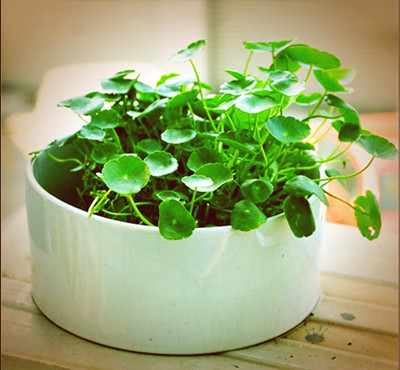
Pennywort
Cultivation method: Pennywort is not demanding about water quality and can be cultivated in low-hardness freshwater; salinity should not be too high. The pH of the water is best kept between 6.5 and 7.0, that is, slightly acidic to neutral. It has a relatively high demand for fertilizer; during vigorous growth, apply fertilizer once every 2-3 weeks. If planted in pots or containers, then only a small amount of fertilizer is needed, such as a quick-acting fertilizer - Huabao No. 2, or a slow-release fertilizer - Mofei (which can maintain fertilizer efficiency in water for a long time).
Pennywort likes a bright, sunny environment; in shaded conditions the plant grows poorly. It grows well in full sun; under half-day sun its petioles will stretch longer and grow toward the light, and its posture will need slight adjustment to look more beautiful. It is best to let it receive 4-6 hours of scattered sunlight every day; using a dedicated fluorescent lamp and giving the plant 8-10 hours of artificial light daily also allows it to grow normally. It likes warmth and fears cold, growing well within a temperature range of 10-25°C, and its overwintering temperature should not be lower than 5°C. Under good management conditions, pennywort is not prone to disease and is also less subject to attack by harmful animals. This plant is perennial, and it sprouts quickly and takes shape quickly. Without repotting, a formed plant should not be continuously cultivated for more than 2 years, otherwise the marsh pennywort clump will grow weaker and weaker.
Other: Pennywort likes warmth and moisture, and the cultivation site is best in half-day sun or shade; avoid direct sunlight. It is not particular about the growing soil; soft, well-drained growing soil is best, and the most suitable water temperature is 22-28°C. It is shade-tolerant, moisture-tolerant, slightly drought-tolerant, and highly adaptable, and can grow both in water and on land.
How to grow pennywort: cultivation methods and tips for pennywort
Pennywort is a beautiful foliage plant, named because its leaves mostly resemble ancient copper coins. It not only beautifies the environment but also has a certain feng shui effect. So how should this pennywort be grown? In a moment I will write out the cultivation methods and tips for pennywort, and after reading them everyone will know how it should be grown.
How to grow pennywort: cultivation methods and tips for pennywort1. Pennywort can be grown hydroponically
Pennywort can usually be grown hydroponically. When growing pennywort in water, the salinity of the water must not be too high, and its pH is best kept at around 7.0, that is, the water should be slightly acidic or neutral. When growing pennywort hydroponically, its demand for fertilizer is relatively high, and during its peak growing season it should be fertilized once every two weeks.
2. Pennywort can be grown in soil
Pennywort has very strong vitality and is not demanding about soil; any soft, well-drained growing soil will do. When growing pennywort in soil, its fertilizer requirements are also not high; base fertilizer can be applied at the bottom of the pot, and during normal cultivation it is enough to fertilize once every twenty days. After winter arrives, fertilizer application should be stopped.
3. Pennywort's growth habits
Whether grown hydroponically or in soil, pennywort's growth habits do not change. It prefers a semi-shaded environment and should not normally be placed in direct sunlight. When the high-temperature weather of summer arrives, necessary shading treatment should be carried out, and two or three times a day water should be sprayed on the leaves to increase air humidity, otherwise the leaves of pennywort will turn yellow and fall off.
Pennywort cultivation methods: tips and precautions for growing pennywort
Pennywort looks like a shiitake mushroom, so it is also called marsh pennywort. Pennywort grows at the water's edge or in moist areas. Nowadays it is popular to grow hydroponic plants in offices or homes, and this grass, which resembles a copper coin in appearance, can represent good fortune or wealth. Below is an introduction to pennywort cultivation methods.
Pennywort cultivation methodsPennywort is also called moneywort, creepingJenny, and in Sichuan it is also called yichuanqian. Pennywort belongs to the angiosperms, order Apiales, and is a groundcover-type herbaceous plant. Pennywort, as the name suggests, has leaf shapes very much like the copper coins used in ancient China, and the leaf diameter is relatively short, generally 0.5 to 2.5 cm. When rubbed by hand, it smells of celery. Because pennywort is a groundcover-type plant, it reproduces very quickly and can be planted both on land and on the water surface, making it a convenient ornamental green plant to grow.
Pennywort — cultivation methodsPennywort has no requirements for the growing soil and can also be grown hydroponically. Pennywort likes a warm, moist environment, is shade-tolerant, moisture-tolerant, and highly adaptable. Pennywort propagation methods include division and cuttings; division is generally used, and as long as the growing soil is kept moist, pennywort will send out new shoots in about one to two weeks. It is best to place potted pennywort indoors, not in direct sunlight, and during the growing period a few drops of nutrient solution need to be added regularly.
Pennywort — cultivation precautionsPennywort is highly adaptable and very easy to grow, but the following points should also be noted during cultivation. First, pennywort needs a highly moist environment; remember the principle of preferring wet over dry. Second, pennywort's leaves need frequent spraying with water to prevent dust from settling and affecting photosynthesis. Third, always pay attention to maintaining ventilation in pennywort's growing environment.