Freesia Blooming and Blooming Period
Is the blooming period of freesia always fixed? Why does it sometimes fail to bloom? Under what conditions can it bloom? With these questions in mind, let us further explore the issues regarding freesia blooming and its blooming period; in fact, freesia is very easy to grow, and as long as the corms are healthy, they will not rot right after being planted. Once they have grown and matured and then dried up and the flowers have faded, cut them off together with the stems and place them in a cool place. After another summer, water them and they will quickly come back to life. For freesia to bloom, the following conditions must be met:
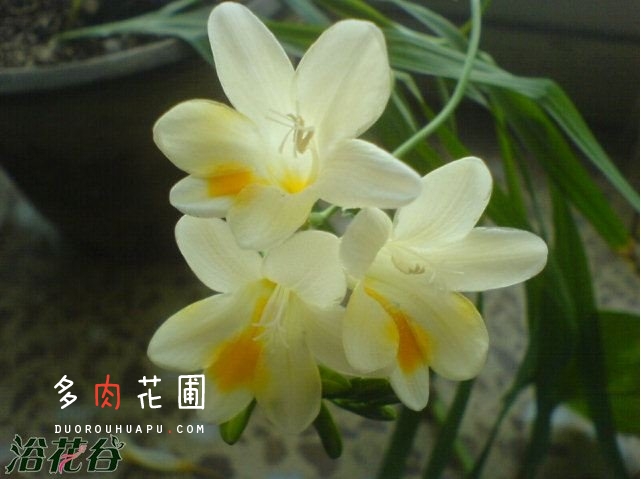
If your freesia does not bloom, it may be because it has not undergone vernalization, the temperature in its environment is too high during the flower bud differentiation stage, or the dormancy period is insufficient. Here is a brief list of its blooming growth habits and cultivation methods. To bloom, it needs to be forced at a temperature of 8-10°C, germinates at 13-15°C, and requires loose, breathable, well-drained sandy loam soil; propagation is mainly by corm division. The mother plant should gradually have its water supply reduced from March to April, then the corms are taken out, divided and classified for storage and dormancy. When planting, take them out and sow them promptly, in a sheltered, sunny spot with shading, at a suitable temperature of around 20°C. Plant in pots in early September, with about 6 corms for a 13-17 cm pot. Move indoors before Frost's Descent, keep the temperature at around 10°C in the initial stage, then gradually raise it to around 15°C. After 10 days, liquid fertilizer can be applied. Keep the soil moist, ensure ventilation; the flower stems are thin and weak, so they need support.
In order to accelerate the utilization of its planting resources and meet the needs of production and consumers, the blooming period of freesia should be changed and controlled. Generally, as long as measures are taken regarding planting dates, temperature regulation and day length, the desired goal can be achieved. For example, if you want it to bloom on New Year's Day, simply treat the corms at low temperature (13-15°C) for about 1 week in July-August to break their dormancy, and after planting keep them at 15-20°C to achieve this. If you want it to bloom during the Spring Festival, simply force it at 18-20°C one month before the Spring Festival, and the requirement can also be fully met. The blooming period of freesia can be changed by altering temperature, humidity and other factors to provide special conditions. Climate and soil factors vary from place to place, and the various conditions that can change the blooming period may not all be the same. Interested friends can try researching this themselves and share their findings.
Freesia Blooming and Blooming Period, How to Handle Freesia After Blooming / 5 Tips You Need to Master
Freesia is known for its rich colors and overflowing fragrance. In addition, the flower language of freesia includes purity, deep affection and happiness, so many flower lovers grow it just to see its blooms. So when does freesia bloom? How long is its blooming period? How should freesia be handled after blooming? Let us take you through the issues of freesia blooming and its blooming period.
Freesia Blooming and Blooming Period
I. When Does Freesia Bloom
Freesia generally blooms in early spring, usually from February to March, and in many cases it blooms around the Spring Festival, bringing a festive atmosphere to the holiday, which is one of the reasons many people grow freesia. However, if freesia is sown and propagated in autumn, it generally blooms in November.
II. How Long Is the Freesia Blooming Period
The blooming period of freesia is usually from February to May, while freesia sown in autumn generally blooms from November to December. The blooming period lasts a long time, and this is related to the cultivation method, environmental factors and so on. If small corms are used, in short, it takes 1 year before you can see it bloom.
How to Handle Freesia After Blooming
1. Cut Off the Flower Stems
After the flowers fade, the spent flowers and flower stems should be cut off together. Since summer is approaching after the flowers fade, freesia will enter a dormant state, so it needs to be placed in a cool place. Wait until midsummer has passed, then begin watering and fertilizing again.
2. Water Moderately
After blooming, freesia must not be watered heavily, otherwise the leaves tend to grow excessively. During the blooming period, it must not lack water, otherwise the flowers will quickly wilt. Just keep the soil moist; at this time there is no need to spray water on the plant.
3. Increase Light
Whether during the growth period, the blooming period or after blooming, attention must be paid to suitable lighting. So what should be done about lighting for freesia after blooming? The answer is to increase light, allowing it to receive scattered light or sunlight for a period each day, but remember not to let the light be too strong.
4. Sufficient Fertilizer
After summer has passed, freesia resumes growth. At this time it can be given additional fertilizer, generally applying fertilizer 1-2 times per month until just before blooming. During the blooming period, fertilization should be stopped to avoid excessive fertilizer causing thick leaves and fewer flower buds.
5. Do a Good Job of Propagation
After the flowers fade, it is exactly summer, and this time is most favorable for freesia propagation. Corm division propagation can be carried out in July-August, and freesia seeds can also be collected for sowing propagation in May-June. The specific operation methods were described in detail in our section on freesia propagation methods.