Does the parlor palm bloom? Flowering conditions and care methods
The parlor palm (Chamaedorea elegans) is an evergreen small shrub, and its potted height generally does not exceed 1 m. Its stems are upright, unbranched, dark green, with irregular markings on them. The leaves generally grow at the top of the stems, are pinnately divided, with lanceolate leaflets, alternate, dark green, and glossy. The parlor palm is cultivated as a foliage plant, but it does bloom. Many people do not know it has this ability; they only feel that this plant is not delicate and is easy to keep, which is why they grow it. Its flowers are very small, and the flowering period is in spring. They are not beautiful and are generally not regarded as an ornamental feature, so people generally do not pay attention to them.
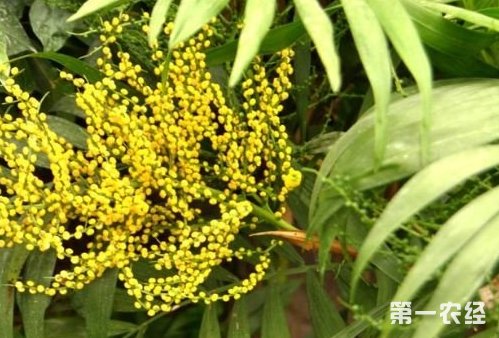
Image: parlor palm blooming
[Common questions] Does the parlor palm bloom? What is the flower language of the parlor palm?
[Expert answer]
Does the parlor palm bloom?
Under ordinary potted conditions, the parlor palm is very difficult to bloom. Only when nutrition has accumulated to a certain point and it has stored more nutrients can it form flower buds and bloom. Its flower buds, the size of a grain of rice, change very slowly, far less quickly than new leaves grow. At first they are half the size of a small grain of rice, and after a few months the small grain of rice will only become slightly larger. The flowers are just these tiny little yellow balls.
What is the flower language of the parlor palm?
The flower language and symbolic meaning of the parlor palm: vitality. The parlor palm has tenacious vitality and is easy to keep. It does not need special care. If it is not watered and its leaves are not washed for a long time, its green stems still hold up a cluster of green, still fresh and emerald green, full of vitality. Although the parlor palm does not have gorgeous flowers or a unique appearance, its tenacious vitality has conquered the hearts of many people.
[Editor's comment] The parlor palm does bloom, but it is relatively difficult under potted conditions. It is a foliage plant with very strong vitality. It is often planted beside grass and in tree shade. Potted plants are often placed indoors. It is elegant and has outstanding pollution resistance. Placing it in the wealth position of the home can increase wealth luck. Friends who like it can plant it in the courtyard or place a potted plant indoors.
Does the parlor palm bloom?
The parlor palm (Chamaedorea elegans) is an evergreen small shrub, and its potted height generally does not exceed 1 m. Its stems are upright, unbranched, dark green, with irregular markings on them. The leaves generally grow at the top of the stems, are pinnately divided, with lanceolate leaflets, alternate, dark green, and glossy. The parlor palm is cultivated as a foliage plant, but it does bloom. Many people do not know it has this ability; they only feel that this plant is not delicate and is easy to keep, which is why they grow it. Its flowers are very small, and the flowering period is in spring. They are not beautiful and are generally not regarded as an ornamental feature, so people generally do not pay attention to them.Under ordinary potted conditions, the parlor palm is very difficult to bloom. Only when nutrition has accumulated to a certain point and it has stored more nutrients can it form flower buds and bloom. Its flower buds, the size of a grain of rice, change very slowly, far less quickly than new leaves grow. At first they are half the size of a small grain of rice, and after a few months the small grain of rice will only become slightly larger. The flowers are just these tiny little yellow balls.
The parlor palm is native to northern Mexico and Guatemala. It likes high temperature, high humidity, and a semi-shady environment. The growing medium is best as well-drained, moist, fertile loam. During the growing period, watering should err on the side of dryness rather than wetness, and it should be kept ventilated and cool, which is beneficial to plant growth and can improve disease resistance. Keep the potting soil moist. If there is a lot of rain or excessive watering, and the potting soil is too wet, it can easily cause the lower leaves of the plant to rot and become diseased, leading to the occurrence and spread of black spot disease, causing the leaves to turn yellow or even die.
In summer and autumn, when the air is dry, spray the plant frequently to increase the ambient air humidity. This is beneficial to its growth and can also keep the leaf surface dark green and glossy; in winter, appropriately reduce the amount of watering to help it overwinter. The suitable growth temperature is 20-30°C, it enters dormancy at 13°C, and the overwintering temperature is 10°C.
Under high temperature and high humidity, the parlor palm is prone to brown spot disease. Under strong sunlight, its leaf color will become lighter or yellow, and scorched leaves and black spots will appear, losing its ornamental value; therefore, although the parlor palm is relatively easy to keep, it is still necessary to understand some necessary precautions. If you want it to bloom, it also needs nutrient accumulation.