How to grow the purple-leaf sand cherry? A detailed guide to cultivation methods and precautions
Propagation methods
Cuttings propagation
In a solar greenhouse, make a seedbed 120 cm wide running east-west or north-south, and spread 8~10 cm of cuttings substrate inside. When spreading, first lay the peat soil on the bottom layer, then thoroughly mix the vermiculite powder and perlite and spread it on top, and rake it level. The cuttings substrate is used in a ratio of vermiculite powder : perlite : peat soil of 2:1:1. After that, install ground-inserted or suspended micro-sprinkler equipment above the seedbed, with a micro-sprinkler radius of 70 cm.
Cut branches from robust mother branches with a diameter of 0.3~0.8 cm. After collecting the branches, place them in a cool, moist place or wrap them well with moist material to prevent water loss, then cut them into 10~12 cm cuttings, with each cutting retaining 4~6 bud nodes. Cut flat 2 cm above the upper bud node of the cutting, and cut the lower end tightly against the back of the bud into a 45° slanted cut. To increase the rooting rate of the cuttings, soak the cuttings in a 500~800 mg/kg solution of α-naphthaleneacetic acid or a 200~500 mg/kg solution of ABT rooting powder for 30~60 min.
The purple-leaf sand cherry is best propagated by cuttings from late November to early December, that is, 20 d after the leaves have completely fallen. Insert the cuttings to a depth of 1/3~1/2 of the cutting length, with a spacing of 2.5~3.5 cm between cuttings, and about 1000 per sq m is more suitable. After inserting, water the substrate thoroughly with a spray pot. During the 20~40 d after cuttings are inserted, the air humidity should be kept at 70%~80% and the temperature at 15~28°C, to favor callus formation at the base of the cuttings and promote rooting. After 40~50 d, as new roots gradually form, attention should be paid to the harm of black spot disease to the cuttings, spraying once every 15 d with a 700~800 times dilution of 70% thiophanate-methyl wettable powder or a 600~800 times dilution of 50% carbendazim wettable powder; to make the seedlings grow robustly, spray once every 7 d with a 2.0 g/kg potassium dihydrogen phosphate solution. At 100~120 d after cuttings are inserted, when the root system of the seedlings reaches 10~15 cm, they can be transplanted and planted out.
Grafting propagation
Select one- or two-year-old disease-free and pest-free wild peach or wild apricot seedlings with strong grafting compatibility as rootstock, and plant them at a plant spacing of 30 cm and a row spacing of 50 cm. After they survive, graft the purple-leaf sand cherry onto them.
Grafting of the purple-leaf sand cherry mainly uses the branch grafting method. It is best to graft in March-April, when the branches of the purple-leaf sand cherry have not yet sprouted but the sap has begun to flow. When cutting the scion, it must be cut off about 3 cm from the first bud at the lowest end, and on both sides of the bud cut downward at a slant into a duck-bill shape, retaining 3~5 buds upward, keeping the scion 8~10 cm long. Then cut the rootstock flat at 5 cm above the ground, and according to the thickness of the scion perform cleft grafting or cut grafting. The cambium of the scion must be closely aligned with the cambium of the rootstock, and finally tie the graft union with plastic strips. After the whole row is grafted, build a small arch shed to retain moisture, to prevent the scions from losing water and shriveling.
Cultivation methods and precautions for the purple-leaf sand cherry
Chinese name: Purple-leaf sand cherryLatin scientific name: Prunus×cistenaBinomial name: Prunus×cistenaKingdom: PlantaePhylum: AngiospermsClass: DicotyledonsOrder: RosalesFamily: RosaceaeGenus: PrunusSpecies: Purple-leaf sand cherry (Prunus cerasifera × Prunus pumila)Distribution area: Provinces and autonomous regions of the Yangtze River basinThe purple-leaf sand cherry (scientific name: Prunus × cistena), of the order Rosales, family Rosaceae, is a deciduous shrub or small tree, a hybrid of the purple-leaf plum and the sand cherry, widely distributed in China. The plant is 1.8 m to 2.5 m tall, with a crown width of 1.5 m to 2.8 m. The branches are purple-brown when young, and the old branches have lenticels. The flowers are solitary, pale pink, with 5 petals and a slight fragrance, blooming from April to May. The purple-leaf sand cherry has good ornamental effect, grows fast, propagates easily, tolerates pruning, and has strong adaptability. The purple-leaf sand cherry is generally propagated by grafting and cuttings; the grafting rootstock generally uses wild apricot or wild peach, with apricot rootstock being the best. It has strong sprouting ability and can easily be trained into a ball or hedge in garden cultivation; through repeated pinching it forms many branches, and before winter remove miscellaneous branches and heavily shorten the leggy branches; it is for cultivation and ornament.1. Morphological characteristics
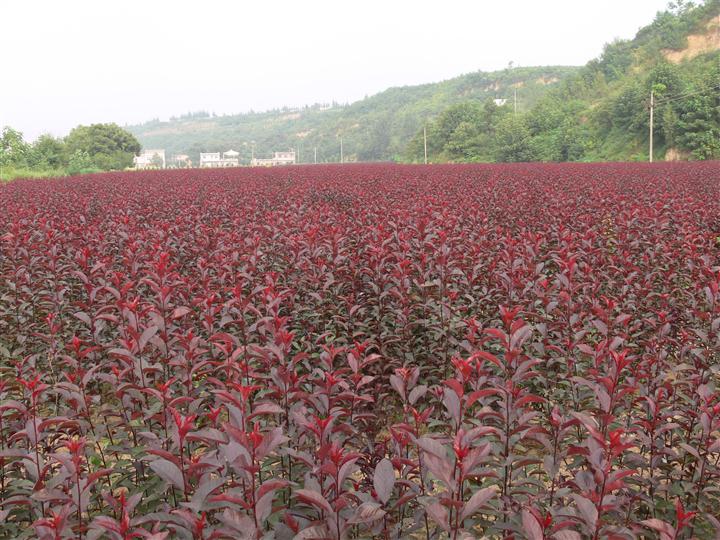
The purple-leaf sand cherry is a deciduous shrub or small tree, up to about 2.5 m tall, with a crown width of 1.5 m to 2.8 m. The branches are purple-brown when young, usually hairless, and the old branches have lenticels distributed over the entire branch. The leaves are long ovate or ovate-oblong, 4~8 cm long, with an acuminate apex, a broad wedge-shaped base, and irregular fine blunt teeth along the leaf margin. The leaf surface is red or purple, the underside is even redder, the tip of new leaves is bright purple-red, and the xylem of current-year branches is red. The flowers are solitary, medium to somewhat small, pale pink, with 5 petals and a slight fragrance, with many stamens and a single pistil, blooming from April to May.
2. Growth habits
Sunlight
The purple-leaf sand cherry is a light-loving tree species, but it is also cold-tolerant and shade-tolerant. If planted in a place with insufficient light, its leaf color will turn green, so it should be planted in a place with sufficient light.Cultivation methods and precautions for the golden-leaved banyan
Chinese name: Golden-leaved banyanLatin scientific name: Ficus microcarpa cv. GoldenLeavesOther names: Yellow-leaf banyan, yellow-heart banyanKingdom: PlantaePhylum: AngiospermsClass: DicotyledonsFamily: MoraceaeGenus: FicusDistribution area: Taiwan, China and South China, Southeast Asia and AustraliaThe golden-leaved banyan (Ficus microcarpa cv. Golden Leaves), also known as the golden-leaf ficus, of the family Moraceae and genus Ficus, is an evergreen shrub that tolerates heat, moisture and poor soil but not shade, and is a foliage and bonsai tree species. It has strong tillering ability, golden and brilliant leaf color, is easy to shape, and is widely used in gardens, often as a street tree, landscape tree or hedge tree. The golden-leaved banyan gets its name because its leaves are golden green. It is an evergreen tree or shrub, up to 25 m tall, with a broad umbrella-shaped crown that can reach 30 m wide, and drooping aerial roots on the trunk and branches. The leaves are alternate and simple, obovate to elliptic, 4-10 cm long, leathery, with entire margins. The flowers are unisexual, monoecious, in a syconium. The fruit is spherical and red when ripe.1. Morphological characteristics
Evergreen small tree, with a broad crown and a trunk with many branches. Leaves are alternate and simple, elliptic or obovate in shape, with a smooth surface, even margins and a glossy finish; young leaves are golden yellow, while old leaves are dark green. The spherical syconium contains male and female flowers growing together. In the fruits of Moraceae, parasitic wasps are often parasitic.2. Growth habits
It prefers a semi-shaded, warm and humid climate. It is relatively cold-tolerant and can withstand short-term low temperatures of 0°C; it grows faster at 25~30°C, and easily produces aerial roots when air humidity is above 80%. It likes light but should avoid direct strong light. It has strong adaptability, vigorous growth, is easy to shape, has few pests and diseases, and can be cultivated in general soil. It is a tropical tree species; from south to north in China, as the temperature decreases, the tree form correspondingly decreases. In northern South China, it is generally only just over 20 m tall, with a diameter at breast height of 150 cm.3. Distribution range
The golden-leaved banyan originates from the tropical and subtropical regions of Asia, and is distributed in Taiwan, China and South China, as well as Southeast Asia and Australia.4. Cultivation techniques
It prefers hot, humid places with sufficient sunlight. It likes high temperature and humidity, has few pests and diseases, tolerates wind and moisture, and has strong resistance to air pollution. It is not selective about soil; as long as the soil is fertile and the sunlight is sufficient, it can be planted anywhere.Cuttings propagation
Seed propagation can be used. Cuttings are done after the temperature rises in spring, and they root fairly easily; either old branches or young branches can be used as cuttings, cut into sections about 20 cm long, or cut into sections about 1 m long, and inserted directly into the nursery field. Keep them moist, and roots will develop in about 1 month; after 2~4 years of nursery cultivation, they can leave the nursery for open-field planting. A thick trunk about 2 m long and about 6 cm in diameter can also be used, with the branches and leaves cut off and the top wrapped in mud, and planted directly as a trunk cutting without going through seedling cultivation.For cultivating stump bonsai, dig up old stumps from rocky hills, and after they survive planting, carry out horticultural processing. Seed propagation is also often used; the fruit ripens in October, and a small amount also ripens from November to January of the following year and in other seasons. After the fruit is harvested and piled to rot, put it into a tightly woven cloth bag, and rub and rinse it in water to wash out the seeds. The thousand-seed weight is about 0.4 g. The germination rate differs among seeds collected in different years, reaching as high as 40%, and in some years the seeds do not germinate. The seeds must not lose water; they should be stored wrapped in moist filter paper or mixed with fine sand, or sown as soon as collected. According to the sowing requirements for small seeds, first broadcast the seeds on a sowing tray or on carefully leveled nursery ground, protecting them from rain impact. After sowing, they can germinate in about 1 day, and after about 2 months they can be transplanted to the nursery for cultivation; after 2-5 years they can leave the nursery for planting out. Seedling branches are soft and the root system is well developed, making them suitable for various shapes such as curved stems, approach grafting and exposed roots, and the crown can also be pruned into many forms.
Pest and disease control
The common pest is the grey-white tussock moth; its larvae feed on leaves and tender shoots. Young larvae bite and eat the leaf mesophyll, while older larvae devour the leaves. Because the larvae have a mimicry phenomenon, they are not easily found and can very easily cause great harm. The nymphs and adults of the Ficus thrips file and suck the sap of the host's tender leaves and young buds, causing purple-red-brown spots of varying sizes, withered buds and shoots, and leaves folding along the midrib toward the upper side to form dumpling-shaped galls.Control measures: spray after mixing imidacloprid, fenpropathrin, deltamethrin and other pesticides with organophosphorus pesticides such as phoxim.
5. Main value
Ornamental value
With dense branches and leaves and an spreading crown, it is a good tree species for street trees and courtyard shade trees in South China. It can become the main landscape feature of lawn greening, and can also be planted in the green belts of highway medians. It tolerates pruning and can be shaped into color landscapes of various forms. It can also be mixed with other foliage herbs, such as green amaranth, to form striking color contrasts. It has roles in cleaning the air, providing shade and scenery.Application value
Young trees can have their stems bent, roots exposed and approach grafted, and be made into various shapes to create artistic bonsai. Old stumps can be trimmed into ancient and vigorous stump bonsai, making it one of the tree species with the most uses in horticultural landscaping. It can also be heavily pruned from a young age and gradually trimmed year by year into a spherical or broad ovate crown.Bonsai is suitable for display in exhibition halls, museums, high-end hotels and other places, and is expensive. Large trees have a strong ability to resist harmful gases and smoke and dust, and are suitable for planting as street trees, for greening industrial and mining areas, and in squares, forest parks and other places, majestic and magnificent. One old banyan can provide shade over several qing and accommodate hundreds of people for gatherings.
Development value
The rapid development of modern gardens is reflected not only in the rising greening indicators but also in the continuous improvement of the greening level. Entering the new century, people's expectations for environmental improvement are growing higher and higher. The so-called meaning of greening refers to a means of using green plants to change the appearance of a city, with the aim of improving people's living and working environment. Because the tree species of the past had a single color, all green, it was called "greening." The monotonous feeling green gives people is increasingly unsuited to the requirements of our colorful era. The characteristics of trees include factors such as tree form and color, and these factors constitute the distinctive features of tree species and can resonate with people; this is where the development value of colored tree species lies. For example, blue makes people calm, red makes people unrestrained, and orange makes people enthusiastic, while different colors set together make people feel rich and colorful; the aesthetic value of the colors of these plants is obviously higher than that of pure green.The flower colors of plants alone are very attractive, yet "flowers do not stay red for a hundred days," and the flowering season of plants is short. Colored tree species refer to trees whose leaves or stems and branches show colors such as yellow, red, purple, orange-red, gray, silver-gray, white or mixed colors. At present, quite a few colored tree species have been developed: evergreen colored species such as Japanese barberry and purple-leaf sand cherry; spring-colored species such as red-leaf tree of heaven; winter-colored species such as golden-branch pagoda tree and red-twig dogwood; autumn-colored species such as maples and goldenrain trees; and multi-season colored species such as golden-leaf black locust, golden-leaf honeylocust, golden-leaf pagoda tree and colored conifer species.
We increasingly value the quality of our living environment, and it should be not only green but also colorful. The tree species listed in this article can meet this requirement and can be applied in street greening, scenic areas, forest parks and so on. Colored tree species have new leaves in spring, brilliant flowers in summer, abundant fruits in autumn and colorful branches in winter; no matter how the seasons change, colored tree species are always eye-catching highlights.
On the basis of greening with native tree species, all localities should work hard on developing colored tree species. The development of colored tree species in China started relatively late, many tree species have not yet been applied on a large scale, and the suitable range of most tree species is not very clear; all localities should carry out scientific introduction on the basis of regional trials.