How to grow marguerite daisies? Growing methods and points to note
Marguerite is also known as cineraria-leaved chrysanthemum and crown daisy. Below is my experience growing marguerite, organized for reference.
1. Soil: Marguerite likes loose, fertile, well-draining soil.
Soil mix: 5 parts black mountain soil, 5 parts peat soil. Those without black mountain soil can substitute garden soil.
2. Cuttings: Marguerite seems not to set seed; its propagation mainly relies on cuttings.
Generally, cuttings are taken in a seeding box with a lid, using a cutting medium of peat soil plus vermiculite, or peat soil plus perlite. The best seasons for cuttings are spring and autumn, and the other two seasons also root easily. The cuttings stay on the terrace the whole time; except in summer, the seeding box lid is put on during the other 3 seasons of cuttings, which retains moisture and warmth and raises the survival rate of the cuttings. In summer, take cuttings directly in flower pots, because seeding trays are too small and moisture evaporates easily.
3. Fertilizer: Generally, apply enough base fertilizer when repotting and planting out, and no further fertilizing at other times. For the base fertilizer, use chicken manure fertilizer and a small amount of slow-release fertilizer. Since the chicken manure fertilizer is already composted, using a bit more is fine, but the slow-release fertilizer must be dosed according to pot size, and the most important point is that the roots must not touch the fertilizer. During the flowering period, occasionally apply a top dressing too, using "Bi Kai Hua".
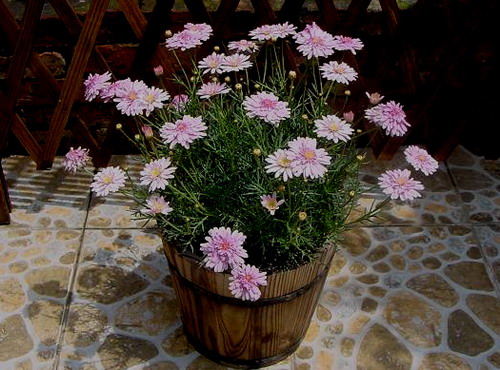
4. Environment: Marguerite is kept on the terrace the whole time, and in summer it does not get too much direct sun. In winter, a few pots receiving key care are placed somewhere out of the rain.
5. Pruning: Generally, marguerite is not pruned; only during the seedling stage are particularly overgrown branches cut short.
6. How marguerite forms a ball shape. A marguerite that has just rooted from cuttings in its first year will not grow into a very dense ball; only after the intense heat of summer and the severe cold of winter does it easily grow into a very dense ball. Everyone should note that after summer and winter, many leaves may have dried up; as long as there is still green in the center of the branches, do not discard it. With normal care and watering, by March or April of the second year, after cleaning up dead leaves plus repotting and fertilizing, the marguerite will quickly grow very dense shoots and buds, and its size will be more than 3 or 4 times the original.
Sunlight is also very important; sunlight and rain are the best nourishment for plants.
How to grow marguerite daisies and points to note
Soil requirements for marguerite daisies
Marguerite likes loose, fertile, well-draining soil. Soil mix: 5 parts black mountain soil, 5 parts peat soil. Those without black mountain soil can substitute garden soil.
Cutting method for marguerite daisies
Marguerite seems not to set seed; its propagation mainly relies on cuttings.
Generally, cuttings are taken in a seeding box with a lid, using a cutting medium of peat soil plus vermiculite, or peat soil plus perlite. The best seasons for cuttings are spring and autumn, and the other two seasons also root easily. The cuttings stay on the terrace the whole time; except in summer, the seeding box lid is put on during the other 3 seasons of cuttings, which retains moisture and warmth and raises the survival rate of the cuttings. In summer, take cuttings directly in flower pots, because seeding trays are too small and moisture evaporates easily.
Fertilizing requirements for marguerite daisies
Generally, apply enough base fertilizer when repotting and planting out, and no further fertilizing at other times. For the base fertilizer, use chicken manure fertilizer and a small amount of slow-release fertilizer. Since the chicken manure fertilizer is already composted, using a bit more is fine, but the slow-release fertilizer must be dosed according to pot size, and the most important point is that the roots must not touch the fertilizer. During the flowering period, occasionally apply a top dressing too, using "Bi Kai Hua".
Environmental requirements for marguerite daisies
Marguerite is kept on the terrace the whole time, and in summer it does not get too much direct sun. In winter, a few pots receiving key care are placed somewhere out of the rain.
Pruning requirements for marguerite daisies
Generally, marguerite is not pruned; only during the seedling stage are particularly overgrown branches cut short.
How marguerite forms a ball shape
A marguerite that has just rooted from cuttings in its first year will not grow into a very dense ball; only after the intense heat of summer and the severe cold of winter does it easily grow into a very dense ball. Everyone should note that after summer and winter, many leaves may have dried up; as long as there is still green in the center of the branches, do not discard it. With normal care and watering, by March or April of the second year, after cleaning up dead leaves plus repotting and fertilizing, the marguerite will quickly grow very dense shoots and buds, and its size will be more than 3 or 4 times the original.
Sunlight is also very important; sunlight and rain are the best nourishment for plants.
Marguerite daisy: how to grow marguerite daisies and points to note
Soil requirements for marguerite daisies
Marguerite likes loose, fertile, well-draining soil. Soil mix: 5 parts black mountain soil, 5 parts peat soil. Those without black mountain soil can substitute garden soil.
Cutting method for marguerite daisies
Marguerite seems not to set seed; its propagation mainly relies on cuttings.
Generally, cuttings are taken in a seeding box with a lid, using a cutting medium of peat soil plus vermiculite, or peat soil plus perlite. The best seasons for cuttings are spring and autumn, and the other two seasons also root easily. The cuttings stay on the terrace the whole time; except in summer, the seeding box lid is put on during the other 3 seasons of cuttings, which retains moisture and warmth and raises the survival rate of the cuttings. In summer, take cuttings directly in flower pots, because seeding trays are too small and moisture evaporates easily.
Fertilizing requirements for marguerite daisies
Generally, apply enough base fertilizer when repotting and planting out, and no further fertilizing at other times. For the base fertilizer, use chicken manure fertilizer and a small amount of slow-release fertilizer. Since the chicken manure fertilizer is already composted, using a bit more is fine, but the slow-release fertilizer must be dosed according to pot size, and the most important point is that the roots must not touch the fertilizer. During the flowering period, occasionally apply a top dressing too, using "Bi Kai Hua".
Environmental requirements for marguerite daisies
Marguerite is kept on the terrace the whole time, and in summer it does not get too much direct sun. In winter, a few pots receiving key care are placed somewhere out of the rain.
Pruning requirements for marguerite daisies
Generally, marguerite is not pruned; only during the seedling stage are particularly overgrown branches cut short.
How marguerite forms a ball shape
A marguerite that has just rooted from cuttings in its first year will not grow into a very dense ball; only after the intense heat of summer and the severe cold of winter does it easily grow into a very dense ball. Everyone should note that after summer and winter, many leaves may have dried up; as long as there is still green in the center of the branches, do not discard it. With normal care and watering, by March or April of the second year, after cleaning up dead leaves plus repotting and fertilizing, the marguerite will quickly grow very dense shoots and buds, and its size will be more than 3 or 4 times the original.
Sunlight is also very important; sunlight and rain are the best nourishment for plants.