Sageretia thea (Chinese sweet plum) cultivation methods and precautions
1. Water must be sufficient. The water used is best natural water such as river water, pond water or rainwater. If tap water is used, it should be stored for one to two days so the chlorine escapes before use; this is more reliable. Laundry water containing soap, as well as water with grease or salt, must never be used.
2. Fertilizing must be done with care. If too much fertilizer is applied, the branches and leaves grow rank and leggy; if fertilizer is lacking, the branches become thin and weak, the leaf color turns yellow, and the plant becomes susceptible to pests and diseases. Therefore fertilizing must follow principles: newly planted, newly potted, or just repotted trees, and those whose roots have been damaged, must not be fertilized for one month. In spring and summer, during the peak growing season of the potted tree, more fertilizer must be applied. After autumn begins, when the potted tree grows slowly, apply less. In winter, when the potted tree enters dormancy, fertilizing can be stopped. Fertilizing is not advisable on rainy days or around midday in midsummer. Liquid fertilizer is best applied on cloudy days or in the evening; when the potting soil is slightly dry, loosen the soil to help the fertilizer water seep into the soil. To speed up the decomposition of the fertilizer, be sure to water the next morning.
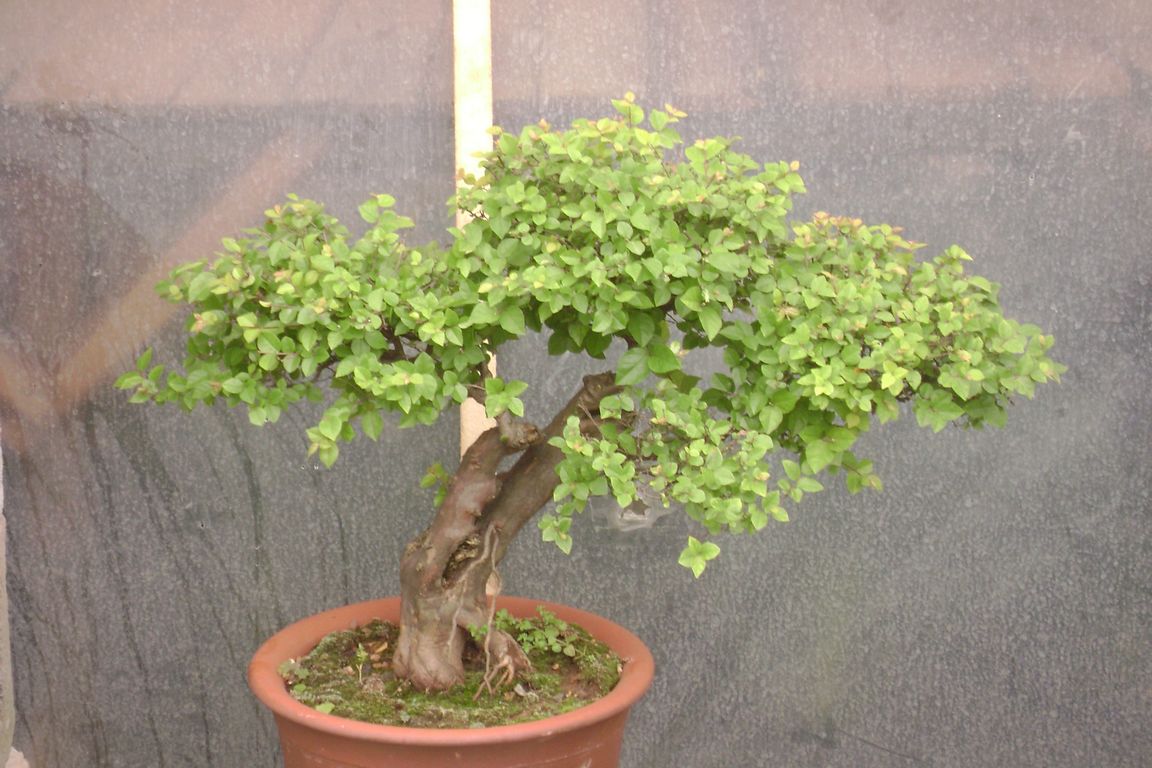
3. The potting soil must be good. Sageretia thea stumps originally grew in wild areas, with well-developed root systems, tolerant of both drought and waterlogging. Once dug up by people and planted in a shallow pot only a foot across, their growing conditions are restricted, and if not cared for properly they easily die, so they must be tended with special care. Choose a flower soil with good drainage, and during the care period it is best to put a thicker layer of potting soil in the pot. Replace the soil with new soil every two years, add some base fertilizer, and keep the soil fertile, so that the stump specimen can grow normally.
4. Pruning must be timely. Generally, the pruning time is best in late spring and early autumn; in these two seasons the Sageretia thea stump has the strongest sprouting ability and the most vigorous growth. Water sprouts, overlapping branches, crossing branches, radiating branches, dead branches, and pest- or disease-damaged branches should be cut off at any time. But note that in hot weather, new buds are easily scorched, causing the leaves to curl, so after pruning it is best to place the plant in a cool spot and only expose it to strong light after the buds have sprouted normally.
5. Pests and diseases must be prevented and controlled. Common pests and diseases of Sageretia thea stumps include the longhorn beetle, commonly known as the "borer". The female longhorn beetle bites through the bark and lays eggs on the branches and trunk; the newly hatched larvae tunnel and feed under the bark, and when grown they bore into the trunk and roots, and affected plants are often hollowed out and die. For control, the location of the pest can be judged by the excrement, and a suitably sized iron wire can be inserted into the bore hole to stab the larvae to death; alternatively, a cotton ball soaked in a 200-fold solution of dichlorvos can be inserted into the bore hole to poison the larvae, then sealed with wet mud. The red spider mite, also called the fire spider, is also a common pest of Sageretia thea stump specimens; it is less than 1 mm in body size, orange-red or reddish-brown, and oval. Red spider mites spin webs on the plant's leaves and pierce the branches and leaves with their mouthparts to suck sap; the chlorophyll of the damaged leaves is destroyed, the color turns pale yellow, fine grayish-yellow spots appear on the leaf surface, and the leaves gradually wither, yellow and fall, with some plants even losing all their leaves and dying. It can be eliminated by spraying a 1000-fold to 1500-fold solution of dichlorvos or dimethoate.
How to grow Sageretia thea (Chinese sweet plum); what to do if a Sageretia thea develops partial dieback
Sageretia thea has an upright, unyielding character, good adaptability and diverse forms, and is suitable for making bonsai of various styles; it is highly ornamental. But how do you grow Sageretia thea? What should you do if a Sageretia thea develops partial dieback? Next, let's talk about knowledge related to Sageretia thea.
How to grow Sageretia thea
1. Humidity
Sageretia thea likes a moist climate environment and requires the relative air humidity of the growing environment to be 70-80%. If the relative air humidity is too low, the lower leaves of Sageretia thea will turn yellow and fall off, and the upper leaves will lose their luster.
2. Temperature
Because Sageretia thea originates from tropical regions and likes a high-temperature, high-humidity environment, it has strict requirements for winter temperature. When the ambient temperature is below 10°C, Sageretia thea stops growing, and when frost occurs it cannot overwinter safely.
3. Light
Sageretia thea likes a semi-shaded environment; in autumn, winter and spring it needs plenty of sunlight, while in summer it should be shaded by more than 50%. When growing Sageretia thea indoors, place it in as bright a spot as possible, such as a well-lit living room, bedroom or study. After growing it indoors for a period, move it outdoors to a shaded spot for a period; alternating like this allows good growth.
4. Fertilizer and water
For potted Sageretia thea plants, besides adding organic fertilizer when potting, appropriate fertilizer and water management should also be carried out during routine care; only then can Sageretia thea grow well.
5. Pest and disease control
(1) Common pests and diseases of Sageretia thea stumps include the longhorn beetle, commonly known as the "borer". The female longhorn beetle bites through the bark and lays eggs on the branches and trunk; the newly hatched larvae tunnel and feed under the bark, and when grown they bore into the trunk and roots, and affected plants are often hollowed out and die.
Control method: the location of the Sageretia thea pest can be judged by the excrement, and a suitably sized iron wire can be inserted into the bore hole to stab the larvae to death; alternatively, a cotton ball soaked in a 200-fold solution of dichlorvos can be inserted into the bore hole to poison the larvae, then sealed with wet mud.
(2) The red spider mite, also called the fire spider, is also a common pest of Sageretia thea stump specimens; it is less than 1 mm in body size, orange-red or reddish-brown, and oval. Red spider mites spin webs on the plant's leaves and pierce the branches and leaves with their mouthparts to suck sap; the chlorophyll of the damaged leaves is destroyed, the color turns pale yellow, fine grayish-yellow spots appear on the leaf surface, and the leaves gradually wither, yellow and fall, with some plants even losing all their leaves and dying.
Control method: it can be eliminated by spraying a 1000-fold to 1500-fold solution of dichlorvos or dimethoate.
What to do if a Sageretia thea develops partial dieback
Generally speaking, there are no more than three causes of partial dieback in Sageretia thea stumps:
1. Physical, where collision injures the bark of the stump.
2. Pathological, caused by bacteria or viruses, though this situation is relatively rare.
3. Physiological, which is also the most important; the first two situations are more or less related to this one as well, and it is due to the special physiological structure of the Sageretia thea stump.
The outer vascular bundles of Sageretia thea differ from those of ordinary tree species: they are only unidirectional, like a row of tubes joined together; if they break in the middle, the function of transporting water over a distance is completely lost. It is not like other tree species, where if you cut into the trunk with a knife and sever the vascular bundles, the severed vascular bundle cells all connect and link up with the surrounding vascular bundle cells to produce new vascular bundles and then heal.
Therefore, during the cultivation and pruning of Sageretia thea stumps, one generally leaves an extra bud's length above the opposite side of the part where a branch is to be kept. When buds sprout, both the upper and lower buds will sprout; at this time, due to apical dominance, the upper bud grows fastest, so the upper terminal bud is pruned appropriately to control its growth, only keeping it alive, allowing apical dominance to gradually shift to the branch to be kept below. When the branch to be kept below has grown to a certain thickness and apical dominance has fully shifted to the lower branch, you can see that the bark of the upper branch stump above the lower branch has already begun to shrink, and the lower branch segment is clearly thicker than the upper segment; at this point the excess upper branch segment can be pruned away.
The above are some answers on how to grow Sageretia thea and what to do if a Sageretia thea develops partial dieback. I hope they can help everyone. For more home knowledge, please stay tuned.
How to grow Sageretia thea: precautions for growing Sageretia thea bonsai
Everyone knows that making a pot of Sageretia thea bonsai is very difficult. Having obtained a bonsai after investing so much time and effort, we must care for it carefully. So what precautions are there for the care of Sageretia thea bonsai? Below we explain them one by one from multiple angles:
Care of Sageretia thea bonsai
1. Placement location: Sageretia thea should be placed in a ventilated and well-lit place. In summer, when temperatures are high, attention should be paid to appropriate shading. In winter it is fairly cold-tolerant; in Jiangnan it can be overwintered outdoors buried in soil, but in severe cold regions it must be brought indoors.
2. Watering: potted Sageretia thea should always keep the potting soil moist; especially in midsummer heat and dry weather, pay attention to watering and spraying frequently to prevent the potting soil from drying out.
3. Fertilizing and care: for fertilizer for Sageretia thea bonsai, cake fertilizer or kitchen scraps can be placed in a jar, sealed and fermented, then the upper layer is taken and diluted with 4-5 times water for watering. At the same time, Sageretia thea is an acid-loving plant, so 1% ferrous sulfate should be added when making the fermented fertilizer water.
4. Heat-preservation care: Sageretia thea bonsai has relatively poor cold tolerance and is prone to freezing, drying up, and even dying. Therefore in winter it should be placed indoors, with attention to ventilation, and the room temperature kept above 5°C; when the room temperature exceeds 25°C, windows can be opened to avoid leggy growth caused by high temperatures; when the room temperature is below 5°C, it can be wrapped in plastic for insulation. When the room temperature is below 0°C, warming methods such as heating with hot water should be used to ensure the Sageretia thea bonsai overwinters safely.
5. Repotting care: Sageretia thea bonsai needs repotting once every 3 to 4 years, preferably before spring budding. When repotting, appropriately prune away some old roots, dead roots, and overly long or dense root systems, replace 1/2 of the old soil, and fill in with fertile, loose culture soil to promote the growth and development of new roots.
6. Pruning care: Sageretia thea is very tolerant of pruning. After autumn each year, a shaping pruning can be carried out, thinning out some overly dense branches and leaves, and cutting away various messy branches or water sprouts, to maintain a certain shape and posture and promote luxuriant branches and leaves. Sageretia thea has strong sprouting ability, so pinching should be done in time; it can make axillary buds sprout side branches, and the more often pinching is done, the denser the branches and leaves.
7. Pests and diseases must be prevented and controlled: common pests and diseases of Sageretia thea stumps include the longhorn beetle, commonly known as the "borer". The female longhorn beetle bites through the bark and lays eggs on the branches and trunk; the newly hatched larvae tunnel and feed under the bark, and when grown they bore into the trunk and roots, and affected plants are often hollowed out and die. For control, the location of the pest can be judged by the excrement, and a suitably sized iron wire can be inserted into the bore hole to stab the larvae to death; alternatively, a cotton ball soaked in a 200-fold solution of dichlorvos can be inserted into the bore hole to poison the larvae, then sealed with wet mud. The red spider mite, also called the fire spider, is also a common pest of Sageretia thea stump specimens; it is less than 1 mm in body size, orange-red or reddish-brown, and oval. Red spider mites spin webs on the plant's leaves and pierce the branches and leaves with their mouthparts to suck sap; the chlorophyll of the damaged leaves is destroyed, the color turns pale yellow, fine grayish-yellow spots appear on the leaf surface, and the leaves gradually wither, yellow and fall, with some plants even losing all their leaves and dying. It can be eliminated by spraying a 1000-fold to 1500-fold solution of dichlorvos or dimethoate.
The above is an introduction to the care knowledge for Sageretia thea bonsai. I hope it can be helpful to everyone!