Detailed Explanation of Key Cultivation Techniques for Abelmoschus manihot
[Aliases] Huangqiukui, Qiukui.
[Family and Genus] Malvaceae, Abelmoschus.
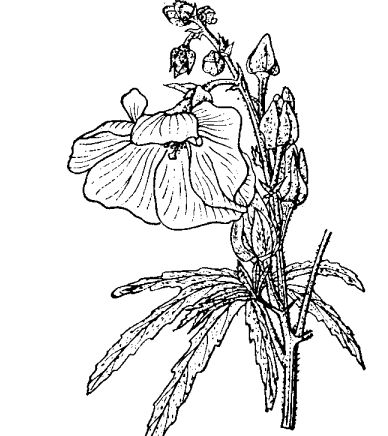
[Morphology] Annual herb, plant height 2 m, branched, sparsely covered with long stiff hairs. Leaves alternate, palmately 5-9 parted, lobes oblong-lanceolate, coarsely toothed, both surfaces covered with long stiff hairs, leaf length 8-18 cm, petiole length 6-18 cm. Flowers large, 12 cm in diameter, solitary in leaf axils or at branch tips, pale yellow with a purple center. Flowering period July—October. Bracteoles 4--5, ovate-lanceolate, persistent. Calyx spathe-like, 6-lobed, falling off at fruiting stage. Capsule covered with stiff hairs. Seeds nearly round, 1000-seed weight 16 g.
[Origin and Distribution] Native to China and Japan.
[Habits] Not cold-tolerant, highly adaptable, capable of self-seeding and propagating.
[Propagation] Sown in open-ground seedbeds in April in spring, germinating quickly and evenly.
[Cultivation] After one transplanting of the seedlings, plant them out in the garden in early June, with a plant spacing of 60 cm. They grow vigorously and are easy to manage. (This article is selected from "Agricultural Encyclopedia"
[Seed Collection] After the capsules mature, they can split open slightly, but the seeds do not easily scatter, so they can be harvested individually in batches.
[Uses] The whole plant is used medicinally, with the effect of clearing heat and cooling the blood. After the flowers are pounded into a paste, they can be applied to treat sores and boils. The roots are rich in mucilage and serve as a mucilaginous agent, and can be used as a paste material for papermaking. The stem bark fibers can substitute for hemp fibers.
It can be used as background material, and can be planted at hedge edges, wall corners, and in scattered gaps of land.
Planting Abelmoschus manihot flowers makes society full of color
We have all probably eaten sunflower seeds, especially when we were children; kids generally quite liked eating them. Usually, when there was nothing to do after a meal, people would put some sunflower seeds in a cloth bag and sit together with a few friends to eat them. Especially during the Chinese New Year, every household would buy all kinds of melon seeds, and of course sunflower seeds were indispensable. Since sunflower seeds are mentioned, I wonder if everyone knows about Abelmoschus manihot flowers. Regarding the planting methods of Abelmoschus manihot flowers, today the editor will popularize some knowledge for everyone so you can understand.
Steps for planting Abelmoschus manihot flowers:
1. Seed propagation:
From March 25 to April 10 (one week around Qingming), it can also be arranged according to local climate. During this period, use nutrient pots for seedling raising (soil and fertilizer requirements can refer to those for cotton), making 1200-1500 pots per mu. Soak the seeds in warm water for 24 hours, then stir the seeds with carbendazim. Herbicides are prohibited in the seedbed. Before sowing, the pots should be watered first, and the covering soil should not be thick. Make a small arched shed and cover it well with plastic film. After the seedlings emerge in about 7-10 days, special attention should be paid to weather changes and temperature control to prevent overheating or excessive cold from damaging the seedlings. The temperature inside the shed should be controlled between 20-35°C. Carry out manual weeding at the proper time, leaving one strong seedling per pot. Before transplanting, spray chlormequat and carbendazim once or twice. The height of transplanted seedlings should not exceed 20 cm.
2. Transplanting seedlings in pots:
For fields after barley, transplant in late May; for fields after wheat, transplant in early June; for blank fields, advance it to mid-May. Specifically, arrange the planting according to the local cotton transplanting time. Use a pot-making tool to open holes for transplanting at a row spacing of 1.3-1.5 m and a plant spacing of 65-80 cm. Apply 10-20 kg of compound fertilizer per mu or an appropriate amount of farmyard manure. For fertile vegetable land, fertilizer application should be appropriately controlled. Place the seedling pot into the hole with the upper surface of the pot level with the field surface, then earth up and water thoroughly.
3. Field management:
Promptly fill in any seedlings that do not survive. During the seedling stage, apply little or no additional fertilizer, and use little or no herbicide for manual weeding. Pay attention to watering regularly to keep the soil moist. The fertilization principle is: focus on applying decomposed human and livestock manure; farmyard manure is the best fertilizer; fertilize according to seedling condition; chemical fertilizer should not be placed too close to the holes; apply fertilizer deeply; and pay attention to using compound fertilizer balanced in nitrogen, phosphorus, and potassium. In the mid-flowering stage, apply another fertilizer high in phosphorus and potassium so the plant produces more flower buds and more flowers.
4. Pest and disease control:
Abelmoschus manihot is cultivated extensively, with no major pests or diseases occurring, and basically no pesticide spraying is needed. In late June and early July, when flower buds first form, in order to control excessive plant growth, chlormequat can be sprayed 2 times, with an interval of 7-10 days. Especially in the plum rain season, work should be done well to clear ditches and open drainage furrows, striving to achieve dry fields once the rain stops. Plants should not be too dense and should maintain good ventilation and light transmission. To prevent residual pathogens in the field, fungicides such as carbendazim or thiophanate-methyl can be used for control.
This is the content on planting Abelmoschus manihot flowers. Each step has its own meaning and is indispensable, because planting plants is a big project with requirements in many aspects. Only when we master the planting techniques will the operation become much simpler. Friends who are interested can remember the operation steps described above, buy some seeds on the market, and then plant them. Nowadays, more and more friends are beginning to plant trees, contributing their own strength to our environment and our society.
How to grow Abelmoschus manihot: essential tips for caring for Abelmoschus manihot
Abelmoschus manihot has soft flower colors and relatively large blooms, making it one of the more distinctive flower varieties. At home, it is generally planted in home courtyards or grown in pots and placed on windowsills and other places. Below, let us look at how to grow Abelmoschus manihot:
Basic information about Abelmoschus manihot:
Abelmoschus manihot L.Medic., also called qiukui, leopard's eye flower, batian umbrella, cotton wormwood, etc., is an annual or perennial robust erect herbaceous plant in the Malvaceae family, Abelmoschus genus. The plant is 1-2 m tall, the stem is covered with yellow bristles, and the leaves are large, ovate to nearly round. The flowering period is June-August. The roots, leaves, flowers, and seeds are used medicinally and can be used to clear heat and detoxify, and to moisten dryness and relax the bowels.
How to grow Abelmoschus manihot:
1. Soil:Abelmoschus manihot is afraid of waterlogging and needs well-drained, loose, and fertile soil.
2. Watering:Abelmoschus manihot has certain water requirements. Pay attention to watering regularly to keep the soil moist, but do not water excessively.
3. Temperature:The growth temperature for Abelmoschus manihot is 25-30°C, and the most suitable temperature during the flowering period is 26-28°C. An average monthly temperature below 17°C affects flowering, and a nighttime temperature below 14°C leads to poor growth.
4. Fertilization:For Abelmoschus manihot, focus on applying decomposed human and livestock manure; farmyard manure is the best fertilizer; fertilize according to seedling condition; chemical fertilizer should not be placed too close to the holes; apply fertilizer deeply; and pay attention to using compound fertilizer balanced in nitrogen, phosphorus, and potassium. In the mid-flowering stage, apply another fertilizer high in phosphorus and potassium so the plant produces more flower buds and more flowers.
5. Pests:Abelmoschus manihot is cultivated extensively and rarely suffers from pests or diseases, but to prevent residual pathogens in the field, fungicides such as carbendazim or thiophanate-methyl can be used for control.
Abelmoschus manihot is a relatively special plant. It has many flowers, is quite ornamental when in bloom, and also has high medicinal value. It is more suitable to choose to plant it in home courtyards.