What are the main species of daylily? A detailed guide in one article
1. Hemerocallis lilioasphodelus (yellow daylily, H. lilioasphodelus L.) : leaves dark green, strap-shaped, 30-60 cm long, 0.5-1.5 cm wide, arching and curved. Flowers 6-9, in a terminal loose panicle, pale lemon-yellow, shallow funnel-shaped, about 9 cm in diameter, fragrant. Scape about 125 cm tall, flowering from May to July. The flower buds are the famous "golden needle vegetable" and are edible. Native to China and Japan.
2. Hemerocallis citrina (golden bell lily, H. citrina Baroni): leaves broad and large, dark green, 75 cm long, vigorous and compact growth. Flowers pale lemon-yellow with a brown flush on the reverse, perianth 13-16 cm long, segments rather narrow, pedicels short, fragrant. Flowering from July to August. The flowers cannot open fully under strong light, often opening in the evening and closing again before noon the next day. The flower buds are edible. Native to China.
3. Hemerocallis minor (small yellow daylily, H. minor Mill.): leaves green, about 50 cm long, 6 mm wide. Flowers 2-6, yellow with a brown flush outside, about 5-10 cm long, fragrant. About 25 cm tall. Flowering from June to August. The flower buds are edible. Native to China.
4. Hemerocallis middendorffii (H. middendorffii Trautv. et Mey.): leaves 30-45 cm long, 2-2.5 cm wide, shorter than the scape. Flowers 2-4, yellow, fragrant, the floral tube cylindrical, 1.3 cm long, pedicels very short, with large triangular bracts. Flowering in July. Native to Japan and eastern Siberia, USSR.
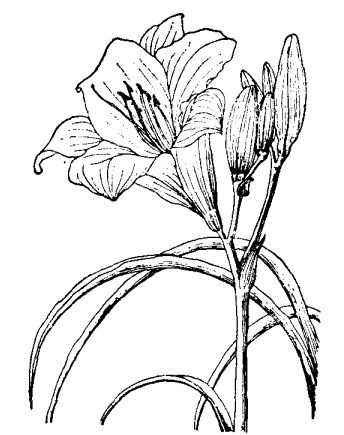
Introduction to the main varieties of daylily
Image: daylily
[FAQ] Introduction to the main varieties of daylily
[Expert answer]
Daylily is also the collective name for plants of the genus Hemerocallis, with about 20 natural species, of which China has 8.
1. Yellow daylily (golden needle vegetable):Native to China, leaves dark green and strap-shaped, 30-60 cm long, 0.5-1.5 cm wide. Arching and curved. Flowers 6-9, lemon-yellow, shallow funnel-shaped, the scape about 125 cm tall, flower diameter about 9 cm. The flower buds are the famous "yellow daylily" and are edible.
2. Hemerocallis citrina (yellow daylily):Leaves rather broad, dark green, 75 cm long, 1.5-2.5 cm wide; the inflorescence bears as many as about 30 flowers, and the bracts below the inflorescence are narrowly triangular; distributed throughout the country, especially most abundant in Guanjiazui Town, Qidong County, Hunan Province, which is the national place of origin of yellow daylily.
3. Hemerocallis middendorffii:Leaves 30-45 cm long, the inflorescence with 2-4 flowers, yellow, fragrant, petals 8-10 cm long, pedicels very short, flowers crowded, with large triangular bracts. Flowering in July
4. Hemerocallis thunbergii:Leaves 74 cm long, scape 120 cm tall, the top branched and bearing 12-24 flowers, apricot-yellow, the throat deeper in color, short funnel-shaped, fragrant.
5. Hemerocallis minor:30-60 cm tall. Leaves green, about 50 cm long, 6 cm wide. Bearing 2-6 flowers, yellow with a brown flush outside, 5-10 cm long, fragrant. Opening in the evening. Flowering from June to September, the flower buds edible.
6. Red Pirate daylily:Extremely strong disease resistance, very low soil requirements, tolerant of waterlogging and drought. Height 25 to 30 cm, flowering from late May to early October, annual tillering rate 8.
7. Hailerfan daylily:Height 40-45 cm, the color bicolored, flowering from June to September, annual tillering rate 5-7 times, able to overwinter naturally at minus 20 degrees.
8. z300 daylily:Height 30-35 cm, flowering from late May to early October, the flower color red, annual tillering rate 15-20 times, low soil requirements, strong resistance to pests and diseases, able to overwinter naturally at minus 30 degrees, an excellent daylily variety for landscaping!
9. Autumn Red daylily:Height 35-40 cm, flowering from May to October, annual tillering 6.
10. Orange daylily:Height 30-35 cm, flowering from May to October, annual tillering rate 12; Children's Day daylily, height 35-40 cm, flowering from June to October, annual tillering rate 6.
[Editor's comment] The above are some of the main daylily varieties introduced to you by the First Agricultural Economics editor. For more related materials, such as"Common pest and disease control of daylily", "Planting methods and precautions for Stella de Oro daylily", "Daylily cultivation and planting techniques"and so on, please follow the relevant sections or special topic channels of First Agricultural Economics. We will wholeheartedly provide you with more comprehensive and more professional materials!
Introduction to the propagation methods of the large-flowered daylily
The large-flowered daylily has a short plant and a long flowering period, and is a polyploid dwarf variety treated by high-tech means, very suitable as a ground cover plant. Nowadays, the large-flowered daylily is often used to arrange flower beds, road medians and other places, and is an excellent garden flower that combines foliage and flower appreciation. Artificial propagation of the large-flowered daylily can use sowing, division, bud division and tissue culture methods.
Large-flowered daylily
1. Sowing method:
Sowing is a method for rapidly producing seedlings in large quantities, but because the seed germination rate is low, the seeds need to be soaked first to germinate, and they can only be planted out one year after sowing. The seed collection period begins around September each year, requiring plants that are robust, with plump fruit and no pests or diseases. Sowing is done in the spring of the following year.
The seedbed should first be given sufficient base fertilizer, the bed 1.3 to 1.7 m wide and about 30 m long, with drainage ditches dug on both sides. When sowing, open a shallow furrow about 3 cm deep every 20 cm, sow the seeds evenly into the furrow, cover with a layer of fine soil, then spread a thin layer of fine sand. Before emergence, water and weed, and maintain good soil moisture; by autumn the seedlings can be lifted and planted. Each mu of seedbed uses 2.5 kg of seed, and can raise 50,000 to 60,000 seedlings.
The seeds can also be soaked to promote germination and then sown in the open field to raise seedlings, with a sowing rate of 5 to 7 kg per mu, using flat-ground drilling. Open furrows at a row spacing of 30 cm, about 3 cm deep, sow one seed every 3 to 5 cm, and after the plants grow 2 to 3 leaves, apply one application of thin human manure and urine. For overwintering, use a small arched shed for cold protection, strengthen field management after spring begins, and transplant in August. Seeds collected from evergreen daylily can be sown directly, or stored at room temperature and then sown.
2. Bud division method:
Bud division refers to the small plants on the flower stem of the large-flowered daylily. The flower buds can be cut from the flower stem, and if they are relatively large, they can be further divided before planting. After transplanting, the flower buds can take root within one week. Rooted flower buds can be used to propagate plants, increasing the number planted and ultimately increasing economic returns.
3. Tissue culture method:
Tissue culture uses young leaves, filaments, flower scapes and other organs to cultivate plants. The method is to first induce the young organs to produce callus tissue, then use a suitable culture medium under suitable conditions of temperature, humidity, light and air to cultivate them into small plantlets. The seedlings are then temporarily planted in nutrient pots, cultivated for a period into young plants, and afterwards planted out. But this method has not yet been widely accepted.
4. Division method:
Dividing daylily clumps is the most commonly used propagation method. This method is simple to perform, the plants survive easily, and growth is relatively uniform. For division, the entire mother clump can be dug up and replanted in divisions; or a portion of plants can be dug out from one side of the mother clump as seed stock, with the remainder left to continue growing.
Division is mostly carried out before budding in spring or after leaf fall in autumn. If divided and transplanted in spring, they can send up scapes and flower the same year; if divided and transplanted in autumn, they can only send up scapes and flower the following year. When transplanting, choose plants that are vigorous, have many flower buds, good quality and no pests or diseases.
When dividing, dig out a portion of the tillers from the clump as seed stock; the dug-out portion must have roots, cut apart at the shortened stem, remove the old roots, rotten roots and diseased roots, retain the fleshy roots as much as possible, shorten them appropriately (leaving about 10 cm), and then plant. Planting should be done on a sunny day, digging, dividing and planting the seedlings as you go, injuring the roots as little as possible, so that they recover quickly. Generally divide every 2 to 3 years to ensure vigorous growth of the plants.