Detailed Guide to Hyacinth Cultivation, Propagation and Management
[Aliases]Dutch hyacinth, five-colored hyacinth.
[Family and genus]Liliaceae, Hyacinthus.
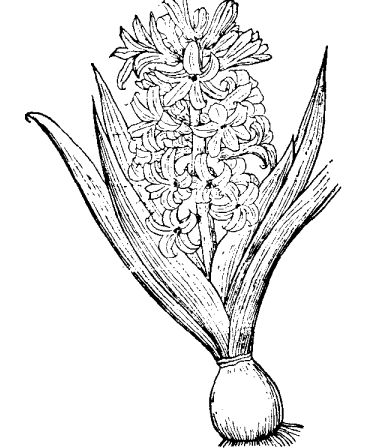
[Morphology]Perennial herb, bulb spherical or oblate, covered with a tunica that is purplish blue or white etc., related to flower color. Leaves 4-6, basal, thick and fleshy, strap-shaped lanceolate. Flower scape 16-45 cm tall, hollow, bearing a raceme at the tip; 10-20 or more
small flowers densely arranged on the upper part. Flowers fragrant, in white, pink, yellow, red, blue and pale purple etc., in varying shades, single or double. Flowering period March—April.
[Varieties, forms and cultivars]Cultivars are extremely numerous, with all kinds of colors and double-flowered cultivars, as well as large-flowered and small-flowered cultivars, early-flowering and late-flowering cultivars, etc. Its important variety Roman hyacinth (var. 42s Baker) has weak plants and early growth habit, each plant can bear several flower scapes, flowers small, suitable for forcing. Due to climatic conditions, hyacinths often degenerate in many places in our country, with dwarfed plants, deteriorated flowers and shrunken bulbs, and are not easy to grow well, so there are currently few cultivars.
[Origin and distribution]Native to southern Europe, the eastern Mediterranean coast and Asia Minor. Most extensively cultivated in the Netherlands, where it became a commercial crop for sale.
[Habits]Prefers a cool, humid, sunny environment, requires well-drained sandy soil, grows very poorly in low-lying, wet, heavy soil. Cold-hardy, overwinters outdoors in the Shanghai area without protection.
[Propagation]Plant small bulbs in September-October in autumn; do not separate bulbs right after harvest, because wounds rot easily during summer storage. Alternatively, in August on a sunny day, cut the base of a large bulb or hollow out a hole, expose to the sun for 1-2 hours, then spread flat indoors to dry; the cut part of the large bulb can produce many small bulblets, which can be separated and planted in autumn. Seed propagation is also possible for breeding new cultivars.
[Cultivation]Hyacinths like fertilizer; whether potted or planted in the ground, it is best to apply plenty of base fertilizer, and the soil should be loose, with frequent topdressing during the growing period. For ground planting, loosen the soil promptly after emergence, apply one topdressing in winter, and one more each before and after spring flowering. Early hot early summer in Shanghai often causes hyacinths to decline prematurely, which is unfavorable for bulb development, so the bulbs shrink and degenerate year by year and are hard to grow well. For potted forcing, plant bulbs in September, using ordinary potting soil (garden soil, rice-hull ash and manure), plant 3--4 per pot, place in sunlight, move into a greenhouse in November; the forcing temperature must not exceed 5-10°C, and they can bloom at Spring Festival. Before storing bulbs, they must be dried in the shade, otherwise the bulbs rot easily.
In the past, the Shanghai area also commonly used water culture for forcing, producing large quantities every year. When forcing hyacinths, be sure to keep them first at a relatively low temperature so that they grow roots but do not sprout leaves. Then place them in semi-shade at a slightly higher temperature so that the leaves grow to a certain height, and only finally give a higher temperature and full sunlight; only in this way can the stems and leaves be full and the flowers abundant.
[Uses]Hyacinth plants are low and neat, with brilliant flower colors and early flowering; it is an important spring bulbous flower, most suitable for cut flowers, flower borders, flower beds or natural clumps along lawn edges, etc.
Propagation, Cultivation and Uses of Grape Hyacinth
[Aliases]Grape lily, blue bottle flower, grape musk hyacinth.
[Family and genus]Liliaceae, Muscari.
[Morphology]Perennial herb, bulb spherical, tunica white. Leaves basal, linear, slightly fleshy, dark green, margins often rolled inward, 10—30 cm long, 0.6 cm wide. Flower scape emerging from the leaf cluster, 10--30 cm tall, raceme densely arranged on the upper part of the scape, pedicels drooping; flowers small, turquoise blue. Flowering period from mid-March to early May.
[Varieties, forms and cultivars]There are cultivars with white flowers, flesh-pink flowers and pale blue flowers, etc.
[Origin and distribution]Native to southern Europe.
[Habits]Prefers deep, fertile sandy soil and requires good drainage. Tolerates semi-shade and cold. Can overwinter outdoors in East China and North China without protection.
[Propagation]Plant bulblets in autumn.
[Cultivation]This species is robust and highly adaptable, with simple cultivation and management, the same as ordinary autumn-planted bulbs.
[Uses]The plant is short, with an early and long flowering period; suitable as groundcover flowers under trees, or for natural clump planting in flower borders and lawns. It can also be potted for ornament or used as a cut flower.
Propagation and Cultivation Methods of Hyacinth
Flower name: Hyacinth
Latin scientific name: Hyacinthus orientalis L.
Other names: Dutch hyacinth, Western hyacinth, five-colored hyacinth, shiyangjin
Family and genus: Hyacinthaceae (Liliaceae), Hyacinthus
Distribution area: Widely cultivated worldwide. Native to the limestone areas above 2600M altitude along the eastern Mediterranean coast of southern Europe and the Asia Minor peninsula. There are extremely many cultivars; the Netherlands has the most in the world today, and like the tulip it is an extremely important export commodity. Cultivated everywhere in China.
Hyacinth is a perennial herbaceous plant in the genus Hyacinthus of the family Hyacinthaceae, with a bulb. It originally belonged to Liliaceae, but has now been elevated to the type genus of the new family Hyacinthaceae, and hyacinth has also been moved from the former order Liliales to the newly established order Asparagales. Hyacinth is native to the Mediterranean and South Africa; its scientific name comes from Hyacinthus, the beautiful youth in Greek mythology who was favored by the sun god Apollo and killed when accidentally struck by a discus he threw. Hyacinth flowers are rich in color and fascinating. Especially at Spring Festival, red, blue, white, purple, yellow and pink hyacinths, with waves of fragrance, fill the festive atmosphere with joy.
Propagation methods
Mainly by bulb division, and also by bulb propagation. The mother bulb produces 1-2 bulblets after one year of planting, and some cultivars can produce more than ten bulblets. These can be used for bulb division propagation; bulblets need 3 years to flower. Seed propagation: sown in autumn, germinating only in February of the following year, and seedlings flower after 4-5 years of cultivation.
Bulb division propagation
After digging up the bulbs in June, separate the large bulbs from the bulblets. “The large bulbs planted in autumn can flower in early spring of the following year, while the bulblets need 3 years of cultivation to flower. Because the natural bulb division rate of hyacinth is low, generally the mother plant can produce only 1-2 bulblets after one year of planting. To increase the propagation coefficient, the large bulbs can be subjected to scoring surgery during the summer dormant period to stimulate them to produce bulblets. The method is: in August when flower buds have already formed, first evenly remove part of the basal plate at the bottom of the bulb so that the wound at the basal plate is concave, then cut vertically and horizontally from bottom to top, forming a cross-shaped cut, deep enough to reach the bud center inside the bulb; at this time sticky liquid will flow out, which should be smeared with 0.1% mercuric chloride solution for disinfection, then exposed to strong sun for 1-2 hours, and then spread flat indoors. Keep the room temperature at about 21C first, so that callus tissue forms, and when the base of the scales swells, gradually raise the temperature to 30 C with a relative humidity of 85%; in about three months many small bulbs will form. The small bulbs induced in this way flower after 3-4 years of cultivation.
Seed propagation
Mostly used when breeding new cultivars; sow in autumn into potting soil in a cold frame, cover with 1 cm of soil, and they germinate at the end of January to early February of the following year. The small bulbs grown from seedlings flower after 4-5 years. Under ordinary storage conditions, seed viability can be maintained for 3 years.
Cultivation techniques
For hyacinth, choose well-drained, not too dry sandy loam, neutral to slightly alkaline; apply plenty of base fertilizer before planting; in field cultivation, avoid continuous cropping. Cultivation methods include open-field cultivation, potting, forcing and water culture.
It is suitable to carry out in October-November, and choosing well-drained soil is the most important condition. Apply plenty of base fertilizer before planting, add a thin layer of sand on top, then arrange the bulbs, with a spacing of 15 cm-18 cm and cover with 5 cm-8 cm of soil. Also cover with grass to keep the soil loose and moist. Generally no other management is done before flowering; after flowering, if seeds are not to be collected, cut off the flower stems to promote bulb development, and the cutting position should be as high on the flower stem as possible. In early June the bulbs can be dug out, spread out, graded and stored in a cold store; the summer temperature should not exceed 28C. Potting
Use a mixture of loam, leaf mold and fine sand as potting soil; generally one bulb per pot of 10 cm caliber, 2-3 bulbs per pot of 15 cm caliber, then bury the pots in the soil and cover with 10 cm-15 cm of soil; after 7-8 weeks, when the shoots grow to more than 10 cm, remove the covering soil to let sunlight reach them. Generally planted in October-November and flowering in March. Water culture
Put clean water in a container and place it in a dark place; choose a large bulb so that the bottom of the bulb is immersed in water; when the roots reach 10 cm, move it to a bright place for sunlight, keeping the room temperature at about 15C; planted in October, flowering can be expected by the end of the year.