Detailed Guide to Four O'Clock Flower Planting Methods and Cultivation Techniques
[Aliases] Rouge flower, night meal flower, tide-coming flower, grass jasmine, night beauty, official powder flower, top scholar red, bath flower.
[Family and genus] Nyctaginaceae, Mirabilis.
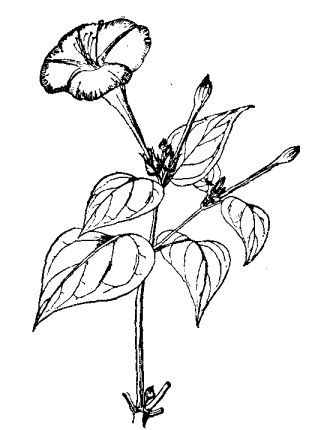
[Morphology] Perennial herbaceous plant, often cultivated as an annual. Height 50--80 cm; in Shanghai the roots can sometimes overwinter in the open ground and sprout again the following year. Stems upright, much branched. Leaves opposite, ovate or ovate-triangular, entire. Flowers terminal, only one flower within the involucre, without petals, the calyx petal-like, trumpet-shaped, 2.5 cm in diameter. The petal-like calyx is purplish red, slightly fragrant. Flowers open around 4 p.m. Flowering period from August until frost. Achene ovate to round-ovate, 1000-seed weight 109 grams.
[Varieties, forms and cultivars] Flower color varies in cherry red, yellow, white, and there are also bicolor types with stripes or spots. There is a dwarf type, 30 cm tall, with rather slender small seeds.
[Origin and distribution] Native to tropical America, now cultivated in various countries. (This article is selected from "Agricultural Encyclopedia"
[Habits] Not cold-tolerant, likes fertile, loose soil and slightly shaded places. The dwarf type is not tolerant of intense heat and often drops its leaves. Can self-sow.
[Propagation] Sow seeds in the open-ground seedbed in early April of spring; because the seeds are large, dibbling is preferable. The roots can also be dug up in late autumn and stored in a cellar, then replanted the following spring.
[Cultivation] After the true leaves appear on the seedlings, transplant once, or after thinning without transplanting, directly plant out in the garden. Plant spacing 60 cm, dwarf type 30 cm. Not demanding about soil, fertilizer or water; management is extensive.
[Seed collection] After the achenes mature, they fall off immediately, so they must be collected by frequent inspection.
[Uses] The roots can be used as medicine, having the effects of removing dampness and promoting urination, activating blood circulation and detoxifying. The leaves treat sores and poisons. The seed endosperm, after drying and grinding fine, can be made into face powder.
This species can be scattered directly on tree beds and other open spaces, and can self-sow and bloom year after year. The dwarf type can be used in flower beds, flower borders and potted cultivation.
How to cultivate four o'clock flower, cultivation techniques of four o'clock flower
The four o'clock flower is native to tropical America, and today it is widely introduced and naturalized in temperate to tropical regions of the world. In all parts of our country, north and south, it is often cultivated as an ornamental flower; it is an ornamental flower, sometimes escaped to the wild, and some people plant it in courtyards. So how is the four o'clock flower cultivated? Today I will briefly introduce the cultivation techniques of the four o'clock flower.
The flowers of the four o'clock flower open from evening to early morning and close under strong light; in summer, if there is tree shade it grows and blooms well, while under intense summer sun it often shows leaf drop. It likes a well-ventilated environment and has a mosquito-repelling effect in summer.
Cultivation techniques of the four o'clock flower
Cultivation techniques:
The four o'clock flower is simple to cultivate and manage: sow in early spring, and it blooms and sets seed in summer and autumn. Tolerant of transplanting, fast-growing and robust. South of the Yangtze it is cultivated as a perennial. In North China it is mostly cultivated as an annual, or at the end of autumn the old roots are dug up, placed indoors at 5°C to overwinter, and planted in the open ground the following spring, where they can still bloom in the afternoon until they wither the next morning.
The four o'clock flower is strong-growing and highly adaptable, with extensive maintenance and management. In cultivation it should be noted that the four o'clock flower is commonly propagated by seed; it can be sown directly in the open ground in spring, and after emergence the seedlings need thinning, or the seedlings can be raised first, and when the seedlings grow 3-4 true leaves, they are transplanted and planted out, with a plant spacing of about 1250px; after transplanting, attention must be paid to shading and watering.
How to cultivate the four o'clock flower
The four o'clock flower grows easily, and maintenance and management are relatively extensive; during the growing period, appropriate fertilization and watering are sufficient. Because the four o'clock flower is wind-pollinated, varieties easily cross with one another; in order to ensure that the harvested seeds can maintain good characteristics, different varieties should be cultivated in isolation, and different varieties must never be mixed planted.
The four o'clock flower likes a warm climate, and the soil should be loose, fertile, deep, and humus-rich loam or sandy loam is better. Daily management of the four o'clock flower is relatively simple: spray some water in the evening on sunny days, and apply dilute fertilizer as a top dressing 1-2 times per week in the evening, which benefits growth. Although pests and diseases are relatively few, aphids are easy to appear in dry weather.
Usually attention should be paid to moisture retention to prevent aphids. Cultivated in flower gardens and courtyards, no pests or diseases have been found for many years. Daily management is relatively simple: spray some water in the evening on sunny days, and apply dilute fertilizer as a top dressing 1-2 times per week in the evening, which is beneficial to normal growth. Cultivated in flower gardens and courtyards, pests and diseases are usually rarely found.
The four o'clock flower is a relatively easy plant to grow, so everyone need not worry about questions like how to cultivate the four o'clock flower. The above text has introduced in detail the cultivation techniques of the four o'clock flower. Growing flowers is a very edifying thing; Huobao Agricultural Materials Network here wishes everyone happiness every day.
Planting methods of the four o'clock flower, growth habits of the four o'clock flower
The four o'clock flower is also known as rouge flower, pink bean flower, wild clove, top scholar flower, etc. It is an annual herbaceous plant of the genus Mirabilis in the family Nyctaginaceae, native to tropical America. It is often cultivated in all parts of our country, north and south, as an ornamental flower, sometimes escaped to the wild; its roots and leaves can be used medicinally, having the effects of clearing heat and detoxifying, activating blood and regulating menstruation, and nourishing. Now let us take a look at the planting methods of the four o'clock flower!
Growth habits of the four o'clock flower
The four o'clock flower likes mild and humid climate conditions and is not cold-tolerant; in winter the aboveground part dies, and in the Jiangnan region the underground part can safely overwinter and become a perennial herbaceous flower, sending up new plants again the following spring. Open-ground cultivation requires deep, loose, fertile loam; for pot cultivation, general flower culture soil can be used, and growth is even better in slightly shaded places. The flowers open from evening to early morning and close under strong light; in summer, if there is tree shade it grows and blooms well, while under intense summer sun it often shows leaf drop. It likes a well-ventilated environment and has a mosquito-repelling effect in summer.
Propagation methods of the four o'clock flower
1. Sowing: The four o'clock flower is propagated by seed; it is suitable to sow and raise seedlings in March-April, and when the seedlings grow 2-4 leaves they are planted out, with a plant spacing of 50-80 cm being suitable. After transplanting, pay attention to shading. The four o'clock flower has extensive management and grows easily; just pay attention to appropriate fertilization and watering. The four o'clock flower is a wind-pollinated flower, and different varieties cross very easily; if variety characteristics are to be maintained, they should be cultivated in isolation.
2. Cuttings: For cutting propagation of the four o'clock flower, foot buds, terminal buds, axillary buds, etc. can be used as cuttings, among which foot buds have the strongest growth vigor, are less prone to degeneration of varietal characteristics, and have strong disease resistance; sand, furnace slag, garden soil, etc. can be used as the substrate. After cutting, control the temperature at about 20°C, and roots will form in 10 days. After rooting, move them into containers to grow into seedlings.
3. Tuberous roots: The tuberous roots of old four o'clock flower plants can be repeatedly propagated and used for 3~5 years, generally after the 2nd year the varietal characteristics gradually decline. South of the Yangtze the tuberous roots can safely overwinter and become bulb flowers; in areas where they cannot overwinter, after frost the plants can be cut off 3~5 cm above the ground, the tuberous roots dug out, air-dried until the surface is dry, and placed in a dry place not exposed to direct sunlight, with no watering all winter, and the temperature controlled at about 10°C; after planting out the following year they send up new plants again.
Planting methods of the four o'clock flower
1. Soil: For household pot cultivation of the four o'clock flower, the soil can preferably be fertile sandy or semi-sandy soil; when planted in slightly acidic soil with a pH of 6 to 6.5, the root system is dense and growth is vigorous. If the soil is sticky and heavy, lacking organic matter, with low fertility and poor aeration, then the root system is few, the plant is short, the stems and leaves are slender, and the flowers are few and small.
2. Watering: The four o'clock flower is not drought-tolerant, but also dislikes waterlogging; in the rainy season, accumulated water in the pot must be promptly poured out, otherwise the leaves easily turn yellow. In summer, on hot sunny days, water twice a day, once in the morning and once in the evening. If the leaves are found to curl and droop, water should be sprayed on the leaves to promote growth; in the rainy season, the soil should be loosened frequently so that water does not accumulate in the pot. In spring and autumn, water thoroughly once every few days. In winter, keeping the pot soil moist is sufficient; too much watering will cause the roots to turn black and rot, and the leaves to wither and fall off.
3. Light: The four o'clock flower is a light-loving plant, and its growth and development require sufficient light; long-day direct light is even more favorable to its growth and development. With strong light, the leaf color is deep green, the branches and stems are thick and strong, there are many flower buds, the coloring is good and the fragrance is strong. If light is insufficient or too shaded, the leaf color is pale green, the leaves are large and thin, photosynthetic products are reduced, physiological activities are inhibited, the plant develops poorly, and flower yield is low and quality poor.
4. Temperature: The four o'clock flower is relatively sensitive to temperature, requiring a warm and humid climate, and can adapt to relatively high temperatures; it is not tolerant of low temperatures and has poor cold resistance. At temperatures below 10°C, growth is extremely slow, even stopping. It can sprout at about 19°C, and only bears flower buds above 25°C; at 30~40°C the flower buds form and develop relatively well, and the suitable temperature for mature opening is 32~38°C.
5. Fertilization: The high-temperature season of midsummer is the vigorous growth period of the four o'clock flower; apply more organic fertilizer and phosphorus-potassium fertilizer, such as peanut cake powder, bone meal, superphosphate and multi-element flower fertilizer, twice a month. During the summer growing period, the four o'clock flower often shows luxuriant branches and leaves but no flowering; the main reason is applying too much nitrogen fertilizer, causing excessive vegetative growth. In such cases, control fertilizer and water, increase phosphorus-potassium fertilizer, promote flower bud formation, and at the same time pay attention to moving the four o'clock flower to a place with sufficient sunlight and good ventilation.
6. Pests and diseases: The four o'clock flower often suffers from the damage of snout moth larvae, scale insects and red spiders, most seriously from July to September, often boring into and eating flower buds; universal powder or fenvalerate can be diluted with water 200 times for spraying, once every half month. Even if pests and diseases have not occurred, spraying should also be carried out to achieve prevention in advance. The suitable spraying times are 9 a.m. and 4 p.m. on sunny days; spraying is not suitable at noon under strong sun, to prevent phytotoxicity.
7. Pruning: The four o'clock flower grows very fast in summer and should be pruned in time. For potted four o'clock flower, pruning should retain 10 cm to 15 cm at the base to promote the emergence of many thick new shoots. If the new shoots grow very vigorously, they should be pinched when they grow 10 cm, to promote secondary shoots, so that there will be more flowers and a compact plant shape. After the flowers fade, the flowering branches should be cut off in time to reduce nutrient consumption, and this can also promote new shoots, making the branches dense, the buds numerous and the flowers plentiful.