How to care for orchids in autumn? A detailed guide to autumn cultivation methods
In autumn, as temperatures drop, orchid plant growth slows down and water requirements decrease, so keeping the substrate just three parts moist is enough. For orchid roots to grow healthily, the substrate must not be too wet or too rich in fertilizer. Excessive moisture will damage the root system and in turn harm the entire orchid plant.
Orchid roots are fleshy, thick and sturdy, and cannot tolerate waterlogging. Preparing a loose, breathable substrate is the key to growing healthy orchid roots. Roots have the tendency to grow toward water and fertilizer. Below is an introduction to the key points of autumn orchid cultivation:
1. Typhoon prevention. Early autumn is a season when typhoons occur frequently, so special attention must be paid to typhoon prevention work, and it must never be taken lightly, otherwise the consequences could be disastrous. I remember one autumn 4 years ago, when a typhoon struck, because the doors and windows of the orchid room were not closed in time, the roof of the orchid room was blown off, and the torrential rain washed the orchid roots right out; once the typhoon passed, the following days were hot weather with the scorching sun blazing in the sky, and because there was not enough time to repair things and there was no good shade, my orchids suffered heavy losses. Several pots of orchids that did not die have not even recovered to this day. So, a reminder to everyone: during typhoon season, you must attach great importance to it, and check whether the shade netting of the orchid room is tied firmly, and whether the roof, doors and windows of the orchid room are secure. It is best to design a contingency plan: if the roof of the orchid room is blown off by a typhoon or strong wind, you can move the orchids to a safe place, and so on.
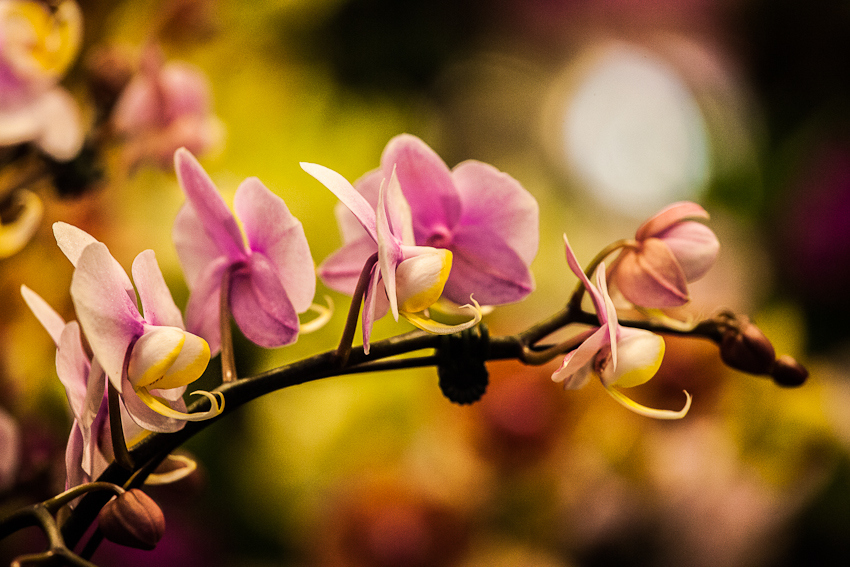
2. Shading and protection from the sun still play the leading role. Autumn climate varies the most; it can be said that early autumn is like summer, and late autumn is like winter. The weather in early autumn is still mainly hot and high-temperature, and on clear days it is no different from summer; sometimes the temperature is even higher than in summer, so the work of shading and protecting from the sun must be done carefully.
3. Prevent disease and eliminate pests to prevent scorched tips (scorched leaf tips). Autumn is also a season with a high incidence of orchid pests and diseases, and the damage is much greater (higher) than in summer, so preventing and controlling orchid pests and diseases in autumn is the top priority in the whole process of orchid cultivation. With the slightest carelessness, once disease occurs, the orchid grass will develop scorched tips (scorched leaf tips), and in severe cases, the fruits of a bumper harvest will vanish like smoke, and a whole year of effort will be washed away. Therefore, pest and disease prevention and control must be carried out every few days. Particularly for diseases, even more attention must be paid.
4. Water at the right time and prevent both dryness and excessive moisture. When the autumn wind rises and dust flies, this shows that the autumn climate is mainly dry, so at this time the surface of the orchid pot dries very quickly. Especially for orchids grown in clay pots and with large-particle planting material, you must water at the right time to prevent dehydration and drying out, but for robust large plants, you can control water to promote flowering; while orchids grown in cinnabar flower pots and plastic flower pots, etc., must be prevented from becoming too wet and suffering heat damage and root rot, and special attention should be paid to orchid pots with fine planting material and poor breathability. At this time, watering and shading for orchids are very important. If the water does not penetrate and does not reach the right place, it will cause orchid roots to dry up and die; if too much water is given, the new orchid roots will suffer pathological changes from the heat, causing incalculable losses.
How to grow orchids: tips and precautions for cultivating orchids
Orchids are a kind of green plant with particularly high ornamental value. Many people want to keep them at home, but people do not know much about how to cultivate them, and they know even less about what to pay attention to when cultivating orchids. Today, the editor will specifically introduce these issues for everyone, so that everyone can easily understand how orchids should be grown.
How to grow orchids1. Choose suitable soil
Usually, the choice of soil for cultivating orchids is very important. They like fertile soil. Normally, you can choose leaf mold soil mainly composed of humus or mountain forest humus soil. In addition, you can also buy special orchid mud from the market, then add an appropriate amount of vermiculite and perlite, and mix them into a nutrient soil that is loose, airy and permeable.
2. Temperature and light
When cultivating orchids, temperature and light are two very important conditions. Normally, they like to grow in a warm environment. When the external temperature is around 20 degrees, they grow fastest. When the external temperature drops below 10 degrees, they stop growing. In addition, orchids are shade-loving plants, so in spring, summer and autumn they must be placed in a cool environment. Especially in summer, they must never be placed on a south-facing windowsill exposed to the sun, otherwise their leaves will be scorched by strong light.
Precautions for cultivating orchids1. Pruning
When cultivating orchids, you must pay attention to pruning. Especially when orchids develop old leaves and yellow leaves, they need to be cut off as soon as possible. Only in this way can new leaves be promoted to grow, and it can improve air circulation and reduce the occurrence of disease. However, when pruning orchids, special attention must also be paid: the scissors used for pruning must be disinfected in advance to prevent infection.
2. Repot on time
When cultivating orchids, you must also pay attention to repotting on time. Orchids grow slowly at first, but later they grow faster and their root systems become well developed, so they must be repotted once a year. When repotting, you can put some tile pieces at the bottom of the flower pot, then add culture soil. After planting the orchid into the flower pot, water thoroughly, and compact the nutrient soil in the flower pot.
How to cultivate orchids in winter
Orchid (scientific name: Cymbidium ssp.): epiphytic or terrestrial herb, with several to many leaves, usually growing at the base of the pseudobulb or on the lower nodes, in two rows, ribbon-shaped or rarely oblanceolate to narrowly elliptic, generally with a broad sheath at the base that wraps around the pseudobulb, and with a joint. Raceme with several to many flowers, with colors including white, pure white, white-green, yellow-green, pale yellow, pale yellow-brown, yellow, red, green and purple. Master the following ten essentials: First, master the correct time to move them indoors; second, spray disease- and pest-prevention medicine before moving them indoors; third, pay attention to preventing freezing; fourth, ventilate regularly; fifth, prevent the pot soil from becoming too dry; sixth, prevent the pot soil from becoming too wet; seventh, prevent coal gas; eighth, prevent overheating; ninth, prevent wet leaves; tenth, prevent water from being poured into the orchid crown.1. When cultivating orchids in winter, prevent freezing
The room where orchids overwinter can be a greenhouse (a glass room that can get sun during the day), an ordinary room or a plastic shed, but the minimum temperature must ensure that the orchids do not go below 1 degree to prevent frost injury. If it is below zero degrees, then it is harmful to any orchid, and under no circumstances should the orchid be allowed to freeze. When the weather is too cold, use an electric heater to raise the temperature.
2. When cultivating orchids in winter, prevent the flower pot soil from becoming too dry
In winter, orchids stop growing and their water requirement decreases. Because orchids have fleshy roots, generally cutting off water can keep them alive, but if the pot soil remains dry for a long time, it will cause healthy orchid roots to become hollow roots, and this will not be reflected on the orchid leaves for a while. If it is reflected on the orchid leaves, then the orchid roots have already been seriously damaged, and in severe cases they have already died of dryness. This problem often arises from a one-sided understanding of "do not keep wet in winter": when seeing the orchid soil dry, only moistening the edge of the pot, and when seeing the surface soil wet, thinking the orchid has been watered thoroughly, causing the orchid roots to dry out completely and die. The correct approach is "do not water until dry," and "when watering, water thoroughly." Orchid pots that are too dry can be placed in water to soak the pot thoroughly.
3. When cultivating orchids in winter, master the correct time to move them indoors
Our country is vast, and temperature differences within the same season are very large, so the time to move them indoors cannot be generalized. It should be decided according to local climate changes. I think that if it is spring orchid, you can choose to move it indoors the day before the weather forecast says freezing will occur the next day. Some people move them indoors when the temperature is below 10 degrees. I think this is not conducive to the development of flower buds. Moving them indoors too early will inevitably lead to fewer or even no flower buds the following autumn. Therefore, as long as the temperature is not below freezing, spring orchids should be given more low-temperature training from 10 degrees to 0 degrees. Under such temperatures, the tissues of the orchid can also become fuller and healthier, and the new shoots the following year will be strong and powerful.
4. When cultivating orchids in winter, ventilate regularly
In order to keep orchids from freezing, they also must not be kept for a long time in a place without ventilation and air circulation. This will cause the orchids to suffer cold damage, and by spring black spots are likely to appear on the orchid leaves. The correct method is to open windows and doors in time when the temperature is high, to promote air convection, but guard against cold northwest wind. Except in severe freezing weather, it is best to open windows for ventilation at noon.
5. When cultivating orchids in winter, spray disease- and pest-prevention medicine before moving them indoors
When the temperature is below 5 degrees, choose clear weather to spray once an 800-fold solution of Topsin or carbendazim. If there are scale insects, also spray once an insecticide such as cobalt oxynitrate, which can prevent diseases caused by the relatively high greenhouse temperature after being moved indoors.
Orchids stop growing in winter, but the quality of management during this period directly affects how well they grow the following year. Some people, due to improper winter management, cause freezing death, frost injury, hollow roots and black spot disease, and in severe cases even death. Therefore, every orchid grower must attach importance to winter care for orchids.