A Detailed Guide to Cyclamen Cultivation Techniques and Flowering Period Control Methods
[Cultivation] When the sown seedlings grow l true leaves, they should be transplanted. The small corms should be moved with soil into a sunken pot filled with growing medium. When transplanting, most of the corm should be buried in the soil, leaving only the top growing point exposed above the soil surface. After transplanting, water thoroughly; afterward, irrigation should not be excessive, and the pot soil should not be too wet - keeping the surface soil moist is best. After one month, loosen the soil, and apply nitrogen fertilizer once every two weeks. When fertilizing, be careful not to let manure water stick to the leaf surface, as this may cause leaf rot.
In January to February of the following year, when the seedlings have grown to 3-5 leaves, move them from the sunken pot into 3-inch pots; there is no need to place pot shards at the bottom. When planting, the top of the corm should be slightly exposed above the soil surface, and the pot soil need not be firmed. After planting, spray water twice to moisten the pot soil thoroughly; afterward, simply keep the surface soil moist. Apply nitrogen fertilizer once a week to make the leaves grow thick and plump.
In March to April, as the temperature warms, cyclamen produces more leaves, and it should be repotted into 5-inch pots, with the top of the corm exposed 1/30 above the soil surface. After repotting, spray water twice to moisten the pot soil thoroughly. At the same time, strengthen fertilizer and water management, applying nitrogen fertilizer once a week to promote lush plant growth. At the end of April, as the temperature rises, shade should be provided at noon when sunlight is strong, to prevent the leaves from being scorched and turning yellow. Later, as the temperature increases, the corm and leaves are extremely prone to rot, so attention must be paid to care and management. In May to June, the temperature rises further, and cyclamen must be removed from the greenhouse and placed on shelves under a rainproof shade canopy outdoors, so that it continues to grow in a cooler, more humid environment. In July to August, when the weather is muggy and hot, the corm is extremely prone to rot, and even greater attention must be paid to care and management: shade and ventilation are essential, and rain protection is even more necessary - the corm must by no means be exposed to rain, to prevent corm rot. Because summer temperatures are high, fertilizing can easily cause corm rot, so from the end of month B, fertilization should be stopped for two months. Wait until the Beginning of Autumn, when the temperature drops, before starting fertilization again.
In late October, move the plant indoors for care, and it flowers in November, meaning it can bloom about fifteen months after sowing. To make the flower buds abundant, provide sufficient sunlight during the bud stage, increase phosphorus fertilizer, and strengthen fertilizer and water management. When fertilizing, be careful not to submerge the top of the corm and cause rot. At the same time, if the leaves are too dense, they may be thinned appropriately, so that nutrients are concentrated and flowering is more abundant.
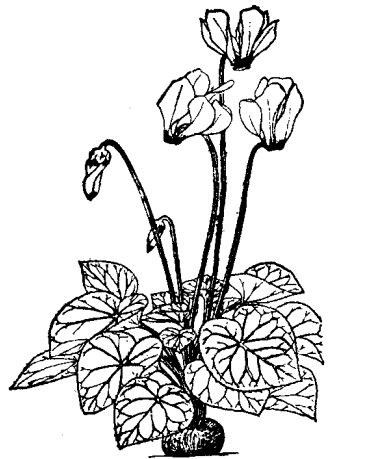
In May of the third year, as the temperature rises, the flowering cyclamen gradually withers and turns yellow, entering dormancy. At this point, reduce watering to bring it into a corm dormancy state. After the branches and leaves wither and the pot soil dries, tip the plant out of the pot, stop watering, and place it in a ventilated, shaded place, or keep it indoors in shade; however, the pot soil should not be allowed to dry out too much, otherwise the corm will shrivel and become useless.
For corms that have passed through summer dormancy, after the Beginning of Autumn, begin watering in small amounts to keep the pot soil moist, but not too wet, because at this time the roots and leaves of the old corm have not yet developed well. Only after October, when the weather turns cooler, should the yellow leaves be removed; if removed too early when the temperature is high, the wounded areas on the corm are prone to rot.
When the buds begin to sprout and grow, tip the old corm out of the pot, peel away the old soil around it, and replace it with new soil and repot it. When repotting the old corm, likewise expose 1/3 of the corm surface above the soil, and water thoroughly; afterward, simply keep the pot soil moist regularly. More than twenty days after repotting, loosen the soil once, and loosen it once more later; when loosening the soil, be careful not to damage the roots. After that, do not loosen the soil again, but strengthen fertilizer and water management, applying nitrogen fertilizer once a week.
How is cyclamen cultivated? Cyclamen cultivation techniques
Cyclamen flowers are brilliant and dazzling, and are deeply loved by many friends. So how is cyclamen cultivated? Below, I will introduce cyclamen cultivation techniques to everyone.
Cyclamen cultivation methods:
Cyclamen can be propagated by sowing, dividing the corm, and tissue culture, but in production, seed propagation is mainly used. Sowing is usually carried out from September to November. The substrate used for sowing can be perlite, vermiculite B, coal cinder, sawdust, and other soilless cultivation substrates. Before sowing, the seeds and substrate need to be disinfected; the substrate can be sterilized by high temperature or chemicals, and the seeds should be soaked in warm water at 30-4013 for 1 day and night. If the seeds carry viruses, they also need virus elimination treatment. When sowing, rub and wash the seed coat clean, sow them at a spacing of 1.5-2 cm in a shallow pot or sowing bed, cover with substrate about 0.5-0.7 cm thick, water thoroughly, and keep the substrate moist.
At a temperature of 20-25C, roots can form in about 20d, and germination occurs in about 1 month, with cotyledons growing out. At this time, the young seedlings can be exposed to light to facilitate photosynthesis. When more than 75% of the seedlings have emerged, apply nutrient solution once every 10d, with a nitrogen, phosphorus, and potassium ratio of 1:1:10. When the seedlings have grown 2-4 true leaves, carry out the first seedling separation (usually in March to April), moving the small seedlings into flower pots with a diameter of 10 cm; after the seedlings recover, enter normal care and management. Dividing the corm is done when the dormant corm sprouts new buds (about September to October), cutting the corm into several portions according to the number of bud clusters, with each cut portion having buds; coat the cut surfaces with plant ash or sulfur powder, place them in a cool place to dry the cuts, and then cultivate them as new plants.
Cyclamen soilless cultivation techniques:
Cyclamen soilless cultivation is mainly substrate pot culture. The cultivation substrate can be vermiculite, peat, furnace slag, sawdust, sand, carbonized rice husk, etc., mixed in different proportions, such as vermiculite:sawdust:sand at 4:4:2 or Shanghai slag:peat:carbonized rice husk at 3:4:3. At the seedling stage, clay pots are preferable, with 3-4 cm thick coarse coal cinder placed at the bottom of the pot and mixed substrate used above. Operate carefully when planting seedlings, taking care not to damage the root system; after spreading out the fibrous roots, add substrate, press lightly, expose 1/3 of the corm, and water thoroughly with nutrient solution (diluted 3-5 times).
Cyclamen likes fertilizer, but fertilization must be uniform. Normally, apply nutrient solution once a week, and spray clear water once every 2-3d according to weather conditions. Because the substrate is loose and breathable and retains water and fertilizer, it can meet the various needs of small seedling growth. Ten leaves is an important stage for cyclamen, generally appearing in May to June, when it enters a stage of simultaneous vegetative growth and reproductive growth. In cool regions, the second transplanting can be carried out at this time, planting into plastic pots, ceramic pots, or porcelain pots with a diameter of 15 cm, using the same method as before. In summer, pay attention to cooling and ventilation, preserve existing leaves, and control fertilizer and water to prevent excessive plant growth. In addition, pay attention to disease and pest prevention, and spray fungicides and insecticides such as carbendazim, thiophanate, dimethoate, and dichlorvos.
At the end of August, as the weather gradually cools, cyclamen gradually resumes growth and grows many new leaves. At this time, pay attention to strengthening light and fertilization, apply nutrient solution once a week at normal concentration, and spray a 0.5% potassium dihydrogen phosphate solution on the leaves about every 10d. Entering October to November, leaf growth slows, flower bud development clearly accelerates, and the plant enters the flowering period. At this time, the suitable conditions are light of 24,000-40,000 1x, temperature of 12-20C, and humidity of about 60%. Temperature is the main means of controlling the flowering period; generally, under a temperature of 10°C, the flowering period can be delayed by 20-40d. Gray mold is prone to occur during the flowering period, so ventilation and chemical control should be strengthened.
The above is an introduction to cyclamen cultivation techniques. Friends who like growing cyclamen can refer to these techniques and carry out scientific cultivation according to actual conditions.
How should cyclamen be cultivated and managed?
Cyclamen (Cyclamen persicum Mill.), also known as radish begonia, rabbit ear flower, rabbit flower, first-grade crown, bonfire flower, and turned-petal lotus, is a perennial herbaceous plant in the Primulaceae family and Cyclamen genus. The leaves grow from the top of the corm and are heart-shaped, ovate, or kidney-shaped; the leaves have fine serrations, the leaf surface is green with white or gray halo spots, the leaf underside is green or dark red, and the petiole is relatively long and reddish-brown. Cyclamen is a commonly grown fresh flower, suitable for planting in indoor flower pots, and in winter it needs greenhouse cultivation. Some cultivated varieties of cyclamen have a rich fragrance, while others have a faint fragrance or no fragrance. Cyclamen is native to southern Europe and the Mediterranean region, including Greece, Tunisia, and Syria. It is a semi-hardy bulbous flower and likes a warm and humid climate, fearing both intense summer heat and severe cold. Autumn, winter, and spring are the growing seasons, while it is the dormant period; it should be placed in a ventilated, cool place, and water should often be sprayed around it to lower the temperature so that the small corm does not enter dormancy, which is beneficial for flowering in winter and spring. The most suitable growth temperature for cyclamen is 15-20°C, and in winter it needs to be cared for in a greenhouse.Cyclamen is suitable for growing in acidic sandy soil rich in humus. In daily management, note that watering should not be excessive; simply keep the pot soil moist regularly. When spraying water on the leaf surface, do not spray water onto the flowers; if it is too dry, the plant will become wilted and listless. Cyclamen relatively likes fertilizer, but thin fertilizer should be applied frequently, generally once a week, and the fertilizer water must not touch the leaves. When the flower stalks emerge, apply an additional dose of bone meal or superphosphate. During the flowering period, fertilization should be stopped and watering controlled.