Detailed Explanation of Zephyranthes Candida Cultivation Techniques and Origin Distribution
[Aliases]Zephyranthes candida, jade curtain, white-flowered iris lily.
[Family and genus]Amaryllidaceae, Zephyranthes.
[Morphology]Perennial evergreen herb, with a small bulb that has a slender neck, plant height 15-20 cm. Leaves basal, linear, slightly fleshy, dark green. The scape is hollow, 10--25 cm tall, enclosed within a brownish-red membranous bract, emerging from one side of the leaf cluster; flowers solitary, white or slightly purplish-red tinged on the outside, tepals 6, elliptic-lanceolate, without a tube; flower diameter 3--4 cm. Flowering from late July to early November. Capsule triangular-globose, dehiscing loculicidally when mature.
[Origin and distribution]Native to South America.
[Habits]Prefers full sunlight, well-drained, fertile and slightly clayey soil, and also tolerates semi-shade and low-humidity environments. It is cold-tolerant, and can overwinter outdoors in the Shanghai and Hangzhou areas.
[Propagation]Divide and plant offset bulbs in spring, preferably 3-4 bulbs per hole.
[Cultivation]Grows vigorously, easy and rough management; after planting in one spot, it can be dug up and divided once every few years, without much additional management.
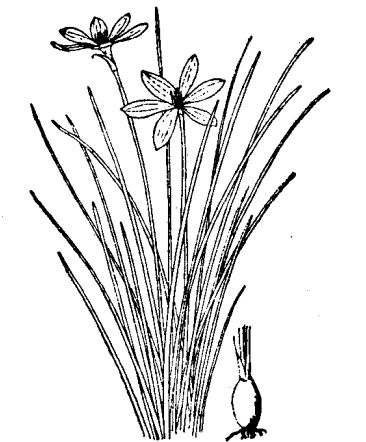
[Uses]The plant clumps are low and neat, with abundant flowers and a very long flowering period; it is very vigorous, best suited as ground cover under trees, on slopes, and other such sites, and is also often used as edging material for flower beds, flower borders, and roadsides, or grown in pots for ornamental viewing.
[Appendix: Other flowers of the same genus]Zephyranthes grandiflora Lindl.: also known as red jade curtain, iris lily, rain flower. Bulb round, slightly larger than the former species. Leaves flat and linear. Bracts red, flowers funnel-shaped, with a distinct tube, tepals obovate, pink or rose-red; flowers also larger than the former species, diameter 5-7 cm. Flowering from mid-June to late September. Native to Mexico, Cuba, and other places. Habits, cultivation management, and so on are all the same as Zephyranthes candida. Only its cold tolerance is slightly poorer; in Shanghai, except in places with a good microclimate, overwintering outdoors is difficult.
Cultivation of Zephyranthes Candida
Scientific name: Zephyranthes Candida Aliases: Zephyranthes candida, jade curtain, white-flowered iris lily Origin: South America Morphological characteristics: Perennial evergreen herb. Has a small bulb with a slender neck. Leaves basal, linear, slightly fleshy, bright green. The flower stem emerges from one side of the leaf cluster, bearing 1 terminal flower. White or slightly purplish-red tinged on the outside. Seeds black, flat. Flowering from July to November. Biological characteristics: Amaryllidaceae, Zephyranthes. Prefers warmth, humidity, and light, and also tolerates semi-shade and low humidity. Requires well-drained, fertile, and slightly clayey soil. Propagation: Zephyranthes candida is mainly propagated by bulb division and sowing. Division: carried out in spring, planting 3-4 bulbs per hole. Sowing: in spring, scatter seeds collected in the previous summer and autumn onto a seedbed; they germinate in 20 days, with a relatively high germination rate. Cultivation: planting density is 60-90 plants per sq m. Prefers warmth, humidity, and sufficient sunlight, and also tolerates semi-shade and moisture. Requires well-drained, fertile, and slightly clayey soil. Zephyranthes candida grows vigorously and requires rough maintenance and management. After several years of planting, it can be dug up and divided to promote growth and propagation. Decayed leaves can be applied as base fertilizer, and liquid fertilizer can be applied once every half month. During the peak growth period, water and topdress according to the plant's condition as appropriate. Zephyranthes candida prefers sufficient sunlight, and the quality of bulbs obtained in shaded environments is poorer. Just maintain appropriate ventilation in the environment. The suitable growth temperature for Zephyranthes candida is 16-28°C; it is not cold-tolerant, and the overwintering temperature should not be lower than 5°C. In cold regions, the bulbs cannot overwinter outdoors; before winter, the bulbs should be harvested, slightly dried, mixed with moist fine sand, and stored in a cellar. After several years of cultivation, they should be replanted to promote robust growth. During the peak growth season, water and topdress according to growth as appropriate. In winter, the bulbs can be dug up and stored. Maintenance and management are relatively rough. Zephyranthes candida can also be grown in a water tank, producing bright leaves. Entering August, the plant height has already reached more than 30 cm, at which time dozens of flower stems can be produced, and by late September, white flowers bloom. What is praiseworthy is that these flowers are all located below the water surface, and through the bright water body, they set off the crystalline white Zephyranthes candida flowers at varying heights. The specific method for water-growing Zephyranthes candida is: prepare several glass fish tanks 90 cm long, 50 cm high, and 35 cm wide. In early April, in white plastic bags or shallow porcelain pots of a long or round shape, 4 cm to 5 cm high, filled with soil, place full Zephyranthes candida bulbs at a spacing of 2 cm to 3 cm, with the roots spread out, press the roots down with clay, fill soil until level with the upper part of the bulbs, gently compact the soil, cover the surface with a 0.5 cm layer of coarse sand, and finally separate the bulbs with pebbles. After planting, sink the pot into a water tank or pool, gently sway it left and right, rinse off the floating mud adhering to the surface, and then place it into a fish tank already filled with water. The water in the fish tank should not be too full; 4/5 of the tank height is suitable. To add interest, some small tropical fish can also be kept in the tank.
.
Key points for the cultivation and management of Zephyranthes Candida
Many friends may think it is an orchid (detailed introduction) just from hearing the name Zephyranthes candida, but in fact Zephyranthes candida is a perennial herb of the Amaryllidaceae family and is completely unrelated to the Orchidaceae. Zephyranthes candida is very common in our daily lives, and they are often seen in flower beds and along roadsides.
Zephyranthes Candida
Zephyranthes candida is mostly used as ground cover, or in flower beds, flower borders, and under trees, and is also grown in pots with rough cultivation management. Zephyranthes candida prefers fertile soil and tolerates semi-shade or low-temperature environments. It is mainly propagated by division and sowing, but to achieve flowering in the second half of the year when planted in spring, dividing and planting bulbs is the most reliable. Zephyranthes candida divides its bulbs naturally very easily, and division propagation is easy; in the Huang-Huai region, attention should be paid to appropriate cold protection in winter.
During the growth period, Zephyranthes candida should be watered sufficiently, and the potting soil should be kept moist often, but not waterlogged. In dry weather, water should also be sprayed on the leaf surface frequently to increase air humidity, otherwise the leaf tips tend to turn yellow and wither. It has a relatively high demand for fertilizer and water, but it is most afraid of indiscriminate fertilization, concentrated fertilizer, and one-sided application of nitrogen, phosphorus, and potassium fertilizers. It is required to follow the two principles of fertilization and watering: "small amounts and frequent applications, dilute fertilizer applied frequently, complete nutrition" and "alternate dry and wet, when dry it should be thoroughly dry, do not water if not dry, and water thoroughly when watering." After fertilizing, keep the leaves and flowers dry at night.
In cold regions, the bulbs cannot overwinter outdoors; before winter, the bulbs should be harvested, slightly dried, mixed with moist fine sand, and stored in a cellar. After several years of cultivation, they should be replanted to promote robust growth. During the peak growth season, water and topdress according to growth as appropriate. In winter, the bulbs can be dug up and stored. Maintenance and management are relatively rough. Zephyranthes candida can also be grown in a water tank, producing bright leaves. Entering August, the plant height has already reached more than 30 cm, at which time dozens of flower stems can be produced, and by late September, white flowers bloom.