What are the methods for growing and caring for plum blossoms at home?
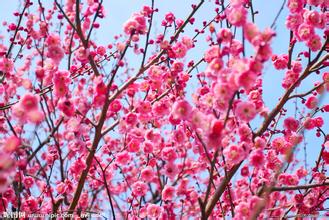
Plum blossom, also known as dry-branch plum, spring plum, red plum, green plum, etc. It likes an environment with ample sunlight, warmth and humidity, and good ventilation. Its cold resistance is fairly strong, but it cannot tolerate low temperatures below -15°C. It is not tolerant of waterlogging and dislikes standing water. It tolerates poor soil and grows well in fertile, loose, neutral or slightly acidic soil rich in humus. It generally blooms when the temperature reaches 6-7°C. Propagation is mainly by grafting, and layering, cuttings, and seed sowing can also be used.
Growing methods: Plum seedlings successfully propagated by grafting are potted in late autumn. For the potting soil, mix 1 part garden soil, 1 part coarse sand, and half a part decomposed cake fertilizer evenly, or mix 4 parts leaf mold, 4 parts compost soil, and 2 parts sandy soil evenly. Place broken tiles at the bottom of the pot to aid drainage. When potting, plant the plum seedling with a small soil ball in the pot. After planting, water thoroughly and place in a sunny, ventilated spot. If placed in shade, it will grow poorly. During the growing period, watering must be controlled in amount; both excessive moisture and excessive dryness will affect root growth, causing leaf drop and poor flower bud development. Water according to whether the potting soil is dry or moist: do not water when it is not dry, and water thoroughly when you do, but prevent standing water. During the growing period, if leaves turn yellow due to iron deficiency, apply a 0.1% ferrous sulfate solution along with watering.
Watering in summer is key: water once in the morning and once in the evening, and spray water on the plant and the ground to raise air humidity. By the end of June, when new branches grow to 20-25 cm, proper “water withholding” is needed (that is, not watering); when the young tips begin to wilt, then water 60-70% of the usual amount. In autumn, the amount of watering gradually decreases, generally watering thoroughly once every 2-3 days to help it overwinter. In winter, watering is strictly controlled. Fertilization during the growing period: in April and May, apply decomposed diluted cake fertilizer water once a month to promote lush branches and leaves; from late June to early July, apply superphosphate and potassium chloride to promote flower bud formation; in early August, apply phosphate fertilizer to promote plump flower buds; in early September, spray 0.1%-0.2% monopotassium phosphate 2-3 times to encourage abundant blooms and vivid color.
In early [month], when the plum blossoms are about to open, apply a quick-acting fertilizer once to promote blooming. After each fertilization, be sure to water and loosen the soil in time, so that the potting soil is loose and the roots can develop well. Pruning is usually done after flowering. For strong-growing or young trees, prune lightly; for weak-growing trees or old plum stumps, prune heavily. Strong branches should be pruned lightly, weak branches heavily; and diseased, pest-damaged, leggy, weak, and dead branches should be cut off at any time. Properly thin out the main and side branches that have already flowered, then shorten the side branches on the main branches after leaving 2-3 buds, and shorten long branches after leaving 5-6 buds. Generally leave 3-5 main branches per plant, so that length, height, and density are well balanced.
How to grow plum blossoms: growing methods for plum blossoms
Plum blossoms have a cultivation history of more than 3000 years in China and are plants with great ornamental value and cultural symbolism. How do you grow plum blossoms? Today I will tell you about the growing methods for plum blossoms.
1. Planting: In the south, it can be planted in the ground; in the Yellow River basin, cold-hardy varieties can also be planted in the ground, but in cold northern regions they should be grown in pots and overwintered indoors. Planting can be done from after leaf drop to before bud break in spring. To increase the survival rate, avoid damaging the root system and transplant with a soil ball. For ground planting, choose a spot sheltered from wind and facing the sun. For potted planting, use a growing medium evenly mixed from 3 parts leaf mold, 3 parts garden soil, 2 parts river sand, and 2 parts decomposed barnyard manure. After planting, water thoroughly once. Keep it in a shaded place for care, and after it resumes growth, move it into sunlight for normal management.
2. Light and temperature: It likes warmth and ample sunlight. Except for apricot plum varieties, which can tolerate low temperatures of -25°C, it generally tolerates low temperatures of -10°C. It tolerates high temperatures and can still grow at 40°C. It grows and develops best in areas with an annual average temperature of 16-23°C. It is very sensitive to temperature and blooms in early spring when the average temperature reaches -5-7°C.
3. Watering and fertilizing: During the growing period, pay attention to watering and keep the potting soil often moist with a tendency toward dryness. It should neither have standing water nor be too wet or too dry. Follow the principle of watering when dry and stopping when moist. Generally, water less on cloudy days and when the temperature is low, and more otherwise. In summer, water 2 times a day; in spring and autumn, water once a day; in winter, water thoroughly only after the soil has dried out. Fertilization should also be reasonable. Apply base fertilizer well before planting, and mix in a small amount of monopotassium phosphate. Apply monopotassium phosphate once more before flowering, and apply decomposed cake fertilizer once at flowering to supplement nutrients. In June, a compound fertilizer can also be applied once to promote flower bud differentiation. After leaf drop in autumn, apply an organic fertilizer once, such as decomposed manure.
4. Shaping and pruning: For ground-planted plum blossoms, shaping and pruning can be done within 20 days after flowering. Focus on a natural tree shape, cutting off crossing branches, upright branches, dry branches, overly dense branches, etc., and shorten side branches to promote abundant flowers and lush leaves. Potted plum blossoms should be heavily pruned after potting to lay the foundation for making bonsai. Usually plum stumps are used as the scenic form, grafted with plum blossoms of various shapes. Maintain a certain temperature, and plum blossoms can be seen in full bloom during the Spring Festival. If you want them to bloom during "May Day", keep them at 0-5°C in a moist environment, move them outdoors in early April, and care for them in a place with ample sunlight and good ventilation, and they can bloom around "May Day".
5. Flowering control: Potted plum blossoms are generally for home viewing. In winter, after leaf drop, place them indoors and keep the temperature at 0-5°C. After New Year's Day, gradually raise the temperature to 5-10°C, provide full sunlight every day, and frequently spray water on the branches; the water temperature should be close to room temperature.
More informationIs crown of thorns poisonous? Is crown of thorns suitable for keeping at home? / Poisonous / Keeping it at home has advantages and disadvantages
Crown of thorns is a highly ornamental flower with relatively vivid colors, so many people want to grow one at home. However, there is one thing everyone should note: if you want to grow a plant at home, you first need to know whether it is poisonous. Regarding questions such as whether crown of thorns is poisonous and whether it is suitable for keeping at home, the editor below will help you understand.
1. Is crown of thorns poisonous? / Poisonous
As for the question of whether crown of thorns is poisonous, the answer is that it does have a certain toxicity. Crown of thorns is a plant with a strong self-protection ability. When it is disturbed by pests, it secretes some toxic white sap from the wound, and this sap can stick to pests and prevent them from moving.
Although the sap is secreted for self-protection, it still has a certain effect on the human body, especially a strong irritating effect on the skin. If this sap is accidentally ingested, it can even cause dizziness and vomiting, so everyone should pay attention to this.
2. Is it poisonous to put crown of thorns in the bedroom? / It has a certain toxicity
Although crown of thorns secretes toxic substances when it enters self-protection mode, as long as it is cared for properly this phenomenon generally does not occur. Also, among ornamental flowers, many have a certain toxicity, but the harm to people is not great, so everyone can analyze this issue from a rational perspective.
3. Is crown of thorns suitable for keeping at home? / There are advantages and disadvantages
As for the question of whether crown of thorns is suitable for keeping at home, it can actually be said that there are both advantages and disadvantages. Although it has a certain toxicity, it also has many benefits for people. It depends on how you think about it.
1. Disadvantages
In the text above, the editor also mentioned that this plant has a certain toxicity, and this is the only disadvantage of keeping it at home. Although it does not occur often, there is still a certain chance of it happening, so it depends on how you choose.
2. Benefits
After discussing the disadvantages, keeping crown of thorns at home also has many benefits. The main one is its ornamental value. Of course, besides that, it also has many uses. In the article on the effects and functions of crown of thorns, this aspect is introduced in detail, and interested friends can learn about it.