How to grow Nicotiana alata? Detailed guide to cultivation methods and precautions
Nicotiana alata
Scientific name: nicotiana alata
Aliases: Jasmine tobacco, long-flowered tobacco, large-flowered tobacco
Morphological characteristics: Biennial herb, plant height 60-90 cm, the whole plant densely covered with glandular hairs. Stem erect, leaves alternate, lanceolate or long elliptic. Loose raceme terminal, corolla salverform, five-pointed star shaped. Flower colors include white, pale yellow, peach red, purplish red, etc., opening at night and on cloudy days, closing at noon on sunny days.
Ecological habits: Sun-loving, not cold-tolerant.
Flowering period and flower language: June to September. Giving up, regret.
Landscape use: Long flowering period, bright flower colors, an excellent flower for summer landscapes. Flower beds, flower borders, forest edges, roadsides, potted plants.
Species identification: Tobacco n.tabacun, annual herb, plant erect and tall, limited cyme, flowers yellow-green before opening, then turning pale red to deep red. Tobacco is a model plant in biological experiments, and its leaves are the raw material for making cigarettes.
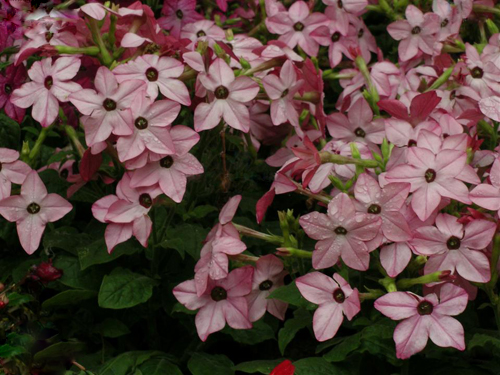
Nicotiana alata
Scientific name: Nicotiana alata
Aliases: Jasmine tobacco, long-flowered tobacco, large-flowered tobacco
Morphological characteristics: Annual or biennial herb, plant height 60-90 cm, the whole plant densely covered with glandular hairs. Stem erect, leaves alternate, lanceolate or long elliptic. Loose raceme terminal, corolla salverform, five-pointed star shaped. Flower colors include white, pale yellow, peach red, purplish red, etc., opening at night and on cloudy days, closing at noon on sunny days.
Ecological habits: Sun-loving, not cold-tolerant.
Flowering period and flower language: June to September. Giving up, regret.
Landscape use: Long flowering period, bright flower colors, an excellent
flower for summer landscapes. Flower beds, flower borders, forest edges, roadsides, potted plants.
Species identification: Tobacco N.tabacun, annual herb, plant erect and tall, limited cyme, flowers yellow-green before opening, then turning pale red to deep red. Tobacco is a model plant in biological experiments, and its leaves are the raw material for making cigarettes.
Nicotiana alata Link et Otto Nicotiana alata illustrated guide: How to grow Nicotiana alata / How to propagate Nicotiana alata
Nicotiana alata profileNicotiana alata Link et Otto
Cultivation methods and precautions for Nicotiana alata Introduction to Nicotiana alata
Nicotiana alata, Latin scientific name Nicotiana alata Link et Otto, aliases Jasmine tobacco, long-flowered tobacco, large-flowered tobacco. A tender perennial herb, 0.6-1.5 m tall, the whole plant covered with sticky hairs. Prefers a warm, sunny environment. Native to Argentina and Brazil, cultivated in many places in China. Has certain ornamental value.
Nicotiana alata is an annual or biennial herb about 80-150 cm tall, the whole plant densely covered with glandular hairs. Stem erect, base woody, leaves alternate, lanceolate or long elliptic. Native to South America, prefers a warm, sunny environment and fertile, loose soil, drought-tolerant, not cold-tolerant.
Morphological characteristics of Nicotiana alata
Nicotiana alata is a tender perennial herb, 0.6-1.5 m tall, the whole plant covered with sticky hairs.
The leaves of Nicotiana alata are spatulate or oblong in the lower part of the stem, base slightly clasping or with winged petiole, becoming ovate or ovate-oblong upward, nearly sessile or with auricles at the base, becoming lanceolate near the inflorescence. Stem erect, base woody, leaves alternate, lanceolate or long elliptic.
The inflorescence is pseudoracemose, loosely bearing several flowers; pedicels 5-20 mm long. Calyx cup-shaped or campanulate, 15-25 mm long, lobes subulate-acicular, unequal in length; corolla pale green, tube 5-10 cm long, tube diameter about 3-4 mm, throat diameter about 6-8 mm, limb 15-25 mm wide, lobes ovate, mucronate, 2 of them longer than the other 3; stamens unequal in length, 1 of them shorter. Capsule ovoid-globose, 12-17 mm long.
Loose raceme terminal, flowers 30 cm long, about 5 cm in diameter, flower trumpet-shaped, corolla round-star shaped, with a small round hole in the center, concealing the pistil and stamens inside. Florets open gradually upward along the stem, flower colors include white, pale yellow, peach red, purplish red, etc., the outside of the flower purplish red, the inside white, opening at night and on cloudy days, closing at noon on sunny days. Flowering period April to October.
Nicotiana alata seeds are about 0.7 mm long, grayish brown.
Ecological habits of Nicotiana alata
Nicotiana alata prefers a warm, sunny environment and fertile, loose soil, drought-tolerant, not cold-tolerant. Prefers a warm, sunny environment, not cold-tolerant, relatively heat-tolerant.
Sunlight must be sufficient; insufficient sunlight makes plants prone to leggy growth, with loose flowering and pale, unattractive colors. After transplanting and establishment, pinch once to encourage more branching. During the plum rain season, guard against prolonged moisture; the optimum growing temperature is about 10-25 degrees.
For cultivating Nicotiana alata, soil rich in organic matter, sandy loam is best, drainage must be good; poor drainage easily causes root rot. Prefers fertile, deep, well-drained soil.
Cultivation techniques for Nicotiana alata Seedling raising of Nicotiana alata
Nicotiana alata seeds are relatively small, about 11,500 seeds per gram; domestic Chinese producers generally use pelleted seeds. The seedling substrate should be imported peat with good moisture retention and good aeration, with a pH value of 5.5-5.8; the substrate must be saturated with moisture before sowing.
Seedling raising is divided into 4 stages according to seedling growth performance:
Stage one
Radicle germination stage, from after sowing until the root is 0.6 cm long and the cotyledons begin to grow. Keep soil temperature at 24°C-26°C, keep the substrate moderately moist, that is, evenly moist but not saturated; drying is not allowed at any time during this stage. After sowing, the seeds must not be covered with soil; light of 1100-4300 lux helps Nicotiana alata seeds germinate; using large-size plug trays helps root development; under good conditions, young roots appear in 3-5 days. At the end of this stage, the radicle has elongated and the root system is forming.
Stage two
Stem and cotyledons grow, from the end of stage one until the root is 1.2-1.4 cm long and the cotyledons have grown. Lower the soil temperature, maintaining 20°C-24°C, and adjust light to 5400-13000 lux. Once the cotyledons unfold, apply 50-75 ppm of 14-0-14 slow-release fertilizer weekly; after the seedling roots penetrate the substrate, allow the soil to dry and wet alternately, but avoid dryness, otherwise the seedlings will stop growing. This stage generally lasts 7-10 days.
Stage three
Roots penetrate deep into the plug tray, reaching 2.5 cm, and 2-3 true leaves appear. The focus of this stage should be on watering and fertilization management, so that Nicotiana alata develops a well-developed root system. Carry out one dry-wet cycle every 24 hours, increase the fertilization concentration, generally applying 100-150 ppm nitrogen fertilizer once a week; fertilizers can be 20-10-20 and 14-0-14 used alternately. Soil temperature can gradually be lowered, maintaining 18°C-21°C; during this stage keep light at 13000-16000 lux; B9 can be used to control plant shape. This stage generally lasts 4-6 weeks in a 200-cell plug tray.
Stage four
In the later part of this stage, the well-developed root system occupies the entire plug cell, and the flower stem should have 3-4 leaves. The focus of this stage is still watering and fertilization management. Soil temperature must be maintained at 16°C-17°C, and light can rise to 16000-38000 lux. Fertilization is the same as stage three, but in the later part of this stage, 7-10 days before potting, reduce watering and fertilization to properly harden the seedlings.
Potted flower production of Nicotiana alata
Nicotiana alata prefers to grow in fertile, well-drained soil. Nicotiana alata must be potted promptly, otherwise it will cause severe root binding and plant aging. To ensure smooth growth, the substrate should be as permeable and aerated as possible and retain fertilizer, with a soil pH value of 5.5-5.8; in production, a mixed substrate with a pH value of 6.0 can be used. Soil temperature at this stage is very important; for newly transplanted seedlings, the daytime temperature should be 18°C-21°C, and the nighttime temperature should be 16°C-18°C. Too low a temperature causes albino seedlings, and a sharp temperature rise causes leaf scorch, and in severe cases leads to the death of some seedlings. The first watering after transplanting must soak through, otherwise it will affect the seedling survival rate and the uniformity of later potted flower growth. The seedling stage of Nicotiana alata is crucial, and its later growth is also very important.
The growth period is simply divided into two stages:
Stage one
Vegetative growth stage; this stage is mainly the vigorous branching period and plant formation period of Nicotiana alata, and the quality of conditions directly affects later growth. Keep the substrate alternately dry and wet to promote normal root growth; this stage has a large demand for fertilizer, so to promote vegetative growth, watering and fertilization are carried out alternately, with 20-10-20 and 15-0-15 slow-release fertilizers used alternately at 150-200 ppm. Sufficient fertilizer supply and light conditions are the key to this stage. Under good conditions, the vegetative body is fully formed in 20-25 days, with a small amount of flowers formed but not yet reaching the desired effect.
Stage two
Reproductive growth stage; this stage is mainly to promote the mass formation of flowers to achieve the desired effect. In this stage, besides still keeping the substrate alternately dry and wet, the regulation of light and fertilizer is still key. To promote increased flower quantity, this stage requires fertilizers mainly of P and K; 10-30-20 and 20-10-20 slow-release fertilizers can be applied alternately at a concentration of 150 ppm once or twice a week. For products marketed from September to February of the following year, the light duration must be extended while fertilizing; if 10 hours cannot be achieved in production, light interruption can be used to promote flowering. However, some varieties such as 'Domino' and 'Hummingbird' can flower without long-day treatment, so production can also save costs by selecting varieties.
Propagation methods of Nicotiana alata
Nicotiana alata is commonly propagated by sowing or division.
Nicotiana alata seeds are relatively small, about 11,500 seeds per gram; domestic producers now generally use pelleted seeds. The seedling substrate should be imported peat with good moisture retention and good aeration, with a pH value of 5.5-5.8; the substrate must be saturated with moisture before sowing. Seedling raising is divided into 4 stages according to seedling growth performance:
Sowing and transplanting
Nicotiana alata grows slowly at the seedling stage; it is easy to sow in January-February. Scatter the seeds evenly on the soil surface; the seeds are light-loving and must not be covered with soil, and should receive sufficient light. Water to maintain moisture, then cover the soil surface with a piece of transparent plastic film. Transplant and cultivate when the seedlings have 4-6 true leaves.
Cultivation methods and care of Nicotiana alata
Nicotiana alata grows slowly at the seedling stage; it is easy to sow in January-February and plant out in flower pots or garden beds in early spring. The care process is relatively extensive and simple. After the beginning of spring, apply effective fertilizer several times, which not only improves growth but also promotes flowering. Because the flowering period is long and the flower colors are bright.
Cultivation management
The cultivation soil is best as sandy loam rich in organic matter, and drainage must be good; poor drainage easily causes root rot. Sunlight must be sufficient; insufficient sunlight makes plants prone to leggy growth, with loose flowering and pale, unattractive colors. After transplanting and establishment, pinch once to encourage more branching. During the plum rain season, guard against prolonged moisture; the optimum growing temperature is about 10-25 degrees C. The care process is relatively extensive and simple. After the beginning of spring, apply effective fertilizer several times, which not only improves growth but also promotes flowering. Because the flowering period is long and the flower colors are bright, it is very suitable for both ground planting and potted planting.
Cultivation data
Number of seeds per gram (seeds/gram): 11,500 seeds/gram; germination conditions: 21-25°C, no soil covering; days required for germination: 10-15 days; optimum growth temperature (day temperature/night temperature): 15-17°C; light requirement and other growth conditions: partial shade or partial light; time required from sowing to flowering (or harvest): 9-10 weeks; ground planting height (cm): 40-45 cm.
Disease control of Nicotiana alata
Diseases in the late growth stage of Nicotiana alata are relatively serious; comprehensive control should be noted during production, with regular pesticide application, and attention should also be paid to preventing leaf rot and other diseases after consecutive cloudy days in summer.
Variety classification of Nicotiana alata
Because of its compact plant, continuous flowering, and large flower quantity, Nicotiana alata has been used more in flat landscaping in the past two years, with good performance both in groups and as individuals. There are many varieties of Nicotiana alata. When selecting varieties, attention should be paid to ornamental value, focusing on varieties with brilliant flower colors and long flowering duration.
Nicotiana alata is divided into the following 3 types by plant form:
The tall type generally has fewer branches, a height of about 45-55 cm, and a crown width that can reach 35-40 cm in the later period. Such varieties are usually used as background material in flat landscaping; this type includes series such as "Perfume".
The medium-tall type generally also has fewer branches, is taller than the common type, reaching about 25-30 cm, and the crown width can also reach 30-35 cm in the later period. Such varieties are often used in flat landscaping; this type includes series such as "Hummingbird".
The common type generally has more branches and is shorter, only about 10-15 cm; such varieties are often used in flat landscaping, and the compact type can also be used as semi-three-dimensional material; there are series such as "Domino", "Havana", and "Saratoga".
Distribution area of Nicotiana alata
Nicotiana alata is native to Argentina and Brazil in South America, and prefers a warm, sunny environment and fertile, loose soil, drought-tolerant, not cold-tolerant.
It has been introduced and cultivated in cities such as Harbin, Beijing, and Nanjing in China.
Uses and functions of Nicotiana alata Potted plant use
The Nicotiana alata variety 'Saratoga' is currently the earliest-flowering F1 hybrid variety on the market with excellent flowering uniformity, performing well under both strong light and shaded conditions.
Miaomu Network The plant is clump-forming, convenient for production management in small pots; eye-catching flowers are presented upright on the plant, which can create a great visual impact. 'Saratoga' has 7 flower colors and 1 mixed color, suitable for potted plants, flower beds, and flower borders.
Landscape use of Nicotiana alata
Nicotiana alata is suitable for planting in flower beds, lawns, courtyards, roadsides, and forest belt edges, and can also be used as a potted plant.
Cultural background of Nicotiana alata
Story and legend
Nicotiana alata is the incarnation of a Greek water nymph's tragic love.
There was a speechless water nymph who fell in love with a handsome young man, but the young man was surrounded by a group of admirers. The speechless water nymph could not express her love and could only watch him leave from afar in sorrow. Day after day, the water nymph's life gradually faded away. Although she lost her life, her love continued to deeply watch over this young man. Thus, where she died, lovely little flowers grew one after another... This is Nicotiana alata.
Flower language of Nicotiana alata
Flower language of Nicotiana alata: No love other than you.
Nicotiana alata pictures