What are the care methods for spearmint round-leaved mint?
Round-leaved mint
Scientific name: mentha rotundifolia (Linn.) Huds.
Other name: spearmint round-leaved mint
Family and genus: Lamiaceae, Mentha.
Morphological characteristics: perennial herb, stem 4-angled, densely covered with white fuzz. Leaves opposite, oblong-ovate to round, with irregular wavy teeth, gray-green, pubescent. Leaf blade 3 cm long, 2-2.5 cm wide, flowers white or pink, clustered at the tips of branches. Blooms in summer.
Ecological habits: grows well in warm and full-sun environments, dislikes high temperatures, relatively cold-tolerant, optimal growth temperature 20-30°C. Prefers moist, fertile alkaline soil.
Cultivation and management: can be propagated by sowing, division, or cuttings. Sowing is best in spring, while division or cuttings are suitable in both spring and autumn. Highly adaptable, requires only rough management. After planting new seedlings, firm the soil and water thoroughly; once sprouts grow new leaves, keep the soil moist but not waterlogged. When seedlings are 15-20 cm tall, pinch off the growing tips to encourage more branching. During the growing period, fertilize once every half month, and apply 1-2 additional applications of phosphorus and potassium fertilizer. It is best to divide the plants once a year.
Uses: can be used as ground cover in courtyards, as well as for beautifying flower beds and flower borders.
Medicinal value: disperses wind-heat, clears and soothes the throat, promotes eruption and relieves itching, reduces inflammation and relieves pain.
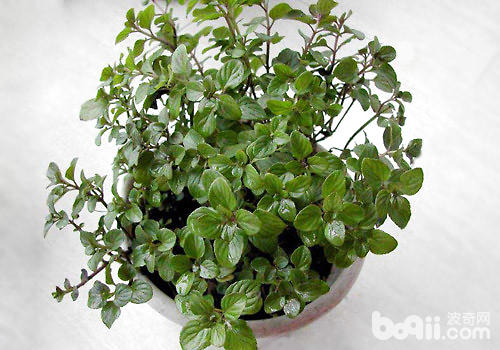
Spearmint round-leaved mint
I. Morphological characteristics
Perennial herb, stem 4-angled, densely covered with white fuzz. Leaves opposite, oblong-ovate to round, with irregular wavy teeth, gray-green, pubescent. Leaf blade 3 cm long, 2-2.5 cm wide, flowers white or pink, clustered at the tips of branches. Blooms in summer.
II. Ecological habits
Grows well in warm and full-sun environments, dislikes high temperatures, relatively cold-tolerant, optimal growth temperature 20-30°C. Prefers moist, fertile alkaline soil.
III. Cultivation and management
Can be propagated by sowing, division, or cuttings. Sowing is best in spring, while division or cuttings are suitable in both spring and autumn. Highly adaptable, requires only rough management. After planting new seedlings, firm the soil and water thoroughly; once sprouts grow new leaves, keep the soil moist but not waterlogged. When seedlings are 15-20 cm tall, pinch off the growing tips to encourage more branching. During the growing period, fertilize once every half month, and apply 1-2 additional applications of phosphorus and potassium fertilizer. It is best to divide the plants once a year.
What is spearmint? Planting and cultivation methods for spearmint. How to grow spearmint
What is spearmint? First, spearmint is a plant; second, it is also a brand. If you go to a large shopping mall and look at Yunnan Baiyao toothpaste, one type is spearmint-flavored. What I am using right now is this type. This is not a recommendation to everyone, but it really is very good to use and can reduce the chance of mouth ulcers. This is Ziyun's personal experience.Speaking of the spearmint plant, I couldn't help rambling on so much. Below, let me share the planting and cultivation methods for spearmint. Spearmint is an upright perennial herbaceous plant of the Lamiaceae family. Spearmint has strong adaptability to the environment and can grow in areas below 2000 m in altitude. It likes warm, humid climates and is a mint variety native to Europe and southwestern Asia. Regarding the specific planting and care of spearmint, the following four points focus on explaining how to grow spearmint.
I. Growing environment: spearmint rhizomes can sprout and emerge at 5-6°C, the suitable temperature for plant growth is 20-30°C, and the rhizomes have strong cold resistance. If the soil maintains a certain humidity, it can still overwinter in areas with winter temperatures of -30 to -20°C. It should not be cultivated in shaded places. Spearmint has no strict requirements for soil, but loose, fertile, moist sandy loam or oil sandy soil is better.
II. Cultivation techniques: the suitable soil pH for spearmint is 5.5-6.5, and slightly alkaline soil can also be used. It can be propagated by seeds, cuttings, and division. In production, the rhizome propagation method is generally used. After the autumn harvest, leave the rhizomes in the soil, dig them out before planting, select rhizomes with short internodes, white color, thick growth, and no pests or diseases, and cut them into small sections 6-10 cm long as propagation material. The planting period can be from November to early March, varying by region. The planting site should be deeply plowed with plenty of base fertilizer applied. After leveling, open furrows at a row spacing of 25 cm and a furrow depth of 6-8 cm. Scatter the seed rhizomes into the furrows, cover with soil, rake level, and firm. About 1125-1500 kg of rhizomes are needed per 1 hm2.
III. Field management: during the growing period of spearmint, in addition to intertillage and weeding, clearing drainage channels, preventing waterlogging after rain, and timely irrigation, the most important thing is topdressing, generally 4 times, namely after full emergence in April; during the peak growth period in May-June; after the first harvest of mint in July; and in late August when the second-crop spearmint seedlings are about 15 cm tall. The fertilizer applied is mainly nitrogen fertilizer, supplemented by phosphorus and potassium fertilizer. Spearmint is prone to degeneration, so attention should be paid to seed selection and retention.
IV. Pest and disease control: spearmint diseases include rust. Field water should be drained promptly. In the early stage of the disease, spray with 25% triadimefon 1000-fold solution, or alternately spray with 1:1:200 Bordeaux mixture. Stop spraying 20 d before harvest. Pests include cutworms, measuring worms, aphids, and red spiders.