How to grow Mandevilla (also known as Dipladenia, red mandevilla, and Chilean jasmine)
Mandevilla (Dipladenia, red mandevilla, Chilean jasmine)
Scientific name: mandevilla sanderi
Aliases: red wrinkled vine, double gland vine, Dipladenia, red mandevilla, Chilean jasmine
Family and genus: Apocynaceae
Morphological characteristics: perennial evergreen vine, with slender rhizomes. Leaves opposite, long ovate, apex acute, leathery, with wrinkled surfaces, and the leaf color is deep green and glossy. Flowers axillary, corolla funnel-shaped, with colors including red, peach red, pink, etc.
Ecological habits: likes light, warmth, and moisture. Native to South America. During the flowering period, Mandevilla often presents a magnificent scene with more flowers than leaves. When a breeze comes, waves of refreshing fragrance make people feel relaxed and happy, hence the elegant name "Mandevilla."
Flowering period: summer and autumn; with proper care, it can bloom all year round.
Landscape uses: large and brightly colored flowers; it is the queen of tropical vines. Suitable for indoor potted cultivation, hanging on balconies, and for outdoor fences, trellises, and small courtyard beautification.
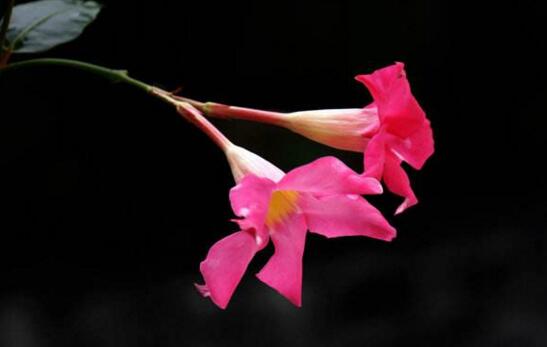
In the earliest times, people in the Americas called this plant only Mandevilla. It is a very common plant in the Americas. Later, after it was introduced around the world, various different names appeared. In many places, Mandevilla is also called red wrinkled vine, Dipladenia, red mandevilla, and so on. Therefore, when understanding the differences between Dipladenia and Mandevilla, the following points should be noted.
1. Dipladenia and Mandevilla belong to the same plant
What people often call Mandevilla and Dipladenia are actually the same plant. This also includes red mandevilla and other names, which are all mixed names for this new type of vine. Its twining stems are soft and very tough, and the flowers it produces are large and vivid. The flowering period of Mandevilla is, like that of Dipladenia, very long, and the cultivation methods for Mandevilla are equally applicable to Dipladenia.
2. The leaves of Dipladenia and Mandevilla are different
Although the two are the same plant, differences between Dipladenia and Mandevilla do exist. Usually, what people refer to as Mandevilla is characterized by large leaves, wrinkles, strong vining habit, and very large flowers; Dipladenia is characterized by large leaves, no wrinkles, strong vining habit, and large flowers. Therefore, the difference between the two is that Mandevilla leaves have wrinkles, while Dipladenia leaves do not.
In addition, what people often call red mandevilla also belongs to the same plant as Dipladenia and Mandevilla, but its characteristics are small, smooth leaves, weak vining habit, and slightly smaller flowers. These subtle differences are actually not obvious without careful observation, and they do not have much impact on cultivation, so they do not affect growing them.
Whether it is red mandevilla, Dipladenia, or Mandevilla, they all share one common characteristic, which is a relatively long flowering time. They bloom for a long time in summer and autumn. However, it is said that these plants seen on the market are all fragrance-free. Still, given their exceptionally long flowering period, many people feel they are very much worth it. Those who want to grow them do not need to struggle over the differences between Dipladenia and Mandevilla.
What is the flower language of Mandevilla?
As a plant loved by many people, Mandevilla has its own unique flower language. The flower language of Mandevilla is love and virtue. When we see the beautiful flowers of Mandevilla, they are as unforgettable as beautiful things like love and virtue. If you want to express such feelings, Mandevilla is one of the best choices.
Mandevilla Dipladenia sanderi Mandevilla illustrated guide: how to grow Mandevilla / how to propagate Mandevilla
Mandevilla profileMandevilla Dipladenia sanderi
Cultivation methods and precautions for Mandevilla Introduction to Mandevilla
Mandevilla (scientific name: Dipladenia sanderi) is a new type of vine, also known as red wrinkled vine, double gland vine, Dipladenia, red mandevilla, and Chilean jasmine. It is native to tropical America and is a perennial evergreen plant in the Apocynaceae family. The twining stems of Mandevilla are soft but tough, spiraling upward along supports. The pink, trumpet-like flowers are large and upright, and the flower stem can reach 6-8 cm. Mandevilla blooms continuously from early spring to late autumn. The flower colors include pink, peach red, bright red, etc., and they are rich in variation. It has the reputation of being the "queen of tropical vines." Mandevilla likes a warm and humid environment, but its branching habit is poor. During the flowering period, Mandevilla often presents a magnificent scene with more flowers than leaves. When a breeze comes, waves of refreshing fragrance make people feel relaxed and happy, hence the elegant name "Mandevilla."
Morphological characteristics of Mandevilla
Mandevilla is a perennial evergreen vine in the Apocynaceae family. Leaves opposite, entire, long ovate, apex acute, leathery, with wrinkled surfaces, and the leaf color is deep green and glossy. Flowers axillary, corolla funnel-shaped, and the flowers are red, peach red, pink, etc. The flowering period is mainly summer and autumn. With proper care, it can also bloom in other seasons.
Ecological habits of Mandevilla
Mandevilla likes a warm, humid, and sunny environment, and can also be placed in a slightly shaded place, but insufficient light reduces flowering. The suitable growth temperature is 20-30°C. It has strong adaptability to soil, but sandy loam rich in humus and with good drainage is best.
Landscape uses of Mandevilla
Mandevilla has large, brightly colored flowers and a beautiful plant shape, and is known as the queen of tropical vines.
When cultivated outdoors, it can be used to beautify fences, trellises, rooftops, and small courtyards. Because its vining habit is not strong, it is also suitable for indoor potting, and can be placed on a balcony as a spherical or hanging basket display. Growing several Mandevilla plants fills courtyards and balconies with an exotic atmosphere.
Cultivation techniques for Mandevilla
Mandevilla is generally propagated by cuttings, which can be done in spring, summer, and autumn. Tissue culture methods can also be used for rapid propagation.
Mandevilla likes a warm, humid, and sunny environment, and can also be placed in a slightly shaded place, but insufficient light reduces flowering. The suitable growth temperature is 20-30°C. It has strong adaptability to soil, but sandy loam rich in humus and with good drainage is best.
For outdoor cultivation, it should not be planted in overly low-lying places, so as to avoid poor growth caused by oxygen deficiency due to water accumulation. For indoor potting in the north, leaf mold plus a small amount of coarse sand can be used. In the south, pond mud, peat soil, and river sand can be mixed in a ratio of 5:3:2. During the growing period, a compound fertilizer can be applied 3-5 times as a top dressing, but the amount of nitrogen fertilizer should be controlled to avoid excessive vegetative growth that affects reproductive growth and reduces flowering. During maintenance, watering should be properly controlled to develop a well-developed root system.
Pruning can be done after the flowering period. If it is a one- or two-year-old plant, light pruning can be done, mainly for shaping. Older perennial plants can be heavily pruned in spring to encourage the growth of strong new branches.
Pest and disease control for Mandevilla
Mandevilla has strong stress resistance and is less prone to diseases. Therefore, during the growing period, spraying a fungicide once a month is enough to prevent diseases.
Mandevilla pictures