A Detailed Guide to Growing Chinese Peony (Jiangli, Moguhua)
Chinese Peony (Jiangli, Moguhua)
Scientific name: paeonia lactiflora
Aliases: Jiangli, Licao, Lanweichun, Yurong, Lishi, Moguhua, Heiqianyi, Hongyao, etc.
Family and genus: Ranunculaceae
Morphological features: thick sturdy roots underground, plant height 60-120 cm. Leaves alternate, bipinnately compound with three leaflets. One to several flowers borne at the top of the stem or the ends of branches, with long pedicels, large and fragrant. There are many horticultural cultivars.
Ecological habits: sun-loving, extremely cold-hardy, dislikes summer heat and humidity, prefers sandy soil. The Chinese peony plant, over the course of a year, undergoes phased developmental changes as the climate rhythm changes. These are mainly manifested as alternating changes between the growth period and the dormant period. Among these, the vernalization stage of the dormant period and the light stage of the growth period are the most critical. The vernalization stage of the Chinese peony requires a low temperature of 0 degrees Celsius for about 40 days to be completed; after the mixed buds grow and sprout, they extend above ground, put out branches and grow leaves, and then develop buds and flower. The Chinese peony is a long-day plant; flower buds must develop and bloom under long-day conditions. After the mixed buds sprout, if the light duration is insufficient, or under short-day conditions, it usually only grows leaves without flowering or flowers abnormally.
Flowering period: April to May.
Flower meaning: shame, shyness, bashfulness. A traditional famous flower of our country, hailed by people as the “Flower Fairy” and the “Flower Minister”.
Landscape uses: flower terraces, flower borders, flower terraces, specialized gardens, cut flowers, potted plants.
Species identification: similar species in the same genus --- tree peony p. suffruticosa.
① Chinese peony: herbaceous, the plant is relatively shorter, leaflets narrow, apex not lobed, dark green on both sides, several flowers clustered at the top of the branches, flowers relatively small, flowering period mid-to-early May.
② Tree peony (woody peony): shrub, plant height 2 m, leaflets relatively wide, apex lobed, surface yellow-green, with soft hairs, flowers solitary at the top of branches, flowers relatively large, flowering period late April, follicles hairy. Long known as the “King of Flowers”.
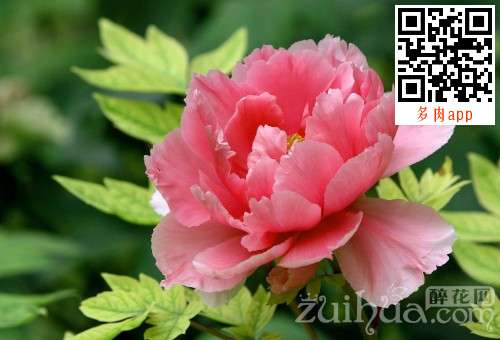
The Chinese peony is cold-hardy and can overwinter in the open ground throughout northern China. Deep loam soil is most suitable, and it grows best in moist soil, but drainage must be good. Waterlogging, especially in winter, can easily cause the fleshy roots of the Chinese peony to rot, so low-lying land and saline-alkali land are both unsuitable for cultivation. The Chinese peony likes fertilizer; the nursery plot should be deeply plowed and fully decomposed manure applied, and it grows best in a sunny location.
Chinese peony propagation includes sowing, cuttings and division, usually mainly by division. The division period is best from late September to early October. Dig up the root clumps, shake off the attached soil, cut with a knife so that each root clump has 2-3 buds, preferably 3-5 buds, then plant the divided root clumps in the prepared nursery plot. If the divided root clumps are relatively large (with 3-5 buds), they may flower the next year, but the flowers will be small; it is better to remove them so the plant grows well. If the root clumps are small (2-3 buds), growth the next year will be poor or they will not flower, and they generally need to be grown for 2-5 years. Sowing propagation is best done by sowing immediately after the seeds mature and are collected; the later the sowing, the lower the germination rate. Chinese peony seeds exhibit epicotyl dormancy; after sowing, they root in the autumn of that year, and the buds only emerge above ground after the warmth of the following spring. The seedlings grow slowly; some buds may not flower until 3-4 years, and some do not flower until the 5th-6th year.
The cutting method can use root cuttings or stem cuttings. When dividing in autumn, broken roots can be collected, cut into 5-10 cm sections, and buried and inserted in soil 10-15 cm deep. For the stem cutting method, about two weeks before flowering, take the middle part of the stem, made up of two nodes, as the cutting, insert it about one and a half inches deep in the sand soil of a hotbed, require shading and frequent watering; after one and a half to two months it can root and form dormant buds.