What are the key care points for the rubber plant (Ficus elastica)?
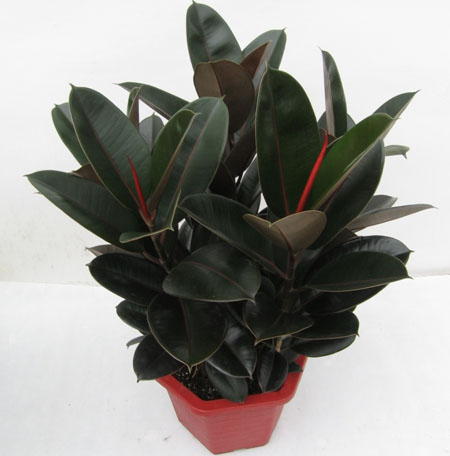
Rubber plant (Ficus elastica) Scientific name: ficus elastica Alternative names: Indian rubber tree, Indian banyan large-leaf green, red Burmese tree, red-mouth rubber tree, Indian banyan
Family and genus: Moraceae, Ficus genus
Place of origin and distribution: Indonesia, India, Malaysia.
Key care points: evergreen tree. Pot in leaf mold or peat soil. It likes high temperatures, high humidity and fairly strong sunlight. During the growing season it can be moved outdoors into the sunlight; give it plenty of water and apply a liquid fertilizer about once every two weeks. The overwintering temperature is around 10 degrees Celsius. Repot about once every two years.
Cultivated varieties include: variegated rubber plant cv. variegata, etc.
Landscape use: as a potted plant it is a great material for decorating hotel halls and family living rooms; in the south it is often placed in front of buildings, at the center of flower beds and along both sides of roads. Small and medium-sized plants are often used to beautify living rooms and studies; medium and large plants are suitable for placement on both sides of the entrance halls of large buildings and in the center of lobbies, looking majestic and spectacular and able to express a tropical scene.
Propagation: cuttings, air layering.
Light: likes strong light, not tolerant of shade (sufficient light).
Water: grows in moist soil.
Temperature: slightly cold-tolerant, able to withstand low temperatures of -5 to 0 degrees Celsius.
Humidity: relative humidity medium, 50%-60%.
How to grow a rubber plant? Rubber plant hydroponics method and care guide
The rubber plant, also called Indian rubber tree, Indian rubber banyan, etc., has been commonly grown as a potted plant in recent years because of its high ornamental value. Below, the editor of Huinong Network will explain the hydroponics method and care guide for the rubber plant. Let's learn together.
1. Growth characteristics
The rubber plant has thick, elliptical leaves with pointed tips, broad as a palm and glossy, evergreen all year round, and is a world-famous foliage tree species. In its place of origin the tree can grow to more than 30 m, with a thick trunk, many aerial roots, smooth twigs, and milky sap throughout. The young buds are red and have bracts, the young leaves are dark red, and the old leaves are dark green.
2. Hydroponics method
(1) For hydroponic rubber plants, it is best to choose a small soil-grown plant with a good plant shape and convert it to hydroponics by the root-washing method. After washing the plant clean, plant it in a container and add water to 1/3-1/2 of the root system. Rubber plants are relatively large, so it is best to choose a glass container with a planting cup.
(2) Select the old roots of a small soil-cultured plant with a good plant shape, wash the roots, and grow hydroponically. Or choose vigorous shoot tips from May to September, remove the basal leaves, let the cut dry, and then directly root them in water. Because the canopy is relatively heavy, ceramsite needs to be added to the container to fix the plant and help rooting.
3. Care guide
(1) Temperature and light
The temperature suitable for rubber plant growth is 22-32°C, and the safe overwintering temperature is above 8°C. The rubber plant likes sufficient scattered light; with sufficient light it grows robustly and its leaves are broad, thick and bright, while with poor light the branches are thin and weak. In summer, direct sunlight must be prevented.
(2) Changing the water
For hydroponic rubber plants, change the water once every 2-3 days in the early stage; after water roots grow out, change the water once every 10-15 days, and change the nutrient solution once every two weeks.
The above is the hydroponics method and care guide for the rubber plant compiled by the editor of Huinong Network. Have you all learned it? If you have any cultivation questions, you can leave a comment below.
How to grow a rubber plant: teaching you rubber plant care tips
The rubber plant, also called Indian banyan or Indian rubber, is an evergreen woody foliage plant of the Moraceae family, Ficus genus. The rubber plant has relatively large leaves, thickly leathery and glossy, round to oblong; the leaf surface is dark green and the leaf back is light green. At first the leaves are wrapped outside the terminal bud; after the new leaves expand, the stipules fall off and leave stipule scars on the branches. Now let's look at the introduction to rubber plant cultivation methods.
I. Basic information about the rubber plant
The rubber plant is native to India and Malaysia, hence it is also called Indian rubber tree or Indian banyan. It is cultivated in many places across China. There are extremely many species in the same genus, about 1000-2000, widely distributed in tropical and subtropical regions, and about 120 species in China. The rubber plant is also called Indian banyan or Indian rubber tree. The rubber plant has large, shiny leaves and is evergreen all year round; it is a common foliage plant and suitable for potting. The rubber plant is native to India and likes warm, humid weather. It requires fertile soil. It likes light and can also tolerate shade, but is not cold-tolerant; when the winter temperature is below about 5°C it is prone to cold damage. The suitable temperature is 20°C-25°C. The rubber plant can reach about 25 m tall, with a diameter at breast height of 25-40 cm; the bark is grayish white and smooth; when young it is epiphytic, and the twigs are thick. Its ornamental varieties: the yellow-edged rubber plant has golden-yellow leaf margins, more obvious in autumn; the white-leaf yellow-edge rubber plant has milky white leaves with yellow margins and yellow-white markings on the leaf surface. The whole plant is smooth, without hairs, the stems produce aerial roots, and it has latex sap. The leaves are broad with long petioles, thickly leathery, glossy, bright green, oblong or oblong, with acuminate tips and entire margins. The young buds are red and have bracts. The lateral veins form right angles with the midrib. When new buds emerge on the rubber plant, they are wrapped in light red stipules, and the appearance is beautiful. The rubber plant has a spreading crown, aerial roots, and milky sap. The leaves are thickly leathery, glossy, oblong or oblong, 15-30 cm long and 7-9 cm wide. The stipules are solitary and light red. The receptacles are borne in pairs in the leaf axils, oblong, yellow when mature; male flowers, female flowers and gall flowers are borne in the same receptacle.
II. Ecological habits of the rubber plant
The rubber plant likes a warm, humid environment with limited sunlight, and can also slightly tolerate shade, but is not cold-tolerant. It requires fertile, loose soil and grows well in neutral or slightly acidic soil. When potting, it is best to use a prepared soil made of leaf mold, leaf ash soil plus about 1/4 river sand and a large amount of base fertilizer. Normally keep the soil moist and apply a dilute liquid fertilizer once every 15-20 days. In summer and low-temperature seasons, the rubber plant grows relatively fast, so it should be given more water and less fertilizer, but waterlogging in the pot must be prevented. After autumn begins, gradually increase fertilization and watering to promote full plant growth and help overwintering. Because the rubber plant likes sunlight, from spring to autumn it should be placed outdoors in a sunny place for care; if it is left in a shaded place for a long time, it easily causes the leaves to turn yellow and fall off. It likes sunlight, but is also relatively shade-tolerant. When watering, often water with overnight tea; the whole plant should be sprayed with water frequently, and the leaves should often be wiped clean with a wet cloth, which is beneficial to photosynthesis.
Because the rubber plant is not cold-tolerant, in summer it must be moved outdoors to a sunny place for care, keeping the room temperature above 10°C, and the lowest temperature should not be lower than 5°C; if the temperature is too low and the potting soil is moist, it will cause the leaves to turn black and fall off and the roots to rot, or even the whole plant to die. From the end of April to the beginning of May the next year, move it to a courtyard or balcony for care. In the south, note that when moving from indoors to outdoors with the change of seasons, it cannot immediately receive strong sunlight exposure, that is, the changes in light and temperature should not be too great. In summer, when the room temperature is low, water it in large amounts and keep the potting soil slightly moist.
The rubber plant has bright, verdant and pleasant leaves, and the plant is short and full of presence, suitable for placement on a balcony to green the environment.
III. Rubber plant cultivation methods
When potting the rubber plant, it is best to use 1 part leaf mold, 1 part garden soil and 1 part river sand, and add a small amount of base fertilizer to make the growing soil. It grows very fast in a high-temperature, humid environment, producing one leaf every 5-10 days; during this period sufficient fertilizer and water must be guaranteed. Generally apply liquid fertilizer or compound fertilizer 1-2 times a month, while maintaining relatively high soil moisture. After autumn begins, gradually reduce the frequency of fertilization and watering to promote full plant growth and help overwintering.
The rubber plant likes strong sunlight; throughout the growing season from spring to autumn it should be grown in sunlight, and in winter it should also be placed in a relatively strong light location; but it can also tolerate shade, and growing it indoors under low light is also fairly good. In addition, in order to make the plant grow evenly and ensure a good plant shape, when the seedling reaches a height of 50-80 cm, pinch off the growing tip to promote the sprouting of side branches; after the side branches grow, choose 3-5 branches, then shorten and prune the side branches once each year, and after 2-3 years a relatively large plant with a complete, round and full plant shape can be obtained.