How to grow bitter orange (Citrus aurantium)? A detailed guide to cultivation methods
Bitter orange (Citrus aurantium)
Synonyms: Daidai, Daidai fruit, Daidai flower, sour orange, bitter orange, Huíqīngchéng
Family and genus: Rutaceae, Citrus
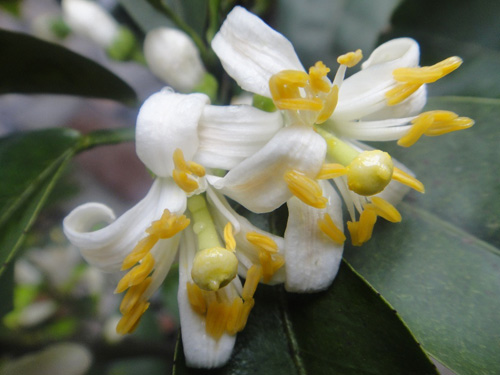
Morphological characteristics: Evergreen shrub. Branches sparsely bear short thorns, young twigs are angular. Trunk bark green, with volatile oil glands. Leaves alternate, leathery, elliptical to ovate-elliptical, apex acuminate, margins with wavy notches, base cuneate, veins prominent. Flowers 1 or several clustered at the leaf axils of branch tips, in racemes, white, strongly fragrant. Fruit oblate, orange-yellow, strongly fragrant. Flowering period May to June, fruit ripening period December.
Ecological habits: Prefers a warm, humid climate, likes fertilizer, and is suited to an environment with ample light and good ventilation. Requires fertile, loose sandy loam rich in organic matter. Not cold-tolerant; the minimum temperature must not fall below 0 degrees Celsius. Potted plants can overwinter when placed indoors where it does not freeze. Avoid overly wet soil, especially waterlogging.
Care points: Repot and change the soil in a timely manner. For small pots, repot and change the soil once every 1 to 2 years; for large pots, once every 3 to 4 years, usually in spring. When repotting, remove excess fibrous roots and poorly growing roots. Promptly prune diseased and pest-damaged branches, dead branches, crossing branches, drooping branches, etc., and cut back the stout current-year summer shoots and autumn shoots by one-half, keeping 2 to 3 buds on each lateral branch and cutting off the rest, so that the new branches grow stout and the number of flowers and fruits increases. When flowering, appropriately thin out some flower buds, which helps raise the fruit-setting rate. Bitter orange likes fertilizer; from April to May, apply 20%-25% decomposed oil cake fertilizer water once about every 10 days to promote sprouting and growth. After that, apply fertilizer mainly of phosphorus to benefit flower bud differentiation and good flowering. Apply less fertilizer in autumn to avoid producing autumn shoots. During the growing period, keep the pot soil slightly moist, avoiding both excessive dryness and excessive wetness. During the plum rain season, never allow water to accumulate in the pot.
Propagation methods: Mainly grafting and cuttings.
Dietary and medicinal effects: The leaves, flowers, and fruit peel all contain aromatic oils and can be used as flavorings for food and cosmetics. The Daidai flower can be used to scent tea, and is the famous Daidai flower tea. Both the fruit and the peel can be used as medicine, with effects of promoting digestion, regulating qi and soothing the middle, and resolving phlegm and stopping diarrhea.
An introduction to the cultivation methods and morphological characteristics of bitter orange
Introduction: In this vast world, we commonly see quite a few flowers, such as chrysanthemums, roses, orchids, pear blossoms, and so on - these are all very familiar to us. But I wonder whether any of you have seen the Daidai flower. I believe some of you have seen it! After all, the Daidai flower is somewhat famous for its many effects and functions, and also because of its many effects, some of you very much want to grow the Daidai flower, but just do not quite understand its cultivation methods. So next, the editor will introduce the cultivation methods of the Daidai flower. Come and take a look!
Morphological characteristics of the Daidai flower
Evergreen small tree, branches sparsely bearing short thorns, young twigs angular. Leaves elliptical to ovate-elliptical, 5-10 cm long, 2.5-5 cm wide; petiole 2-2.5 cm long, leaf wing obcordate. Flowers in racemes; calyx 5-lobed, lobes ovate; flowers white, petals 5, 2-2.5 cm long; stamens 21-24, often 3-5 united. Fruit oblate, 7-8 cm in diameter, not fragrant. Flowering period May to June, fruit ripening period December.
Cultivation methods of the Daidai flower:
1. Overwintering
The Daidai flower is a kind of sour orange of the genus Citrus, and by nature likes warmth. In southern Jiangsu it can overwinter outdoors with a little protection; in various parts of North China it can only be potted, and in winter it should be placed indoors where it does not freeze to overwinter.
2. Repotting and fertilizing
Potted plants need pruning of dead branches and diseased branches in early spring each year, and the pot soil must be changed every two or three years, with sandy loam rich in humus being best. For fertilizer, soybean cake water or decomposed human manure and urine can be used.
3. Propagation methods
Propagation of the Daidai flower can be divided into several methods such as layering, cuttings, grafting, and sowing.
① Layering
For layering, the air layering method is used, preferably in late spring and early summer; roots form in one month, and the survival rate is relatively high; cuttings are rather difficult, with a survival rate of about 20%-30%. If auxin or low-temperature treatment is used, the survival rate can reach more than 50%.
② Cuttings
Generally, in May to June, cut full-grown branches, take 10 cm long cuttings, remove the lower leaves, insert them in flower pots, and place them indoors or under a shade shed to avoid direct sunlight, watering frequently to keep them moist; only after 2 months will they root, and they are transplanted the next year.
③ Grafting
Flowers can be produced in 3 to 4 years. For grafting, trifoliate orange can be used as the rootstock. Sowing is best done in autumn, and the seeds can be sown directly after being taken from the fruit. If spring sowing is used, the seeds must be taken out in autumn and stored in wet sand.
The editor has already introduced the cultivation methods of the Daidai flower in the article above, and the editor also introduced the morphological characteristics of the Daidai flower, which I believe all of you have seen. So through today's study, you should no longer be confused about the cultivation methods of the Daidai flower! However, the knowledge introduced above is official knowledge, and the specifics still need to be carried out by each of you yourselves, hands-on. Even if one attempt at growing it fails, do not be discouraged - try again, and I believe you will always succeed.
Cultivation methods and precautions for the Daidai flower
Chinese scientific name: Daidai flowerLatin scientific name: Citrus aurantium L.Other names: sour orange, Huíqīngchéng, DaidaiKingdom: PlantaePhylum: AngiospermsClass: DicotyledonsOrder: SapindalesFamily: RutaceaeGenus: CitrusSpecies: Daidai flowerDistribution area: Distributed in various parts of southern China; cultivated in Zhejiang, Jiangsu, Guangdong, Guizhou, and other places.Daidai flower, other names: sour orange, Huíqīngchéng, Daidai. Latin name: Citrus aurantium L. Belongs to the Rutaceae family, Citrus genus. Small tree, with dense branches and leaves, many thorns, and the thorns on vigorous shoots reaching up to 8 cm. With its dancing green leaves and hanging golden fruits, it is a rare fine specimen among home-grown flowers. The fruit of the Daidai flower is initially dark green, turns orange-yellow when ripe, and does not drop; by the following spring and summer it turns green again, hence the name "Huíqīngchéng" (return-to-green orange). If cared for properly, the fruit can persist until the third year, hence it is also called "Daidai" (generation after generation).1. Morphological characteristics
Small tree, with dense branches and leaves, many thorns, and the thorns on vigorous shoots reaching up to 8 cm. Leaf color deep green, texture rather thick, leaf wing obovate, base narrowly pointed, 1-3 cm long, 0.6-1.5 cm wide, or in some varieties almost without leaf wings. Racemes with few flowers, sometimes also with axillary solitary flowers, tending toward unisexual flowers, that is, stamens develop and pistils degenerate; flower buds elliptical or nearly spherical; calyx 5- or 4-lobed, sometimes thickening after flowering, hairless or in some varieties hairy; flowers of unequal size, flower diameter 2-3.5 cm; stamens 20-25, usually united at the base into multiple bundles. Fruit spherical or oblate, peel slightly thick to very thick, difficult to peel, orange-yellow to vermilion, oil cells of uneven size, uneven surface, fruit core solid or semi-solid, segments 10-13, flesh sour, sometimes bitter or with a peculiar odor; seeds numerous and large, often with ridged angles, cotyledons milky white, monoembryonic or polyembryonic. Flowering period April to May, fruiting period September to December. Evergreen small tree, branches sparsely bearing short thorns, young twigs angular. Leaves elliptical to ovate-elliptical, 5-10 cm long, 2.5-5 cm wide; petiole 2-2.5 cm long, leaf wing obcordate. Flowers in racemes; calyx 5-lobed, lobes ovate; flowers white, petals 5, 2-2.5 cm long; stamens 21-24, often 3-5 united. Fruit oblate, 7-8 cm in diameter, not fragrant. Flowering period May to June, fruit ripening period December.2. Growth habits
The Daidai flower by nature likes a warm, humid environment, likes sunlight, likes fertilizer, and is slightly cold-tolerant (more cold-tolerant than jasmine and Michelia alba). In the south, if there are relatively good microclimate conditions, it can overwinter outdoors. Potted plants can overwinter indoors where it does not freeze. It is not very demanding about soil; it grows, flowers, and fruits best in well-drained, fertile, loose, slightly acidic sandy loam rich in organic matter.3. Geographical distribution
Distribution of the Daidai flower: various places south of the southern slope of the Qinling Mountains, usually planted, sometimes escaping to semi-wild. The Daidai flower is native to Zhejiang, China, and is now cultivated in all provinces of southeastern China. In North China and the middle and lower reaches of the Yangtze River, it is mostly potted.4. Subspecies types
Daidai sour orangecv. Daidai,Abbreviated as Daidai, also known as Huíqīngchéng, Chunbuluo, Daidaiyuan. It was once treated as an independent species C. daidai Sieb. or regarded as the variety C. aurantium var. daidai Tanaka. Fruit nearly spherical, with shallow radial grooves at the top, fruit calyx thickened and fleshy, peel orange-red, slightly rough, oil cells large, uneven, fruit core solid, flesh sour. The main production area is Zhejiang.
The flowers are fragrant; when used to scent tea leaves, it is called Daidai flower tea. Its fruit does not drop after frost; if not harvested, the same tree will bear fruits from different seasons, hence it is also called Daidai fruit. Ripe fruit sometimes turns back to green in summer and autumn, hence it is also called Huíqīngchéng. This is because the chlorophyll in the peel gradually breaks down during fruit ripening, turning yellow to vermilion, but when temperature and moisture conditions change, this is enough to promote its physiological and biochemical activities, and new chlorophyll is synthesized again, thus turning green once more.
Sour orange can roughly be divided into two major categories: yellow-peel sour orange and red-peel sour orange. There are also some variant types and natural hybrids.
(1) Yellow-peel sour orange Huangpi Suan Cheng, also known as sour tangerine, stinking tangerine, medicinal orange. Mainly produced in western Hubei, Hunan, and eastern Guizhou. The main production area in Hunan is around Yuanjiang and various places in the west. The traditional Chinese medicines Zhishi and Zhike in this region are made from its fruit. The flesh is very sour, and the segments have a bitter taste; seeds are numerous and large.
The yellow-peel sour orange type has relatively primitive traits, with thicker peel, rough or wrinkled surface, pale yellow or orange-yellow color, containing more oil, with a stronger fragrance, and rather difficult to peel; the flesh is very sour, often with a bitter taste or a peculiar odor. It is more commonly cultivated south of the Yangtze River and north of the Five Ridges, and occasionally occurs semi-wild in mountainous areas. Representatives of this type include:
Goutouchengcv. Goutou Cheng,
Also known as Pitoucheng, Da Huangcheng. The main production area is around Huangyan, Zhejiang. The root system is well developed, drought-tolerant and salt-alkali-tolerant; after grafting, the tree form is large, the tree age is long, few leaves drop in winter, and the yield is high, making it an excellent rootstock for grafting citrus. The flesh is very sour and has a peculiar odor; seeds are numerous, with their tips slightly hooked.
(2) Red-peel sour orange Hongpi Suan Chenghas orange-red peel, thinner peel, slightly rough, relatively easy to peel, fruit relatively large, fruit core nearly hollow, flesh sour, sometimes with a bitter taste. Representatives of this type include:
Xiaohongchengcv. Xiaohong Cheng,
Mainly produced in Jiangsu and Zhejiang provinces. It is one of the rootstocks for grafting loose-skin citrus, but the tree age is relatively short and cold tolerance is relatively poor. Fruit oblate, bright orange-red, oil cells sunken, peel slightly rough, still relatively easy to peel, fruit core large and hollow, flesh sour, sometimes slightly bitter; cotyledons occasionally pale green.
Zhuluancv. Zhulan,
Also known as Xiangluan, Suanluan. Mainly produced in Jiangsu and Zhejiang provinces. Also used as rootstock. The unripe fruit is used medicinally, as a substitute for Zhishi or Zhike. The fruit shape resembles Xiaohongcheng but is larger, orange-red, fruit core hollow or semi-solid, flesh sour, without off-flavors.
(3) Hybrids of sour orangeThere are quite many species, including various hybrids of sour orange with sweet orange, sour orange with pomelo, and sour orange with loose-skin citrus. The more common ones include:
Hutougancv. Hutou Gan,
Was once treated at the species level as C. kutokan Hayata. Mainly produced in Fujian (Zhangzhou, Xiamen), Taiwan, China, and various places in eastern Guangdong. It may be a hybrid descendant of sour orange and pomelo. Leaf texture rather thick, with rounded blunt teeth on the upper half of the leaf margin. Racemes with few flowers, peel pale yellow, some thick and some thin; used medicinally as a substitute for Zhike, the former called coarse-peel Zhike and the latter fine-peel Zhike; peel cottony and soft, central column large and hollow, segment walls thick and tough, flesh has the flavor of pomelo, but being very sour it also resembles sour orange; seeds have longitudinal ridges, cotyledons milky white, polyembryonic.
Nanzhuangchengcv. Taiwanica,
Was also once treated at the species level: C. taiwanica Tanaka et Shimada in Bull. Sci. Hort. Inst. Kyushu Univ. 2: 54. 1926; Flora of Taiwan 3: 510. 1977. Mainly produced in Taiwan, China (Nanzhuang). It is a hybrid or cultivated variant of sour orange. Leaves narrow and long, resembling willow leaves. Fruit oblate, peel very thick and rough, orange-yellow, oil cells large, fruit core large, semi-solid, flesh very sour; seeds polyembryonic.
Japanese summer orangecv. Natsudaidai(=C. natsuidaidai Tanaka)
Cultivated in some citrus horticultural farms in Taiwan, China, Fujian, and Guangdong. It may be a hybrid descendant of sour orange and loose-skin citrus or have another origin. The fruit ripens in late spring and early summer, usually spherical, peel orange-yellow, slightly thick, flesh on the sour side, often with a bitter taste.