Cultivation and Management Methods for Beach Morning Glory (Horse-hoof Grass, Climbing Vine Flower)
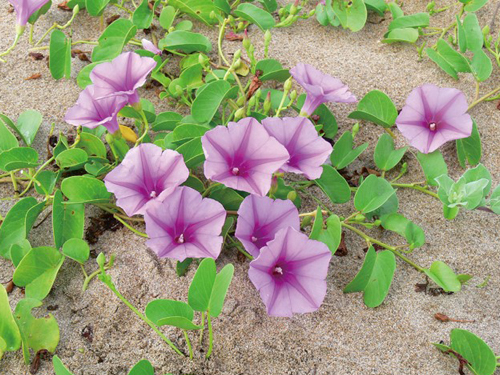
Beach Morning Glory (Goat's-foot Creeper, Horse-hoof Grass, Sea Potato, Climbing Vine Flower) Scientific name: ipomoea pes-caprae
Family: Convolvulaceae Alternative names: Beach Morning Glory, Horseshoe Vine, Two-leaf Sweet Potato, Lion Vine, Horseshoe Gold, Horse-hoof Grass, Sea Rush Vine.
Morphological characteristics: Perennial herb, stems creeping on the ground. Leaves alternate, thick leathery, leaf apex notched, shaped like a horse's hoof. Cymes axillary, corolla funnel-shaped, purplish-red, stamens and style included.
Ecological habits: Prefers high temperatures, dry conditions and full sunlight. It has good salt tolerance, good wind resistance and drought tolerance, but slightly poorer cold tolerance and shade tolerance.
Flowering period and flower meaning: Blooms year-round, with peak flowering in summer.
Landscape use: A dominant population on tropical and subtropical seaside beaches, it is an excellent ground cover for beach sand fixation.
Plant Configuration and Maintenance Techniques for Family-style Roof Gardens
Abstract Through an overview of the environmental factors of family-style roof gardens, this paper proposes roof garden layout and planting forms, plant selection principles and maintenance management methods under such conditions, with the aim of providing reference for the construction of family-style roof gardens. Keywords Family-style roof garden; Plant selection; Planting and maintenance managementIn the 21st century today, due to continuous urbanization, populations have become more densely concentrated, and modern buildings have increased accordingly. Along with the increase in buildings, green space area has sharply declined, and the corresponding environmental conditions have worsened, causing people's attention to and emphasis on the environment to reach an unprecedented level. Roof greening is of extremely important significance for increasing urban green space area, improving the living environment within specific areas, and enhancing quality of life. Under such circumstances, purchasing or building a roof garden has become a fashion, and how to create a good roof garden is even more a goal that people pursue. Because family-style roof gardens have relatively small areas, their main focus should be greening plants. They can produce oxygen, purify air, regulate air temperature and humidity, thereby creating a good ecological environment; the gaseous substances they release have bactericidal effects and are very beneficial to people's physical and mental health; they also have multiple functions for buildings such as heat insulation, thermal preservation, sound insulation, noise reduction, and protection of waterproof layers and roof slab structures, and are praised as “living building materials.”
1. Principles of Plant Selection
1.1 Choose low shrubs and herbaceous plants with strong drought and cold tolerance
Because roof gardens have high summer temperatures, strong winds, and poor soil moisture retention, and poor thermal insulation in winter, drought-tolerant and cold-tolerant plants should be selected as the main choices. At the same time, considering the special geographical environment of the roof and load-bearing requirements, attention should be paid to selecting more low shrubs and herbaceous plants to facilitate plant transportation, planting and management.
1.2 Choose sun-loving, barren-tolerant shallow-rooted plants
Most areas of a roof garden receive direct full sunlight with high light intensity, so sun-loving plants should be selected as much as possible. However, in certain specific micro-environments, such as under flower trellises or near walls where sunlight duration is shorter, some semi-sun-loving plant species can be appropriately selected to enrich the plant varieties of the roof garden. The planting layer on the roof is relatively thin, and to prevent root systems from eroding the roof building structure, shallow-rooted plants should be selected as much as possible. Because applying fertilizer can affect the sanitary conditions of the surrounding environment, barren-tolerant plant species should be planted as much as possible in roof gardens.
1.3 Choose plant species that are wind-resistant, not prone to lodging, and tolerant of waterlogging
Wind force above the roof is generally greater than at ground level, especially during rainy seasons or when typhoons arrive. The combination of wind and rain poses the greatest danger to plant survival. In addition, the roof planting layer is thin and the soil's water retention capacity is poor. Once heavy rain occurs, short-term waterlogging is likely. Therefore, plants that are wind-resistant, not prone to lodging, and at the same time tolerant of short-term waterlogging should be selected as much as possible.
1.4 Choose plants that are mainly evergreen and can overwinter outdoors in winter
The purpose of building a roof garden is to increase the urban greening area and beautify the “fifth facade.” The plants in a roof garden should be mainly evergreen as much as possible, and varieties with beautiful leaf shapes and plant forms should be used. To make the roof garden more colorful and reflect the seasonal changes of the garden, some colored-leaf tree species can also be appropriately planted; additionally, where conditions permit, some potted seasonal flowers can be arranged so that the garden has flowers in all four seasons.
1.5 Use native plants and appropriately introduce new greening varieties
Native plants have a high degree of adaptability to the local climate. In the relatively harsh environment of a roof garden, using native plants achieves twice the result with half the effort. At the same time, considering that roof gardens are generally small in area, to arrange them more exquisitely, some new varieties with high ornamental value can be selected to raise the grade of the roof garden.
2. Commonly Used Plant Species
Roof greening should determine the plant materials used according to time and place. Flowering shrubs are the main body of roof garden construction, and the pairing of flowers for all four seasons should be achieved as much as possible. For example: in spring, flowering almond, spring azalea, winter jasmine, gardenia, peach blossom, cherry blossom, and Japanese quince; in summer, crape myrtle, summer azalea, Michelia alba, banana shrub, and pomegranate; in autumn, crabapple, chrysanthemum, and osmanthus; in winter, wintersweet, camellia, and sasanqua. Herbaceous flowers can include trailing loosestrife, daisy, peony, cockscomb, calendula, chrysanthemum, cockscomb, and Dianthus chinensis, etc. Aquatic plants include water bamboo, lotus, water lily, water chestnut, and water hyacinth, etc.
In addition to considering the four-season pairing of flowers, attention should also be paid to the selection of trees according to seasonal changes. Depending on growing conditions, plants such as Hongyun magnolia, large gardenia, dragon juniper balls, large boxwood balls, purple-leaf plum, golden-branch pagoda tree, kumquat, osmanthus, and bamboos can be selected; tree species with high ornamental value and symbolic meaning should be used more, such as the graceful Japanese maple with red leaves, red osier dogwood, and purple-leaf photinia; the elegant and refined sago palm and Canary Island date palm; the gracefully swaying fernleaf bamboo; and plum, orchid, and pine symbolizing noble character, etc.
Border plants are very widely used in roof gardens. Planting some border plants around flower beds or beneath trees and shrubs is very charming, and at the same time makes full use of the bed edges and corners. Border plants can include dwarf lilyturf, bamboo leaves, ground sunflower, small-leaf privet, and indocalamus, etc. This can avoid the appearance of bare lower layers and corners, leaving less exposed soil and blank space.
Wall greening in roof gardens usually uses plants with tendrils, hooks and thorns that can attach, twine and climb, enabling them to grow rapidly on various vertical wall surfaces, such as Boston ivy, wisteria, ivy, Chinese trumpet creeper, and wintercreeper, etc. These are both inexpensive and ornamental, and can be the first choice. Other flowers, grasses and plants can also be used to drape over walls, such as wisteria, climbing rose, banksia rose, akebia, morning glory, and cypress vine, etc., or fruits and vegetables such as grape, green vegetables, pumpkin, loofah, and chayote, etc.
Turfgrasses and ground cover plants are the most widely used varieties in roof gardens, such as tall fescue, pink reineckea, dwarf lilyturf, autumn zephyr lily, horse-hoof stem, verbena, moss rose, creeping gold, Wedelia chinensis, lantana, red and green alternanthera, wandering jew, and feverfew, etc. In addition, many perennial plants are good ground cover varieties, such as red-flowered stachys, small burnet, pachysandra, and dianthus, etc. If cleverly paired and reasonably organized, they can create a vivid and lively ground-level space.
In addition to planting the above plants, roof gardens often use eaves, gable roofs, flat roofs, and trapezoidal roofs for plant decoration. Depending on the planting form, potted forms for flower, foliage and fruit viewing are often used, such as potted Chinese rose, oleander, firethorn, osmanthus, caladium, and kumquat, etc. Hollow bricks can also be made into various flower troughs 25cm high, lined with thick plastic film reaching the trough rim, with drainage holes left at the bottom, filled with growing medium, and planted with various herbaceous flowers such as scarlet sage, impatiens, China aster, zinnia, and petunia, etc. Various woody flowers can also be planted, and wooden barrels or large pots can be used to grow woody flowers as accents.
In roof greening design, priority should also be given to selecting varieties with strong pollution resistance such as mulberry, fig, palm, large-leaf boxwood, hibiscus, jasmine, rose, guava, pittosporum, and osmanthus, etc.
3. Planting, Maintenance and Management
The growing medium is the soil layer on which roof-planted plants depend for growth. The selected growing medium should have properties such as light weight, no compaction, water and fertilizer retention, suitability for plant cultivation and growth, easy construction, and being economical and environmentally friendly. Generally, materials such as planting soil, peat, sawdust, expanded vermiculite, expanded perlite, fine sand, and fermented animal manure can be selected and mixed in certain proportions.
The thickness of the planting layer in a roof garden is generally determined by the type of plant. For low ground cover plants such as turf, the cultivation soil depth is about 16cm; for shrubs, 40-50cm; for trees, 75-80cm. The above thicknesses can only meet the minimum soil conditions required for their survival and breeding period, so the planting layer thickness should be greater than these minimum values. A slope transition should be used between grass and shrubs.
After a roof garden is completed, whether it can perform its due role requires attention to plant growth conditions and timely measures for poorly growing plants; attention to water and fertilizer, with watering mainly by frequent light watering; frequent pruning; timely removal of dead branches and fallen leaves; attention to drainage to prevent the system from clogging; and timely renewal of herbaceous flowers to avoid affecting the overall appearance.
Complete Guide to Indoor Flower Feng Shui
Indoor Flower Feng Shui Plant SelectionGenerally speaking, indoor feng shui plants are upward-growing bamboo and woody plants. Plants with a single hard stem such as lucky bamboo and bamboo are quite suitable, representing the generation of wealth and prosperity; yellowed plants and downward-creeping vine plants are not suitable as fortune feng shui plants grown indoors. In ancient China, vine plants were only grown outdoors because vine plants represent twists and turns, gossip, and tangled disputes, and will bring entanglement, dissatisfaction, failure and setbacks. Foliage plants dominated by lush evergreen leaves have an aura that belongs to "inward restraint," and can absorb and transform bad indoor "qi."
From a scientific theory perspective, green plants release oxygen and absorb carbon dioxide, renewing indoor air, so the aura is naturally good. Business people can place some evergreen plants in wealth positions, such as the accounting department, cash registers, safes and other places where money frequently comes and goes. General clerical workers placing a small potted green bamboo on their desk is meant to seek fame and success.
The money tree is a perennial evergreen herbaceous plant and is a very rare foliage plant with underground tubers, native to tropical Africa. China introduced it from the Netherlands in 1997, and it appeared in Fangcun, Guangzhou and Chencun, Shunde. The money tree's leaves are thick and solid, with bright leaf color, just like a string of connected coins. Hence its name.
Suitable varieties for the living room include lucky bamboo, Guzmania, ponytail palm, Schefflera arboricola, money tree, Zamioculcas zamiifolia, fortune tree, clivia, orchid, cyclamen, and kumquat, etc.
Guzmania is a flower of the Bromeliaceae family, with flowers opening at the top or middle of the plant. Guzmania has abundant flowers and leaves, with bright red flower colors, carrying a very festive atmosphere.
Money Tree The money tree is an evergreen tree, 8-15 meters tall, and when grown in pots usually does not exceed 2 meters. Palmately compound leaves, with 5-7 leaflets, and branches mostly whorled. Flowers are large, up to 22.5cm long, petals lobed, flower colors red, white or pale yellow, with brilliant luster. For indoor viewing it is mostly grown as a stump-style potted plant.
Balcony Flower Placement Feng Shui Dos and Don'ts
Balconies are relatively open and have sufficient sunlight, so they are suitable for growing various colorful flowers and evergreen plants. Placing some flowers and plants on the balcony, besides beautifying the environment, also has good feng shui effects.
Balcony wealth-promoting plants: lucky bamboo, money tree, sago palm, bamboo palm, rubber tree, money tree and jade plant, etc.
Placing these plants on the balcony can achieve prosperity-promoting effects, supplement the residence's vitality, protect the residence's peace, and benefit the household's wealth luck.
Plants unsuitable for growing: vine plants such as Boston ivy.
The plants unsuitable for growing on the balcony are mainly vine plants such as Boston ivy. These plants easily shade the balcony, making the interior lightless and gloomy, unable to promote prosperity and attract wealth?!
Living Room Flower Placement Feng Shui Dos and Don'ts
Living room wealth-promoting plants: lucky bamboo, ponytail palm, Buddhist pine, etc.
Large potted plants can be placed at the living room entrance, hall corners, and beside stairs; small foliage plants can be placed on coffee tables and low cabinets; medium foliage plants as well as hanging plants and false embankment, ivy, and spiderwort, etc., can gather wealth and bring good fortune.
Plants unsuitable for placement in the living room: cactus, azalea, etc.
The wealth position in the living room is most suitable for placing large-leaf plants, but needle-leaf plants or needle-shaped ones are taboo, such as azalea, rose, and cactus, etc., which are absolutely unsuitable for placement in the home, otherwise family members will take turns falling ill.
Kitchen Flower Placement Feng Shui Dos and Don'ts
Kitchen wealth-promoting plants: spider plant, begonia, impatiens, pothos, geranium, etc.
If your kitchen is located in the south, placing foliage plants such as pothos helps with saving and reduces the tendency to spend recklessly; if it is in another direction, placing red flowers on the table or near the refrigerator is beneficial to health and attracting wealth; if located in the west, yellow flowers, narcissus or pansies should be placed by the window, which can not only block the bad energy of the setting sun but also bring wealth luck; and when located in the north, pink and orange flowers should be placed, which can add vitality to the interior and gather wealth and blessings.
Plants unsuitable for placement in the kitchen: orchid, bird of paradise, etc.
Kitchen spaces are generally relatively small, and kitchens have a lot of cooking fumes and high temperatures, so they are unsuitable for placing large potted plants and some delicate, hard-to-grow varieties. Placing large potted plants easily blocks the kitchen's wealth channel, while delicate varieties are not easy to keep alive in the kitchen and easily spoil the kitchen feng shui, leading to loss of wealth.
Bedroom Flower Placement Feng Shui Dos and Don'ts
Bedroom wealth-promoting plants: spider plant, lily, tuberose, calla lily, cactus, etc.
Placing these plants in the bedroom can improve the bedroom atmosphere to achieve a tranquil, peaceful and gentle effect, make the marital relationship harmonious, children calm, allow rest in warmth and quiet, and at the same time improve bedroom feng shui and bring good wealth luck.
Plants unsuitable for placement in the bedroom: orchid, Chinese rose, pine and cypress plants, night-blooming cereus, tulip, etc.
These plants either emit a strong fragrance that makes people uncomfortable, or their fragrance stimulates the body's stomach and intestines and affects mood, or they release fine particles that easily cause allergies and trigger diseases, etc., spoiling bedroom feng shui and affecting not only family health but also wealth luck.
Bathroom Flower Placement Feng Shui Dos and Don'ts
Bathroom wealth-promoting plants: ferns, spider plant, ivy, pothos, money tree, areca palm, giant taro, Calathea, etc.
The plant feng shui of bathrooms is often overlooked by us. However, growing plants in bathrooms can not only purify the air but also promote household prosperity. For example, growing tall shade plants can bring you wealth.
Plants unsuitable for placement in the bathroom: aloe
It is best not to place sun-loving flowering plants or sun-loving plants in the bathroom, because bathrooms are generally relatively humid and dark, so sun-loving plants are not easy to keep alive. This not only fails to absorb foul qi but also spoils feng shui and affects wealth luck.
In short, remember that indoor flower feng shui placement should pay attention to placing large-leaf evergreen plants in "prosperous positions" and placing cactus and thorny plants in "declining positions."
Shop No. 6, Building 5, Economically Affordable Housing, Fengcheng Road, Jincheng City
For details, please consult: xjjdec.58.com.cn
National toll-free hotline: 400-0****108