How to grow the four o'clock flower (Mirabilis jalapa, also known as marvel-of-Peru and beauty-of-the-night)
Four o'clock flower (little landmine, marvel-of-Peru, beauty-of-the-night, night-blooming jasmine) Scientific name: mirabilis jalapa
Aliases: pink bean flower, supper flower, zhuangyuan flower, night-blooming jasmine, etc. Family and genus: Nyctaginaceae
Morphological features: perennial herb grown as an annual, 50-100 cm tall. Stems have distinctly swollen nodes. Leaves are simple, opposite, ovate. Several flowers are clustered on the involucre; the calyx is petal-like, trumpet-shaped, in red, orange, yellow, white, pink and other colors, or with stripes, spots, or two colors alternating, and fragrant. The fruit is black, with a wrinkled surface and ridges, commonly called the little landmine.
Ecological habits: It prefers mild and humid climate conditions and is not cold-tolerant; the above-ground parts die in winter, while in the Jiangnan region the underground parts can overwinter safely and become a perennial herbaceous flower, sending up new plants the following spring. For open-field cultivation, deep, loose, fertile loam is required; for container growing, general-purpose flower potting soil can be used. It grows even better in slightly shaded spots. The flowers open from dusk to early morning and close under strong light; if there is shade in summer, it grows and blooms well, while under scorching sun it often drops leaves. It likes a well-ventilated environment.
Flowering period: summer and autumn.
Flower meaning: cowardice, timidity.
Landscape uses: The flowers open from dusk to early morning and close under strong sun, giving off a strong fragrance at dusk. Suitable for flower borders, forest edges, hedges, and grouped planting around buildings.
Species identification: There are many flower species with the alias "night-blooming jasmine," and they are often confused.
① Tuberose polianthes tuberosa, Amaryllidaceae.
② Evening primrose oenothera biennis, Onagraceae, blooms at night, with a rich floral fragrance.
③ Jasmine jasminum sambac, Oleaceae, a shrub, with white flowers, strongly fragrant, blooming continuously from early summer to late autumn.
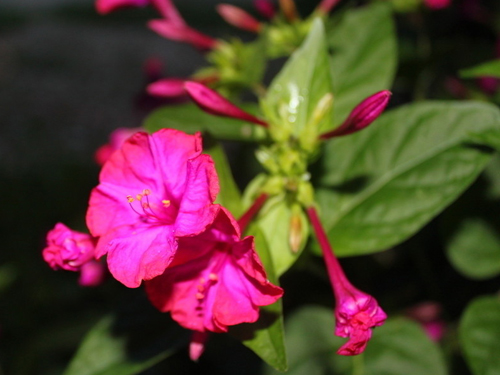
Introduction to growing the four o'clock flower
The four o'clock flower originated in tropical America. It is often cultivated across northern and southern China as an ornamental flower, and sometimes escapes into the wild. The roots and leaves can be used medicinally, with effects of clearing heat and detoxifying, invigorating blood and regulating menstruation, and tonifying. The white powder from the seeds can remove facial spots, moles, and acne. So how much do you know about the four o'clock flower? What uses does it have? What is the method for growing it? Below, the editor will introduce it to everyone, hoping it will be helpful.
Introduction to the uses of the four o'clock flower
Introduction to the four o'clock flowerThe four o'clock flower, also known as yanzhi flower, bathing flower, night-blooming flower, night flower, yejiaojiao, tide flower, grass jasmine, palace pink flower, zhuangyuan red, etc., is a perennial upright herbaceous plant of the genus Mirabilis in the Nyctaginaceae family, often cultivated as an annual flower in production. The achene is spherical, black, with longitudinal ridges and reticulate veins, resembling a landmine, hence also called little landmine. The endosperm inside the seed is white, fine and powdery, and can be used instead of lead powder for facial application; it is a natural ideal cosmetic. The 1000-seed weight is 90-130 grams. The root is spindle-shaped, fleshy, with a brownish-black surface.
It likes sufficient sunlight and tolerates slight semi-shade, but fears scorching sun. It is not cold-tolerant and also fears heat and frost, and likes fertile, loose soil. The suitable temperature for seed germination is 20-22°C. Sandy seedbed soil is beneficial for seedling growth, and it likes moist seedbed soil.
Uses of the four o'clock flower
1. Ornamental value: The four o'clock flower comes in many colors, and its flower shape is as small and lovely as a morning glory; blooming together gives a distinctive beauty. The four o'clock flower does not bloom fully during the day, but at night it is a mass of blossoms and has a light fresh fragrance. It is an ornamental plant that is relatively easy to keep alive. It can be used for potted planting or wild planting.
2. Medicinal value: As a flower of the Nyctaginaceae family, it not only has high ornamental value, but its medicinal value is also immeasurable. The four o'clock flower seeds are black in appearance and round-spherical, but when used medicinally the seeds have the remarkable effect of clearing heat and detoxifying. If ground internally and combined with some ingredients, they can make excellent cosmetic beauty products for removing acne and freckles. The leaves of the four o'clock flower can disinfect wounds and have a detoxifying effect. Placing a pot of four o'clock flower indoors has a good mosquito-repellent effect.
Is the four o'clock flower toxic?
The outer parts of the four o'clock flower are not toxic. So it is still quite suitable for growing, and many of its parts can be made into medicine. However, every medicine has some toxicity, and the roots and seeds of the four o'clock flower are where its toxins are found. Generally, if these parts are eaten by mistake, the symptoms are numbness of the mouth and tongue, followed by reduced hearing, vision, and touch, and body pain. The solution is to induce vomiting or send the person to the hospital emergency department.
How to grow the four o'clock flower
How to grow the four o'clock flower1. Soil: The soil should preferably be fertile sandy or semi-sandy soil. Planting in slightly acidic soil with a pH of 6 to 6.5 can make the root system dense and the growth vigorous.
2. Watering: Jasmine is not drought-tolerant, but it also dislikes waterlogging. On hot sunny days in summer, water twice a day, once in the morning and once in the evening. If the leaves are found to curl and droop, spray water on the leaves to promote growth. In the rainy season, loosen the soil often so that water does not accumulate in the pot.
3. Light: Jasmine likes hot, humid, ventilated, and airy environments and needs sufficient light. Jasmine is a light-loving plant, and its growth and development require sufficient light; long-day direct light is even more favorable for its growth and development. With strong light, the leaves are dark green, the branches are thick and strong, there are many flower buds, the color is good, and the fragrance is strong; if the light is insufficient or the shade is too deep, the leaves are pale green, large, and thin.
4. Temperature: Jasmine is relatively sensitive to temperature and requires a warm, humid climate, and can adapt to higher temperatures; but it is not tolerant of low temperatures and has poor cold resistance. Below 10°C, jasmine grows extremely slowly, or even stops growing. It can sprout at around 19°C, and only develops flower buds above 25°C; at 30-40°C, flower bud formation and development are better.
5. Fertilizing: The hot summer season is the peak growth period for jasmine. Apply more organic fertilizer and phosphorus-potassium fertilizer, such as peanut cake powder, bone meal, superphosphate, and multi-element flower fertilizer, twice a month.
How to grow the four o'clock flower
The four o'clock flower is also known as night-blooming flower, yanzhi flower, bathing flower, and supper flower. The best viewing period for the four o'clock flower is July to October.Ornamental features:
Perennial herbaceous flower, plant height 60 to 100 cm. Several flowers are clustered at the top of the branches; the corolla is salverform with a long tube, with 5 shallow lobes at the tip. The flowers are red, pink, yellow, white, and bi-colored with spots. They generally bloom in the evening or after the sun goes down, are fragrant, and close or wither the next morning. The flowering period is relatively long; in the south it can be grown in the open field and blooms continuously from early summer to late autumn.
Suitable growing environment:
It likes a warm, humid environment and is not cold-tolerant. The suitable growth temperature is 25 to 35°C. It is neither drought-tolerant nor afraid of waterlogging. It likes light and tolerates slight shade, growing well in slightly shaded spots.
Growing methods:
Propagation is commonly by sowing. After flowering it can self-sow; artificial sowing is generally done in spring by direct sowing in the open field or in flower pots. Cuttage propagation can also be used, generally carried out from June to October, and in the south the plum rain season is best. Select robust branches of the current year, cut them into 6 to 10 cm lengths with 3 to 5 buds, keep 2 to 4 leaves, maintain moisture after inserting, and they will take root in about 10 days. In addition, division propagation can be carried out in spring or autumn, and attention should be paid to watering and shading.
Cultivation and care:
During the growing period, apply more organic liquid fertilizer, supplemented by phosphorus and potassium fertilizers. After the flowers fade or are picked, promptly pinch off the tips to encourage new buds to sprout and keep the plant full in shape. To keep it green and evergreen, apply 0.25% ferrous sulfate about once every 15 days. If there is a lack of water or the air humidity is not high, new branches are not easy to sprout, while waterlogging easily causes root rot and leaf drop. It is best to plant it in a place with sufficient sunlight and good ventilation. If the light is insufficient, the leaves are large, the nodes are thin, and the flowers are small.
Courtyard pairing:
The four o'clock flower has rich, brilliant colors, a long flowering period, and fragrance. It can be planted in courtyards, in front of and behind houses, beside fences, and along roadsides, and is especially suitable for arranging places for evening rest or nighttime cooling off.