Cultivation methods for flowering flax (red flax, large-flowered flax)
Flowering flax (red flax, large-flowered flax) scientific name: linum grandiflorum
Morphological characteristics: biennial herb, plant height 40-50 cm. Stems erect, branched at the base. Leaves alternate, grayish-green, linear-lanceolate. Flowers solitary, pedicels slender, flowers nodding, corolla 5-lobed, bright red or peach red, flowers relatively large.
Ecological habits: not cold-tolerant, dislikes extreme heat, not tolerant of waterlogging, not tolerant of fertilizer, prefers sandy soil.
Flowering period: blooms in spring or autumn.
Flower meaning: beautiful sorrow.
Landscape uses: flower beds, flower borders, cut flowers or potted flowering cultivation.
Species identification: species of the same genus --- flax (blue flax) l. perenne has slender stems, drooping tips, and blue flowers. Similar species in name --- nierembergia frutescens, Solanaceae, perennial herb often cultivated as an annual plant. Plant height 20-30 cm, blue flowers, much branched, long flowering period, extensive management. Best suited to rock gardens, flower borders, potted cultivation, and mass planting. Among the commonly cultivated species of the same genus is white-flowered nierembergia n. repens.
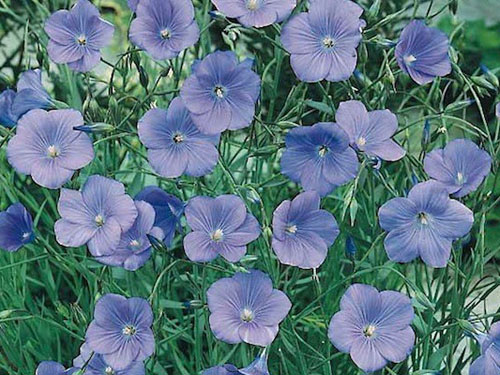
Blue flax planting, propagation methods and cultivation management
Plant name: blue flax; Latin name: Linum perenne L; aliases: perennial flax, blue-flowered flax, perennial herbaceous plant.
Propagation and cultivation: mainly seed propagation. Can also be divided. Seed propagation method: can be divided into spring sowing and autumn sowing. 1. Spring sowing: first wash the seeds with dish soap or laundry detergent, soak for 24 hours, place the seeds in the refrigerator to freeze for 24 hours, after thawing mix the seeds with fine sand, spread them out on a clean ground surface to dry, after drying and loosening, the seedbed should first be watered thoroughly with 1500 times potassium permanganate solution for disinfection, after the water penetrates, then scatter-sow the seeds on the seedling bed soil, cover with fine sandy soil or vermiculite 2 times the thickness of the seed diameter; for pot cultivation, cover with a piece of glass with good transparency, then cover with newspaper of even type for shading; for seedbed cultivation, cover with plastic film and pull up a shade net; after one week the seedlings emerge evenly, then remove the glass or plastic film, and gradually remove the shade net; after the seedlings have 4 true leaves and are relatively strong, prick out the seedlings. After pricking out, cultivate the seedlings indoors or in a shed for about half a month, then place the seedlings in a well-ventilated place for 3-5 days, then move them out of the room to harden off, and only after half a month of hardening off can the seedlings be planted out in the ground, with a planting spacing of 25-30 cm. Because the seedlings are slender and weak and easily overwhelmed by weeds, therefore frequent cultivating and weeding should be done, and fertilizing should also be done lightly and repeatedly. 2. Autumn sowing: autumn sowing is generally carried out from late September to mid-October, sown in an open-field seedbed, the seedbed is generally 10 m long and 1 m wide, scatter-sow or drill the seeds on a level and finely prepared seedbed, the sowing density can be relatively lower, so that transplanting is not necessary.
Blue flax can also use the division propagation method, dividing plants in combination with transplanting, but with this method the propagation quantity is easily limited by the source of seedlings.
Flowering flax
[Scientific name] Linum grandiflorum
[Alias] flowering flax
[Family and genus] Linaceae, Linum
Native to North Africa. Not tolerant of severe cold, dislikes extreme heat. Not tolerant of waterlogging, not tolerant of fertilizer, requires well-drained sandy soil. Plant height 40-50 cm, stems erect, branched at the base. Leaves alternate, grayish-green, linear or linear-lanceolate. Flowers solitary, bright
red or peach red, borne at the tips of the pedicels. Flower diameter 2.5-3.8 cm. Blooms in spring or autumn. Capsule spherical, seeds obovate, grayish-brown. Spring-sown or autumn-sown flowering flax has an elegant plant form, used for flower beds, cut flowers or potted flowering cultivation.