How to care for the bottle palm (Beaucarnea recurvata)? Detailed guide to cultivation and propagation
The bottle palm (Beaucarnea recurvata) is an evergreen succulent plant in the Asparagaceae family. Its stem is upright, with a particularly swollen base that resembles a wine bottle. At the top of the stem, a cluster of downward-arching, ribbon-like, slightly leathery blue-green leaves grows, closely resembling an elegant orchid, which is why it is named the bottle palm.
It likes ample sunlight, and its optimum growing temperature is 20-25°C. When grown outdoors, it needs appropriate shading in summer, and in spring and autumn it should be placed in a spot with ample light. During the growing season, sufficient fertilizer and water supply helps promote swelling of the stem base. However, watering must not be excessive, otherwise it easily leads to root rot. The bottle palm is not cold-tolerant; in northern regions, bring it indoors before frost, and it can safely overwinter if the room temperature is maintained above 5°C.
For pot cultivation, it is best to choose a tall pot, and the pot should not be too large. The pot's diameter should be about 1/3 larger than the diameter of the bottle palm's stem base. The potting soil can be prepared by mixing garden soil and sandy soil with a small amount of bone meal. Usually repot once a year; when repotting, remove the old soil around the root ball and replant it in a pot one size larger.
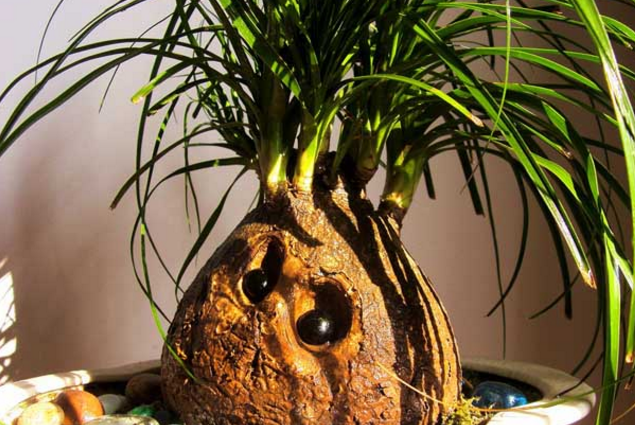
The growing environment of the bottle palm plays a major role in its propagation. Generally, an ambient temperature of 16-28°C is optimal, and in such a high-quality environment the bottle palm will thrive. Now let's get to the main topic: how to propagate the bottle palm. It can be roughly divided into two major categories, one is the seed-sowing propagation method, and the other is the cutting propagation method. Regarding these two propagation methods for the bottle palm, below the editor brings you a detailed introduction.
II. Propagation methods of the bottle palm / details matter a lot
(1) Sowing
Selecting seeds: In the propagation methods of the bottle palm, sowing is a very important step. Whether the seeds are good or bad will directly determine how robust the bottle palm will be in the future. It is best to choose new seeds from each year; the shorter the storage time, the better, because the newer the seeds, the relatively higher the germination rate of the bottle palm will be. Also, when selecting seeds, be sure to check whether there are pests or diseases.
Sowing method: When sowing, first use a tool to place them on the surface of the substrate, with a covering thickness generally of about 1 cm. Then place the flowerpot in water, letting the water reach half the height of the pot, and let the water slowly soak in. Larger seeds can be placed directly into the substrate and covered, with a thickness generally 2-3 times that of the seed, and then they can be watered. But do not water too much; just moisten the substrate. When watering, it is best to choose a spray bottle and not water directly, otherwise the seeds may be washed up.
(2) Cuttings
Temperature management: For bottle palm cuttings, the temperature is best controlled at 20-30°C, because if the temperature is too low, it will cause the cuttings to root slowly, and if the temperature is too high, it easily causes the bottle palm to develop a pathogen infection. The higher the temperature, the easier the infection, so controlling the temperature is very important.
Light management: The vast majority of plants cannot do without sunlight. Bottle palm cuttings need to carry out photosynthesis, so that they can produce nutrients for the plant to take root and sprout. Of course, the light also cannot be too strong, as this is not conducive to propagation. It is best to shade about two-thirds of the sunlight.
Humidity and moisture: In addition to the above two points, bottle palm cuttings also need to ensure air humidity, with 75%-85% being optimal. Of course, all of this is after rooting, because if there is no rooting, the cuttings cannot absorb water to maintain the internal growth balance. Therefore, we need to use misting to reduce water evaporation.