Care methods and precautions for potted Golden Camellia
For potting, it is best to use a growing medium made from leaf mold or peat soil mixed with some garden soil and river sand. To promote rapid growth, it should be planted in a well-ventilated clay pot. When planting, it is best to choose a deep cylindrical pot. Before potting, first place a layer of broken tile pieces at the bottom of the pot to improve drainage; then apply a small amount of decomposed cake fertilizer powder or bone meal on top as a base fertilizer, and cover the fertilizer with a layer of growing medium; then place the seedling in the center of the pot, straighten it, and fill in the growing medium layer by layer, firming it as you fill, finally leaving about 3 cm of the pot rim. After planting, water thoroughly and place it in a semi-shaded spot for cultivation. After the seedling has recovered, move it to normal care.
The best time for transplanting and potting is early spring or late autumn. During the seedling stage it prefers shade, and after entering the flowering stage it prefers scattered light. Normally, do not water too much; it is best to follow "water when dry, stop when wet." In summer, when temperatures are high, watering needs to be sufficient, but not so much that water accumulates in the pot. At the same time, spray clean water on the branches and leaves 2~3 times each morning and evening to increase air humidity. Although it tolerates poor soil, it also likes fertilizer. During the seedling stage, apply thin fertilizer frequently to promote rapid growth. For mature plants, generally apply 1~2 times each of fully decomposed dilute cake fertilizer water or 0.1% compound fertilizer before and after flowering.
After winter begins, move it to a cold room to overwinter. Usually, repot once every 2~3 years in early spring after flowering. When repotting, cut off rotten roots, add new growing medium, and plant it with the original soil ball into a pot one size larger. Generally, no special pruning is needed; simply cut off leggy branches and diseased or pest-infested branches. If anthracnose damage is found, spray 75% thiophanate-methyl 1000x solution at the early stage of the disease for control. If pests such as small green leafhoppers or tussock moths cause damage, spray 40% dimethoate 1000~1200x solution for control.
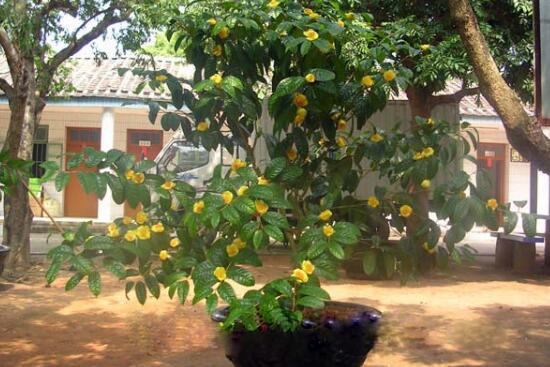
Wanting to grow Golden Camellia indoors is not a simple matter. First, we need to understand the growth habits of Golden Camellia, and then create the most favorable growing environment for it at home. So how do you grow Golden Camellia? The editor will explain this in detail from the aspects of soil, water and fertilizer, temperature, and more. Let's continue reading below.
II. Cultivation methods and precautions for Golden Camellia
1. Potting soil
How do you grow Golden Camellia? If it is indoors, potted soil is naturally indispensable. According to its growth habits, there are also strict requirements for choosing flower pots and soil, as follows:
Soil: Golden Camellia prefers loose, fertile, well-drained acidic soil, so the editor recommends using soil mixed from leaf mold/peat soil, garden soil, and river sand.
Flower pot: It is best to use a clay pot for growing Golden Camellia, because this kind of pot has better drainage and air permeability, which is beneficial to root development. As for the size of the flower pot, it should be determined according to the size of the seedling being potted.
2. Watering
In the cultivation methods for Golden Camellia, watering is certainly indispensable. It is understood that Golden Camellia prefers a semi-shaded, semi-cool environment with moist air, so while watering daily, you should also sprinkle water around the flower pot to increase humidity.
Precautions: Because Golden Camellia prefers acidic soil, when watering, be sure to add a small amount of ferrous sulfate. This can keep the growing environment of Golden Camellia weakly acidic at all times, which is very beneficial to its growth.
3. Fertilizing
If you want Golden Camellia to grow well, besides watering, fertilizing is naturally indispensable. According to research, Golden Camellia likes fertilizer, but it should not be too much. Generally, fertilize once every week. Fertilizer options include diluted sour milk, or fertilizer water made from fermented soybeans, etc. These can be applied directly to the flower pot.
Precautions: In addition to daily fertilizing, before and after flowering, apply one time each of fully decomposed dilute cake fertilizer water or compound fertilizer. In addition, when fertilizing Golden Camellia, you must not apply raw fertilizer, otherwise the plant will develop root rot.
4. Temperature
How do you grow Golden Camellia? Temperature regulation is also very important. It is understood that Golden Camellia is a shade-tolerant tree species and likes a moderately warm ecological environment with high humidity and little light. It grows very well within 20~25°C, so you can control plant growth by adjusting the temperature.
5. Pruning/pests and diseases
In the process of growing Golden Camellia, pruning is generally rarely needed. If pruning is necessary, simply cut off leggy branches and diseased or pest-infested branches. In addition, pests and diseases need to be prevented and controlled. When encountering diseases such as anthracnose or pests such as small green leafhoppers, spray chemicals immediately. As for what to spray, there is a detailed introduction in the pest and disease control section for Golden Camellia, so it will not be repeated here.
How do you grow Golden Camellia? The complete guide to Golden Camellia cultivation and care
Characteristics of Golden Camellia: The flowers are golden yellow and dazzling, with beautiful flower forms and high ornamental value. They are much loved by people in daily life. Recently, many friends who like flowers and plants have asked the editor how to grow Golden Camellia. In fact, the method is very simple. Just pay attention to soil, water and fertilizer, and flowering period management. Below is a detailed complete guide to Golden Camellia cultivation and care for everyone's reference.
Growing environment
Golden Camellia prefers a warm, humid climate and a semi-shaded, semi-cool, moist environment. During the seedling stage it prefers shade, and after entering the flowering stage it quite likes transmitted sunlight. This plant tolerates poor soil, also likes fertilizer, has strong waterlogging tolerance, and is not cold-tolerant.
Soil management
Golden Camellia is not picky about soil and likes to grow in well-drained slightly acidic to neutral soil. For potting, a mix of leaf mold, garden soil, and river sand can be used.
Water and fertilizer management
Golden Camellia prefers weakly acidic soil, so when watering, a little ferrous sulfate can be added to maintain a certain weak acidity in the soil and water. It likes fertilizer and needs fertilizing once a month, mainly with organic soybean cake fertilizer water or nitrogen-phosphorus-potassium fertilizer. Stop nitrogen fertilizer after flower buds appear, and apply phosphorus-potassium fertilizer during the flowering period to promote more buds and larger flowers.
Sunlight management
Golden Camellia prefers semi-shade. During the growing period, maintain weak light in the morning and evening. In hot summer, shading is needed to avoid direct sunlight. During the flowering period, keeping the air circulating is beneficial to flowering.
Temperature control
The suitable growth temperature for Golden Camellia is 15~30°C. When the summer temperature reaches 30°C, shade is needed, and when the winter temperature reaches 5°C, attention should be paid to keeping it warm.
Flowering period management
Golden Camellia blooms only after 3~5 years of planting. For potted plants, when the seedling is 30 cm tall, pinch off the growing tips to maintain the plant shape. After the plant buds, you can cut off some weak branches' flower buds, inward-facing flower buds, overly dense flower buds, and deformed flower buds. This concentrates nutrients, makes the flowers larger, and can also prolong the flowering period. Golden Camellia does not fully open until November, and it blooms until March of the following year, with the peak flowering period lasting 1~2 months.
Pest and disease control
Mature Golden Camellia is prone to pests and diseases; just pay attention to prevention and control!
Golden Camellia is a very beautiful flowering plant. Its flower color is golden yellow, as if coated with a layer of wax, crystalline and glossy. Its flower form is delicate and charming, elegant and refined. It is very popular among those who like flowers and plants. With such a beautiful flower, everyone can try planting it according to the care tips shared by the editor.