What are the key points of magnolia cultivation and management? Explained clearly in one article
Magnolia is also known as white magnolia. It is a deciduous tree. The flowers are large, pure white, and delicately fragrant. The calyx and petals are difficult to distinguish, 9 in total, and they open before the leaves. Other commonly cultivated plants of the same genus include purple magnolia, Zhusha magnolia, night-fragrant magnolia, and southern magnolia.
① The planting site for magnolia should be chosen to be wind-sheltered, sunny, with high and dry terrain, good drainage, and deep, loose, fertile soil. Transplanting is best done in spring after the flowers fade and the leaves have just begun to unfold. When transplanting, a soil ball must be kept, and leaves should be appropriately pruned to reduce water evaporation. When pruning leaves, be careful to retain the petioles to protect the axillary buds. Before planting, apply sufficient decomposed organic fertilizer at the bottom of the pit, and water thoroughly after planting.
② During the growing period, apply liquid fertilizer 1-2 times as appropriate. After planting, apply a quick-acting liquid fertilizer once before and after flowering each year in combination with watering, and the flowers will be large and strongly fragrant. After the dog days begin, open a trench and apply topdressing once more to promote the formation of more flower buds in late summer, which is beneficial for flowering the following spring.
③ Magnolia has few branches, and because its wound-healing ability is relatively poor, it is generally not pruned. However, dead branches, pest- and disease-damaged branches, and branches that disrupt the tree shape should be cut off after the flowers fade, when the leaf buds begin to extend. After the flowers fade, if seed is not to be kept, the follicle fruit clusters should be cut off to avoid consuming nutrients and affecting flowering the following year.
④ In the north, during the initial planting period, soil should be mounded around the base or straw wrapped for cold protection in winter. The key management points for open-field cultivation of magnolia in the north are preventing drought in spring, preventing waterlogging in summer, avoiding dampness in autumn, and preventing cold in winter.
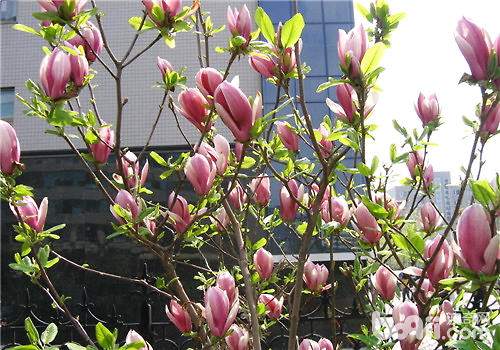
Purple magnolia
Water and fertilizer:Purple magnolia prefers moisture and fears waterlogging, so timely and appropriate watering is very important. From the beginning of spring to flowering, keep the potting soil moist but not wet; after flowering, keep the potting soil moist but not waterlogged; after leaf fall, keep the potting soil slightly moist but not dry. At no time should it be drought-stricken or waterlogged, and especially during the rainy season, attention should be paid to drainage and waterlogging prevention.
Purple magnolia prefers fertilizer. Fertilization should seize the two key periods: 2 months before flowering and 5 months after flowering. Apply a nitrogen-phosphorus-potassium compound fertilizer about once every ten days. The former makes the buds swell and the flowers open, while the latter promotes more bud formation and more flowers the following spring. When leaves fall in early winter, apply a fertilizer mainly of phosphorus and potassium once to enhance its cold resistance and overwintering ability; at other times, apply less or not at all. Avoid applying nitrogen fertilizer alone.
Light and temperature:Purple magnolia prefers light. Placed in a sunny courtyard or rooftop garden, it grows robustly and luxuriantly with more sunlight. Under semi-shaded conditions it can still grow, but it is weaker and produces fewer flowers; in too much shade it produces no flowers. It is relatively cold-tolerant, and in Beijing and areas to the south it can overwinter outdoors.
Pruning:Purple magnolia has strong root sprouting ability. If propagation is not needed, cut them off as they grow, and only 3 main stems per pot need to be kept. For branches that are too tall or too long, they can be shortened after flowering when the leaves have just unfolded. Because its wound-healing ability is poor, sulfur powder should be applied after cutting for antisepsis; if unnecessary, do not prune. After flowering, if seed propagation is not needed, the spent flowers should be cut off together with the receptacle.
Propagation methods and key cultivation management points of Hongyun magnolia
How is Hongyun magnolia cultivated? What is the difference between Hongyun magnolia and red magnolia? The main difference is that in the south, 'Hongyun' magnolia blooms three times a year in spring, summer, and autumn, with the petals red on the outside and white on the inside. Let's learn about the variety characteristics and propagation methods of Hongyun magnolia together.
1. Morphological characteristics
Hongyun magnolia is a deciduous shrub with a fragrant scent, and the petals go from purple-red, deep red, and light red to white from outside to inside. Petal-like, elliptic-obovate. The aggregate fruit is dark purplish-brown, turning brown, cylindrical. The mature follicles are nearly spherical, with a short beak at the apex.
2. Growth habits
It prefers sunlight and grows suitably in warm and humid environments. It is slightly tolerant of semi-shade and tolerant of cold. It can overwinter outdoors in most areas of our country. It is suitable for growing in fertile, moist, well-drained acidic sandy soil, and can also grow in weakly alkaline soil. Because it has fleshy roots, it is neither tolerant of drought nor of water accumulation. It should be planted in wind-sheltered, sunny areas without standing water.
3. Propagation
3.1 Cutting and layering propagation
In cutting propagation, the cutting time has a great effect on the survival rate. It is generally carried out from May to June, and the survival rate is highest when the cuttings are current-year branches from young trees. Soaking the base in 50 ppm naphthaleneacetic acid for 6 hours can increase the rooting rate. In layering propagation, select a well-growing plant and take a 1-2-year-old branch 0.5 cm thick as the layer. If there are branches, they can be layered on the branches. The layering time is February to March. The longer the layered branch remains connected to the mother plant after rooting in the same year, the more developed the root system and the higher the survival rate. After planting, it can bloom in 2-3 years.
3.2 Grafting propagation
In South China, from December of the previous year to January of the following year, select from an adult mother tree of 'Hongyun' magnolia a robust, pest- and disease-free, plump-axillary-bud, dormant one-year-old branch as the scion, cut off the leaves, and retain part of the petiole, with the petiole length equal to or slightly shorter than the axillary bud. Select a robust 2-3-year-old yellow magnolia with a well-developed root system and no pests or diseases as the rootstock.
Using the cut grafting method:
(1) Scion cutting. On the side of the scion with long axillary buds, use a grafting knife to cut a flat surface about 2-3 cm long, with the depth best being to cut away the phloem and expose the xylem, then cut a short 45° cut surface on the opposite side to ensure the lower end is flat and thin.
(2) Rootstock cutting. According to the size of the scion, make two vertical cuts on the rootstock where the bark is thick, smooth, with straight grain, and without scars or pests and diseases, with the depth preferably not injuring the xylem of the rootstock, and the length matching the length of the long cut surface of the scion.
(3) Joining. Use the tip of the grafting knife to lift the bark of the rootstock, insert the long side of the scion toward the xylem of the rootstock into the rootstock incision, so that the xylem of the scion and rootstock fit closely together.
(4) Wrapping. Use grafting film to wrap the rootstock and scion tightly and securely to prevent rain and pathogens from entering and to maintain humidity. The axillary bud is wrapped with only one layer of grafting film to prevent the axillary bud from being unable to break through the grafting film due to too many wrapping layers, thus failing to grow and eventually dying.
(5) Post-grafting management. Determine the amount of water by observing the water mist inside the grafting film. Fine, uniform water droplets all over the grafting film indicate that the rootstock moisture is suitable. If water flows abundantly over the rootstock inside the grafting film, it indicates too much water, and water control should be carried out. If there is very little water mist inside the grafting film, it indicates a lack of water, and watering should be done immediately. As the scion sprouts and grows, the water requirement gradually increases. When the scion grows to 30-40 cm, remove the film at the joint, and then manage according to the normal water requirement of seedlings, that is, water once every 2-3 days. For scions that grow too tall and too vigorously, place a wooden stick beside the rootstock and gently tie the scion to the stick with rope to prevent strong wind from causing breakage at the joint between the scion and rootstock. The survival rate of grafted seedlings propagated by this method can generally reach about 80%.
'Hongyun' magnolia has a ground diameter of 1.5 cm and a height of more than 1.5 m. In the winter of the following year, cut the main trunk at 0.8-1.0 m above the ground. In the winter of the 3rd year, select and retain one thick strong branch as the main trunk, appropriately prune the side branches, and gradually prune the crown into an oval shape year by year, so that the seedlings can leave the nursery for planting and landscaping.
For tissue culture, in January select 'Hongyun' magnolia branches with buds, cut them into lengths of about 2-3 cm, gently scrape off the dense long silky hairs on the buds with a blade under running water, and rinse for 30 minutes, disinfect with 70% alcohol for 30 s + 0.1% HgCl2 for 14 minutes, then rinse with sterile water 5-8 times, cut the explants shorter and inoculate them on MS basic medium, with a light duration of 16 hours per day, light intensity 2000 lx, temperature 25 °C ± 1 °C, in the tissue culture room for 4-5 weeks. Then inoculate them on the best medium for bud proliferation (MS + BA 0.5 mg/L + NAA 0.5 mg/L + KT 1 mg/L) to differentiate adventitious buds.
4. Cultivation management
4.1 Transplanting
Planting should be neither too early nor too late. It is most suitable to plant 10 days before germination in early spring or after the flowers fade and before the leaves unfold. After seedlings from sowing emerge, appropriate shading is needed during the hot summer season in the first 1-2 years, and in northern regions cold protection should also be provided after winter begins. The best transplanting time is before bud break, or just after the flowers fade and before the leaves unfold. When transplanting, regardless of seedling size, the roots must be kept with a mud ball, and care should be taken to avoid damaging the root system as much as possible to ensure survival. At the same time, try to avoid planting in low-lying areas prone to water accumulation.
4.2 Temperature
'Hongyun' magnolia does not have very strict temperature requirements. However, in hot, high temperatures it needs moderate shading or cooling. From 12:00 to 16:00 each day, avoid harsh sun exposure, and also avoid high-temperature radiation from brick walls or cement floors. At this time, not only should water be sprayed on the plants to cool them, but water should also be poured or sprayed on the ground to cool and dissipate heat, so as to increase air humidity. For overwintering in the north, the main trunk needs to be wrapped with straw rope or burlap, and the root system should be watered thoroughly before winter begins.
4.3 Light
'Hongyun' magnolia needs sufficient sunlight. During the growing period, it should be maintained in a sunny place with long sunshine duration and strong light. Daily light must not be less than 6 hours. If planted in a shaded place, it will only grow leaves and not bloom, or bloom very little, with slender branches, pale leaf color, thin leaves, and no luster, which is unfavorable for growth.
4.4 Moisture
'Hongyun' magnolia both needs water and fears water accumulation. At the seedling stage, from summer to early autumn, water once a day to keep the soil moist, but in the hot summer, water once each in the morning and evening, and spray water on the leaves to increase air humidity. When irrigating with tap water, prevent soil alkalinization. If leaf yellowing is found, apply ferrous sulfate water or use 0.7%-0.8% vinegar water to water the roots, or use 0.3%-0.4% vinegar solution to spray the leaves; the effects are all very good. In the rainy season, water must not accumulate, otherwise the roots will rot.
4.5 Fertilizer
Because 'Hongyun' magnolia has a long flowering period and blooms many times, nutrients must be replenished regularly. In addition to applying sufficient base fertilizer at planting, from March to October during the flowering period, apply an organic liquid fertilizer mainly of phosphorus and potassium once every 10 days (such as decomposed cake fertilizer water). The fertilization principle is to apply thin fertilizer frequently, and a method of first dilute then concentrated can also be adopted. Raw fertilizer must not be applied, otherwise it will burn the roots. At the same time, carry out foliar fertilization once every half month, using 0.5% plant growth promoter and 0.3% potassium dihydrogen phosphate for leaf spraying.
5. Pest and disease control
At the seedling stage, prevent damping-off, root rot, and underground pests such as white grubs. The stems may be damaged by longhorn beetles, and in midsummer red spider mites should be prevented. In the management process, in addition to paying attention to preventing yellowing disease and root rot, anthracnose should also be controlled. If disease is found, promptly remove diseased plants and leaves, and at the same time spray the leaves with a 50% carbendazim 500-1000 times aqueous solution, or use 70% thiophanate-methyl 800-1000 times solution for control. If aphids or scale insects are found damaging young buds and flower buds, 10% imidacloprid 1000 times solution or 5% thiamethoxam 750-1000 times solution can be used for control.
The above is all the content on the propagation and pest and disease control cultivation techniques of Hongyun magnolia. Flower farmers who are interested are welcome to come to Huinong Network to learn more!