What conditions are needed for the Jerusalem cherry to have bright, colorful fruit?
The Jerusalem cherry, also known as coral cherry, lucky fruit, coral seed, coral bean, jade coral, red coral, wild chili, wild sea pepper, false winter cherry, and four-season fruit. It is an upright small shrub in the Solanaceae family. Its leaves are oblong or oblanceolate. The flowers are solitary or clustered in the leaf axils, with a white corolla. The fruit is spherical, turning red or yellow when ripe.
(1) It likes warmth and a sunny environment. If placed in a dark spot, the branches and leaves tend to grow leggy, with few flowers and small fruit, or even no fruit at all. The Jerusalem cherry is propagated by sowing, mostly in early spring. After the seedlings are planted out, pinch the tips 2-3 times to encourage more branching.
(2) During the growing period, apply a dilute cake fertilizer solution once every half month, and keep the potting soil moist at all times. Pause fertilizing during the flowering period and control watering appropriately; if too much water is given at this time and the potting soil is too wet, flowers and buds are likely to drop. Once the fruit has grown to the size of a mung bean, gradually increase watering and apply liquid fertilizer as usual. From the bud stage to the young fruit stage, apply fast-acting phosphorus fertilizer 2-3 times to make the fruit larger and more brightly colored. In the north, bring it indoors for the winter and keep the room temperature above 10°C. During overwintering, keep the potting soil on the dry side; if the soil is too wet at this time and the room temperature is low, the fruit is likely to drop.
(3) When the plant grows too vigorously, prune and shape it appropriately to keep the plant neat and to favor fruiting. In summer, during hot and rainy seasons, it is susceptible to anthracnose; after the young stems are infected, dark brown streaks appear, and when the lesions encircle the top of the branch, it withers, and in severe cases the whole plant dies, so spray promptly to control it.
(4) If you want it to continue flowering and fruiting the second year, repot it in early spring. When repotting, cut off part of the old roots, remove some of the old soil, and add fresh potting mix made of garden soil and sand. Prune the branches along with repotting so that it sends out new growth, and it can continue to bloom and bear fruit.
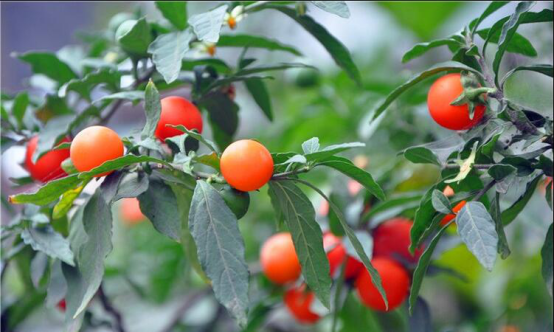
The flower language of the Jerusalem cherry is that tomorrow will be happy. Wouldn't you also like to grow a green plant with such a beautiful meaning? After reading the introduction above, I believe you won't be poisoned by the Jerusalem cherry and can grow it with confidence.
How to prune the Jerusalem cherry
Because the Jerusalem cherry is a fruit-ornamental plant, when pruning, take care to highlight its fruit. We can cut off the branches and leaves at the top of the whole plant so that more fruit is revealed, making the bright red fruit and green leaves echo each other from afar, which is very beautiful. After the fruiting period has passed, shorten the old branches and dense branches of the Jerusalem cherry, and cut off diseased and weak branches, to help it grow new branches the following year.
So there are several reasons why the Jerusalem cherry does not bear fruit. My friend must now know how to truly take good care of his Jerusalem cherry! I also hope the added pruning method for the Jerusalem cherry can help you, so that your Jerusalem cherry bears more fruit and looks even better!