Why can Kalanchoe blossfeldiana live so long? A full analysis of the reasons
Kalanchoe blossfeldiana is also known as Shouxing flower, dwarf kalanchoe, and Christmas kalanchoe. It is a perennial evergreen succulent plant of the Crassulaceae family. The stems are upright; the leaves are fleshy, opposite, elliptic-oblong, dark green and glossy, with slightly reddish edges; the paniculate cyme bears flowers in colors such as scarlet, peach red, orange red, yellow, and white; the flowers are small, arranged tightly and clustered into balls. Its natural flowering period generally starts in late December and can last until early May of the following year, which is why it is called the longevity flower.
Kalanchoe blossfeldiana is a short-day plant, and the flowering period can be advanced or delayed by regulating day length and temperature to achieve year-round flowering. There are many horticultural cultivars. Commonly cultivated plants of the same genus include Yu Haitang, whose flowers are bright red and open in winter, making it an excellent indoor potted flower for winter; Yu Diao Zhong, whose leaves are variegated in yellow, green, and pink, making it a fine indoor potted foliage plant; and Huaye Chuanlian, whose light yellow leaves bear brownish-purple spots. It produces yellow flowers in spring and summer.
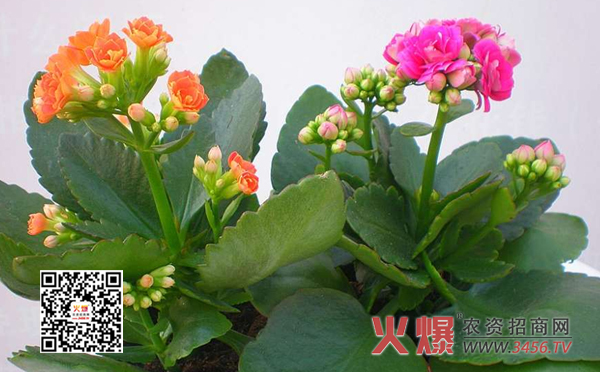
The main reasons why Kalanchoe blossfeldiana does not bloom are as follows:
First, we know that for a plant to bloom, sufficient sunlight and fertilizer are indispensable. According to the editor's understanding, many flower growers are used to not repotting for years. According to observation, some cultivars of Kalanchoe blossfeldiana naturally age at the root and stem after two years, and may even become withered and rotten. Because Kalanchoe blossfeldiana is relatively easy to propagate, and can be easily propagated by cuttings or leaf cuttings, we suggest that flower growers plant robust Kalanchoe blossfeldiana that is 1-2 years old.
Light: Kalanchoe blossfeldiana likes a sunny and well-lit environment. At noon in midsummer, it should be protected from strong direct sunlight. At other times, it can be placed in a sunny spot. It needs at least 4 hours of direct light every day to grow robustly. To make the Kalanchoe blossfeldiana plant bloom evenly, care should be taken to frequently change the direction of the flowerpot so that the plant receives light evenly. On a balcony of a building, the flowerpot should be turned 180 degrees every half month. Although it can also grow in semi-shade, the stems are thin, the leaves are thin, the flowers are few, and the color is pale, far less luxuriant than in a sunny spot. If it is too shady, it will not only easily drop leaves and fail to bloom, but even a plant that has already bloomed, if placed in shade, will have duller flower color, and then the flowers will fall off and wither.
The effect of fertilizer on Kalanchoe blossfeldiana: Kalanchoe blossfeldiana likes fertilizer. Half a month after young seedlings are potted and planted, or half a month after old plants are divided, a nitrogen-based liquid fertilizer can be applied 2 to 3 times to promote stem and leaf growth. After flowering, a nitrogen-based liquid fertilizer can be applied once to promote recovery and vigor. At other times, except for stopping application in summer, only a compound fertilizer of nitrogen, phosphorus, and potassium can be applied. When fertilizing, do not get fertilizer on the leaves, otherwise the leaves are prone to rot. If the leaf surface is accidentally dirtied, it should be rinsed off with water. Kalanchoe blossfeldiana has a long flowering period, so the rule of not fertilizing during the flowering period should be broken. Apply a dilute nitrogen-phosphorus-potassium fertilizer or a 0.2% potassium dihydrogen phosphate solution once a month so that later flowers do not become smaller and paler due to lack of fertilizer.
From the time Kalanchoe blossfeldiana is brought indoors at Frost's Descent until October of the following year is exactly the late stage of flower bud differentiation and the full flowering period of Kalanchoe blossfeldiana, so the demand for fertilizer is great. Before flowering, apply a fishy-smelling fertilizer mainly based on phosphorus and potassium once a week to promote flower bud differentiation. During the flowering period, mainly apply quick-acting potassium dihydrogen phosphate, with a concentration of 2%, once every 10 days.
The above are the main reasons why Kalanchoe blossfeldiana does not bloom. Kalanchoe blossfeldiana is still relatively easy to grow. Its flowering period generally starts in December. I hope everyone will care for Kalanchoe blossfeldiana attentively, for everyone to enjoy.
Why does Kalanchoe blossfeldiana not bloom? Three clever tips to make Kalanchoe blossfeldiana bloom quickly
Many friends, when they first buy Kalanchoe blossfeldiana in the first year, have flowers bursting from the pot, a beautiful sight beyond description. By the second year, the plant becomes thinner, the leaves become smaller, and when the flowering period arrives, it only grows taller without blooming, or the blooms are sparse, with only a few flowers before they wither. The editor has also had such an experience; only after going through it does one think about it. First, when you encounter a problem, do not rush. Growing flowers is delicate work. As long as the method is right, the flowers can be grown well. Today the editor shares a few points about why Kalanchoe blossfeldiana does not bloom and some care techniques, hoping to be helpful to flower growers.
Share 3 reasons for not blooming: pinching, fertilizing, and controlling short-day conditions. The third point is the most important!
Regular pinching
Pinching is what we often call removing the top. Starting in autumn, Kalanchoe blossfeldiana enters its vigorous growth period, and its growth will be very good. If it is not pinched, the stems will grow relatively long, leaning in all directions, and the plant will become slender, with nutrients all consumed on this. After summer, it can be pinched, preferably pruned in one go. The purpose of pinching is, on the one hand, to control wild growth so that the whole plant remains low, sturdy, and attractive, and on the other hand, to avoid consuming unnecessary nutrients. Remember not to pinch too late. If flower buds have already formed, do not pinch again.
Apply light fertilizer frequently
Kalanchoe blossfeldiana likes fertilizer. This does not mean you can fertilize arbitrarily. Remember to apply light fertilizer frequently. Only when the branches and stems are thick and strong can the flowers be abundant during the flowering period. After summer, fertilization can begin, mainly with water-soluble fertilizer, at least once a month (if you know your plant well, once every 10 days). Remember to apply fertilizer in the soil, not spray it on the branches and leaves. Kalanchoe blossfeldiana has a long flowering period, and fertilization is also needed during the flowering period. As long as it is light fertilizer, there will not be any big problem.
Control short-day conditions
Kalanchoe blossfeldiana is a short-day plant. Based on the above 2 points, then just wait for it to bloom. Starting in October, short-day treatment can be done (in northern regions it can be earlier), continuously for 1.5 months, without interruption on any day.
It is recommended to place Kalanchoe blossfeldiana in a dark, lightless area for 13-14 hours each day. If necessary, make an artificial light-blocking cover to avoid nighttime light exposure. The editor generally places Kalanchoe blossfeldiana in a dark, lightless environment from 6 p.m. each day to 7 a.m. the next morning. Pay attention to keeping it warm. Persist every day during this period, and flower buds will begin to differentiate, numerous and dense. After blooming, the flowers will be full and abundant, and by mid-to-late November there will be the joy of flowering.
Everyone knows the flowering period of Kalanchoe blossfeldiana. As long as short-day conditions are well controlled and the pattern of long nights and short days in winter and spring is simulated, Kalanchoe blossfeldiana can also bloom in summer.