How to prune and shape Bougainvillea? A full analysis of methods and techniques
Bougainvillea is a vine plant with very strong branching ability. To keep its tree shape graceful, it needs frequent pruning and shaping. When the seedlings grow 5-6 leaves, remove the terminal bud and keep 3-4 leaves, after which 3-4 branches will sprout; when the branches grow 5-6 leaves, pinch them again.
Repeat pinching several times to form a full crown. For pruning perennial old plants, usually two times a year are needed: one is combined with repotting in early spring, cutting off overly dense branches, weak branches, diseased and pest-infested branches and leggy branches from the base; the retained branches should also have their top shoots cut short;
the other is after the flowers fade and before new shoots grow, thinning branches appropriately as needed, cutting off dead branches, overly dense branches and inner branches; the retained branches are cut to about 30 cm long with the top shoots removed, and at the same time all side branches are cut short to encourage more new branches, so that more flower buds can form and abundant flowering is ensured year after year.
Old plants that have grown for 5-6 years should be heavily pruned, that is, each retained branch keeps only 2-3 buds, so that they sprout new branches again and the tree vigor is renewed.
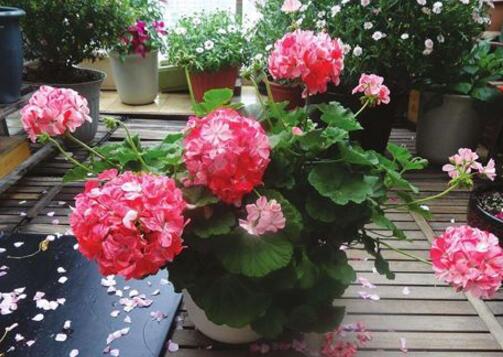
I. What to do when Geranium leaves turn yellow / care precautions
There are many possible causes of yellowing Geranium leaves; improper daily care as well as pests and diseases can both lead to this kind of problem. If it is caused by pests and diseases, you can refer to the article on pest and disease control for Geranium, which has detailed control methods, so I will not describe them at length here.
II. How to prune and shape Geranium
1. Choose pruning tools
Regarding how to prune and shape Geranium, the pruning tools are key. When choosing tools, it is best to choose sharper ones, so that the pruning looks neat and natural. If you choose too blunt ones, it is very easy to crush and damage the plant; this is something to pay attention to when pruning.
2. Prune according to the variety
Before pruning Geranium, also pay attention to the variety, because different varieties require different pruning methods. For example, hybrid Geraniums have rather messy natural branching, so when pinching, the effect will not be as obvious as with other varieties.
3. Pruning methods
Regarding how to prune and shape Geranium, mastering the method is very important. Generally, pruning is done according to its growth vigor; usually 3-5 main branches can be kept, and other branches that grow too densely, too long, or weakly can be pruned directly from the base.
Then shorten the main branches and side branches of the Geranium, keeping only the robustly growing side branch on each side branch. In this way the distribution of the whole branch system will appear even and compact, and the plant shape will appear full and short and sturdy.
How to prune and shape Bougainvillea
Bougainvillea has a high branching rate and is also a vine plant. To maintain its graceful tree shape, it needs frequent pruning and shaping. Generally, pruning can be done twice a year. One is combined with repotting, cutting off overly dense branches, weak branches, diseased and pest-infested branches and leggy branches from the base. The retained branches should also have their top shoots cut off. The other is to thin branches appropriately after flowering and before new shoots grow, cutting off dead branches, overly dense branches and inner branches; for horizontal branches, only the top part is cut off to keep the tree shape symmetrical. During the growth of new branches, their top shoots should also be cut off in time to promote more new branches, so that more flower buds can form and abundant flowering is ensured year after year. After repeated pruning in this way, a round-headed crown with many branches, dense flowers and a graceful shape can be formed. After growing for 5-6 years, it also needs to be cut back (each branch keeps only 2-3 buds at the base) or renewed once again. Bougainvillea can also be shaped together with pruning into a "trellis frame", that is, using bamboo strips or galvanized wire to make an oblong framework on the pot, then after straightening the flowering branches, tie them onto it with fine string, preferably so that the framework is not visible.
Bougainvillea is native to Brazil in South America. Leaf drop often occurs during cultivation. The main causes of Bougainvillea leaf drop are: (1) Bougainvillea is a strongly sun-loving plant and likes sufficient sunlight. If it is placed in a shaded environment, it easily causes leaf drop. (2) In hot seasons, insufficient water supply or excessive watering in winter can both easily cause leaf drop. Therefore, watering should be done as appropriately as possible. (3) Bougainvillea likes a warm and humid climate, and the suitable growth temperature is between 20°C and 30°C. If the winter room temperature is lower than 12°C or fluctuates up and down, some leaves also easily fall off. (4) Applying undecomposed organic fertilizer or applying liquid fertilizer that is too concentrated can both easily damage the roots, causing leaf scorch and drop, and even the death of the whole plant. Therefore, fully decomposed fertilizer must be applied, and the method of "light fertilizer applied frequently" should be used.