How to shape a potted wintersweet? Introduction to common shaping methods
Wintersweet has strong growth vigor, sprouts branches easily, and tolerates pruning, making it suitable for training as a stump bonsai.
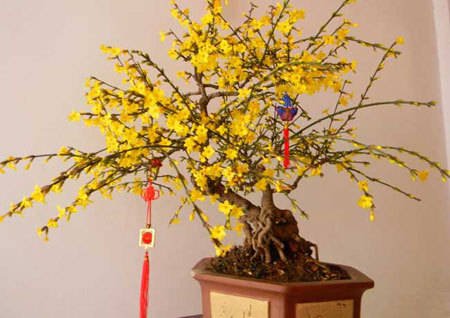
The common shaping method for the "hanging-branch plum" is as follows: in early spring, plant an old dog-tooth wintersweet that has a “knot” on the root crown into a pot; when planting, take care to leave part of the “knot” exposed above the pot rim. After planting, cut off all the branches on the upper part of the plant, then wrap it well with thin mud mixed with grass to keep it moist and encourage new branches to sprout. After the new branches grow out, keep 4~5 thick, strong branches and cut away the rest. In summer, after the new branches have become woody, approach-graft them onto wintersweet. For the approach grafting, take a pot of wintersweet that has been bent into curves, choose a fairly good branch and place it above the “knot”, then approach-graft the 4~5 branches of the dog-tooth wintersweet separately onto this one wintersweet branch, and separate them from the mother plant after they have healed together. After the approach grafts have taken successfully, several thin dog-tooth wintersweet branches support one thicker, older wintersweet branch, thus forming a pot of a uniquely shaped hanging-branch wintersweet stump bonsai.
· Wintersweet likes moisture and fears waterlogging
There is a farming proverb: "Wintersweet will not die of drought." Watering should be "dry then wet" - do not water when the potting soil is not dry, and water thoroughly when you do. Under normal circumstances, water once a day in spring and autumn; in summer, spray once a day at 8-9 a.m., and water thoroughly in the afternoon and toward evening. From June to July, water evaporates quickly and leaf transpiration is also fast; this is exactly the period of flower bud formation, so watering must be sufficient. If water is insufficient, the leaves easily become dry and yellow, affecting flower bud formation. But in winter, watering should be controlled - water once every 4-6 days at noon, and do not use much water. After leaf fall, watering should be reduced further - water once every 7-10 days. Before flowering and during full bloom, watering should be moderate; too much water easily causes buds to drop, while too little water makes the flowers open unevenly. It must be specially noted here that the potting soil must not become waterlogged. If a storm comes, move the pot indoors or cover the potting soil with plastic film to prevent water from standing in the pot for a long time and waterlogging from causing disaster.
Timely pruning
There has long been a saying that "wintersweet never lacks branches." After the flowers fade and before the leaves emerge, prune fairly heavily while also shaping the plant. Cut off dead branches, overly dense branches, crossing branches, inward-growing branches, and diseased or weak branches. Leave two or three pairs of buds at the base of one-year-old branches and cut off the upper part to stimulate new branches. At the same time, during pruning, pay attention to replacing old branches, using one- or two-year-old branches to replace aging ones. If renewal is not carried out in time, the flowers will be small and few. Afterward, each time the new branches grow two or three pairs of leaves, pinch out the tips 2-3 times to encourage many short, sturdy branches, so that the plant shape becomes well balanced and graceful. During the process of pruning and pinching, if a branch is not needed in a certain direction of the plant shape, remove the buds promptly. From April to June, observe frequently and do the work of pruning, pinching, and bud removal well; otherwise, many rampant water sprouts are likely to grow, consuming nutrients and making flower buds difficult to form. After July, the plant shape has already been set; if buds and branches still sprout, remove them promptly so that nutrients are transported to the flower buds.
· Potting soil preparation
For potted wintersweet, potting soil preparation is very important. Because the capacity of a flowerpot and the amount of soil it holds are not large, the potting soil preparation must meet a standard: First, the pH must be suitable. If it is strongly acidic soil, the sulfur concentration is greater than the concentration of the root cell sap; root hairs cannot absorb water, and instead the cell sap seeps into the potting soil, resulting in dehydration and shrinkage of the wintersweet stump roots and even death. Second, the nutrient content must be rich. The prepared potting soil must be fertile, with good drainage and air permeability, strong water-holding and fertilizer-retaining capacity, and the content of organic matter and various nutrients must all meet the needs of the wintersweet stump for growth and development, vigorous branches and leaves, and bud formation and flowering. Third, the granular structure must be good. The prepared potting soil should contain granules of various sizes, from rapeseed-sized to pea-sized. A good potting soil structure can make the water, fertilizer, air, and heat conditions of the potting soil suitable and coordinated in supply. According to the above standards, the potting soil for wintersweet can be prepared according to the following formula: 3 parts leaf mold, 3 parts vegetable garden soil, 2 parts coarse sandy soil, and 2 parts coal ash soil, mixed evenly and disinfected. The simplest method is sun exposure and freezing. It can also be treated by steaming in a pot, or by frying or burning into soil ash; in this way, most harmful pathogens, pests, and weed seeds in the potting soil are all killed, and the disinfected soil is loose and beneficial to the growth and development of wintersweet.
· Wintersweet likes fertilizer
Using loose, fertile potting soil selected according to the above standards, water once with relatively strong decomposed human and animal manure before Qingming Festival. When leaves grow from April to May, apply decomposed dilute human and animal manure or decomposed cake fertilizer water about once every two weeks to promote flower bud formation. June to July is exactly the flower bud differentiation period and also the period when new shoots form flower buds, so apply phosphorus and potassium liquid fertilizer 1-2 more times. It must not be too concentrated, so as to avoid yellowing leaves and leaf drop. After the weather turns cool, at White Dew, apply a relatively strong fertilizer once more to plump up the flower buds. Before the beginning of winter, apply decomposed dilute human and animal manure 1-2 more times to supply the nutrients needed for flowering. After each fertilization, water once with clear water the next day, and loosen the soil in time to keep the potting soil well aerated.
· Clever ways for potted wintersweet to get through the summer
To grow potted wintersweet well, you must never be careless at any time. In summer, during high temperatures and sunscald, even a slight negligence may, in mild cases, cause thin branches and sparse flowers and reduce the ornamental value of the stump bonsai; in severe cases, it may cause the whole plant to wither and die, ruining in one moment an old wintersweet stump cultivated carefully for many years. Based on many years of maintenance, the specific environmental conditions, and the particular characteristics of wintersweet, the following techniques can be used for care. First, double-potting to retain moisture. Use a pot larger than the potted plant, or a bamboo basket or wooden box used for fruit, place the potted wintersweet inside it, then fill the bottom and surroundings of the outer pot or bamboo basket firmly with leaf mold or loose soil. Then use a few small tiles or roll plastic into a large ring, fix it on the inner edge of the upper opening of the container used, and tie the tiles or plastic ring firmly with rope or galvanized wire, and fill it full of loose culture soil, so that the base of the trunk with the exposed dragon-claw-shaped lateral roots of the wintersweet is also buried well. This can prevent sunscald in summer and also maintain the humidity around the potted wintersweet and provide heat resistance. Second, covering materials to increase humidity. During the hottest days of summer, humidity can be increased by covering the pot surface with materials that do not easily release water, such as leaf mold, rice husk ash, rags, old cotton, and so on. These materials, once fully soaked with water, can at least keep the potted wintersweet in a moist state for two days during high-temperature drought, thus ensuring that wintersweet stumps in dry areas or on high-rise balconies will not lose water and die because the air is excessively dry. Third, shading to retain moisture. Wintersweet by nature likes semi-shade. In the hot summer, during the midday sunscald, it can be shaded or moved to a shaded place.