How to grow and propagate frangipani? Explained clearly in one article
Frangipani, also known as pagoda tree. It is a small tree. Cyme inflorescence, many flowers, white, yellow at the center, sometimes tinged with red, fragrant, flowering period April to July. It likes a sunny and warm environment, slightly tolerant of shade, not tolerant of cold, and prefers well-drained sandy loam. Management is relatively extensive; because the branches are brittle and break easily, when planted in the ground it is best to choose a wind-sheltered, sunny spot with loose, fertile soil.
If grown as a hedge, attention should be paid to pruning to encourage more new branches and make the plant shape neat and full. When potting, choose small-flowered varieties; the pot should be wide but not too deep, and the potting soil should be a culture soil mixed with peat soil, black soil and river sand. After planting, water thoroughly and place in a sunny spot to cultivate so it can set flower buds. If placed in too dark a spot, the branches and leaves will flourish but it will bloom very little or not at all.
During the growing season, the potting soil should be kept moist regularly; in winter, when temperatures are low, watering should be controlled. After the weather warms up in spring, apply a compound fertilizer once every 10-15 days until flowering begins. In summer, spray water on the branches and leaves to increase air humidity. But do not spray on the flowers, to avoid early fading of the blooms. In the north, move indoors before winter begins, preferably to a sunny spot, and keep the room temperature above 5°C. It can be propagated by sowing or by cuttings.
Generally, in early spring, cut 1-2 year old strong branches for cuttings; wait until the cut wound of the cutting has dried appropriately, then insert it into a sand bed.
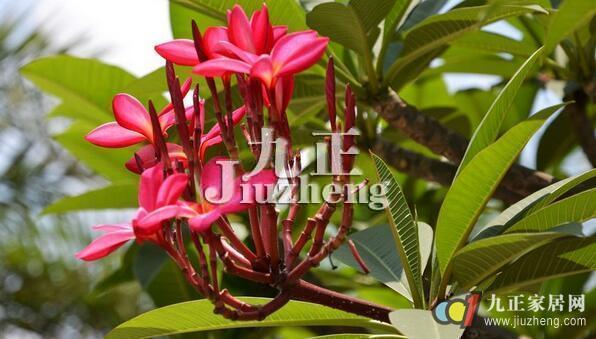
Red frangipani has thick papery leaves, oblong-obovate, apex acute, base narrowly cuneate, 14-30 cm long, 6-8 cm wide, dark green on the upper surface; midvein sunken, lateral veins flat, light green on the underside, midvein slightly raised, lateral veins flat, only the edge of the midvein on the underside covered with soft hairs, lateral veins 30-40 per side, extending nearly horizontally, anastomosing before reaching the leaf margin; petiole 4-7 cm long, covered with short soft hairs. Cyme terminal, 22-32 cm long, 10-15 cm in diameter, peduncle trichotomous, 13-28 cm long, fleshy, covered with short soft hairs that gradually fall off with age; pedicels covered with short soft hairs or hairs fallen off, about 2 cm long; calyx lobes small, broadly ovate, apex rounded, not spreading but pressed tightly against the corolla tube; corolla dark red, corolla tube cylindrical, 1.5-1.7 cm long, about 3 mm in diameter; corolla lobes narrowly obovate or elliptic, longer than the corolla tube, 3.5-4.5 cm long, 1.5-1.8 cm wide; stamens inserted at the base of the corolla tube, filaments short, anthers included; carpels 2, free; each carpel with many ovules. Follicles paired, widely spreading, oblong, apex acute, about 20 cm long, pale green; seeds oblong, flat, about 1.5 cm long, 7-9 mm wide, light brown, apex with an oblong membranous wing, wing margin with irregular indentations, wing 2-2.8 cm long, about 8 mm wide.
Red frangipani flowers from March to September; in cultivation it rarely sets fruit, and the fruiting period is generally July to December.
Ecological habits of red frangipani
Red frangipani likes a hot and humid climate, is tolerant of drought, but fears waterlogging, and likes to grow in limestone rocky areas; it is very easy to propagate by cuttings. Red frangipani likes a warm, humid, sunny growing environment; in summer it does not need shading and can be placed outdoors in full sun.
Red frangipani has no strict requirements for soil; it is best planted in loose soil rich in humus. When planting, the roots may be slightly exposed when potting; after planting, place it indoors, let it see weak light after 1 week, and after another half month it can be placed in a sunny spot.
Red frangipani is a strongly sun-loving flower; the more ample the sunlight, the more luxuriant the growth, and the more numerous and fragrant the flowers.
How to grow red frangipani
1. Frangipani has no strict requirements for soil; it is best planted in loose soil rich in humus. When planting, the roots may be slightly exposed when potting; after planting, place it indoors, let it see weak light after 1 week, and after another half month it can be placed in a sunny spot. Frangipani grows quickly and needs repotting once every spring, generally into a pot with a diameter of 30 cm. The potting soil can be mixed from 4 parts garden soil, 4 parts horse manure soil and 2 parts river sand, and each pot should also have 100 g of cake fertilizer or sauce residue, and 50 g of superphosphate or bone meal added. After repotting, water thoroughly, and move outdoors to a sunny spot around Grain Rain.
2. Frangipani likes a warm, humid, sunny growing environment; in summer it does not need shading and can be placed outdoors in full sun.
3. Frangipani is drought-tolerant but fears waterlogging. Therefore watering should be moderate, following the principle of not watering when not dry, watering as soon as it dries, watering thoroughly when watering, and not allowing waterlogging. In spring and autumn, water once when the soil dries, at intervals of 1 to 2 days; in summer, water once every morning on sunny days, and in the evening water again if the soil is dry; in the rainy season, be careful to pour out accumulated water from the pot to prevent root rot; in winter, water once every ten days to half a month, keeping the potting soil slightly moist but not dry.
4. Frangipani likes fertilizer. When potting or repotting and changing soil, it is best to add 20 g to 30 g of bone meal and 50 g to 80 g of superphosphate to the culture soil (because it likes to grow in calcareous soil, attention should be paid to calcium supplementation). From May to October, apply a dilute, well-rotted organic fertilizer or nitrogen-phosphorus-potassium compound fertilizer once every 10 to 15 days; avoid applying nitrogen fertilizer alone to prevent excessive vegetative growth; do not fertilize in winter.
Propagation methods of red frangipani
Red frangipani is most commonly propagated by cuttings; cuttings root easily, so there is no need for seed propagation.
Red frangipani likes a hot and humid climate, is tolerant of drought, and likes to grow in limestone rocky areas; it is very easy to propagate by cuttings.
Generally, in mid-to-late May, cut branches 20-30 cm long from the base of the branches. White latex flows from the cut, so they need to be placed in a cool, ventilated place for 2-3 days to let the wound form a protective film before cutting; cuttings with latex are prone to rot. Insert into clean vermiculite or a sand bed or a shallow sand pot, then spray water, place indoors or under an outdoor shade shed, and spray water once every other day to keep the substrate moist. After cutting, move to a semi-shaded place after 15-20 days to let it see weak light; it roots in 30-35 days and can be potted after 45 days. After the small cutting seedlings have rooted and survived, transplant them in time into pots with a diameter of 20 cm. Frangipani has no strict requirements for soil; it is best planted in loose soil rich in humus. When planting, the roots may be slightly exposed when potting; after planting, place it indoors, let it see weak light after 1 week, and after another half month it can be placed in a sunny spot.
Red frangipani is suitable for cut grafting, cleft grafting or side grafting.
The problem is that the cut surface has a relatively large flow of latex, which will affect the survival rate of grafting to varying degrees. You can refer to the grafting methods for succulent plants such as banyan and desert rose. The time can be arranged in March to April or October. When grafting, the knife should be operated quickly, completing the cut in one stroke, and striving to complete the alignment of the cambium between the cut surfaces of the rootstock and scion before a large amount of latex flows out; if more latex seeps from the cut surface, quickly wipe it away with a clean piece of gauze or paper, then immediately align the rootstock and scion cuts, then tie the joint with a band, add a plastic bag to keep it moist, and place it in a semi-shaded place. After the scion survives, remove the bag, untie the binding band, and give it normal water and fertilizer management.
The flower language of red frangipani
Frangipani flower language: breeding hope, resurrection, new life.
Frangipani blooms from May to October. It has no mysterious legend, no elegant temperament, no noble posture, yet it has a very simple appearance, using five petals to form a fresh flower language full of hope. It is as simple and ordinary as life, so it can always be so close to people, without distance.
The frangipani corolla is tubular, milky white on the outside, bright yellow at the center, extremely fragrant, spreading in a spiral shape, with white petal edges and a golden-yellow petal center, as if egg white were wrapping the egg flower. Frangipani has two types: white frangipani and red frangipani. Among them, "red frangipani" has bright red flowers, but it is relatively rare.
After reading the above introduction to the cultivation and propagation methods of red frangipani, do you have a better understanding of the morphological characteristics of red frangipani? If you want to know more about red frangipani, please continue to follow.
Frangipani propagation methods, 4 common propagation methods for frangipani
Frangipani is a sun-loving tree species, liking high temperature, humidity and a sunny environment. But it can also grow in a semi-shaded environment; only in a shaded environment the branches grow excessively, with few flowers or only leaves and no flowers; while yellow frangipani in a shaded, humid environment will grow aerial roots on the branches.
The soil suitable for planting frangipani is best a deep, fertile, well-aerated, organic-rich acidic sandy loam; plants grown this way are robust, with a large number of flowers and bright flower colors. When the soil is poor, frangipani grows and develops poorly, with small flowers and dull flower colors.
Frangipani propagation method 1. Cutting propagationWhen propagating frangipani, the relatively easy-to-root cutting method can be used. When the temperature is relatively high, cuttings can be taken all year round.
Choose thick, mature branches, cut them into cuttings about 20 cm long, and take cuttings after the wounds have dried in the shade. Cuttings are generally inserted into clean sandy soil; after cutting, spray water and keep the soil moist. Generally they can root in one month. After rooting, they can be transplanted; in the early stage, shade treatment is needed, and afterward they can grow normally.
2. Layering propagationFrangipani can also be propagated by layering. Layering propagation is mainly carried out during the growing season, but compared with cuttings, it is still used relatively little.
3. Seed propagationFrangipani does bear fruit, but not very much; the fruit contains seeds and can be sown.
Sow the collected seeds, generally on a sand bed, keeping the germination temperature at 18°C——24°C. When sowing, cover with a layer of soil and water moderately to keep the soil moist; germination is relatively fast. When the seedlings grow to 15 cm, they can be transplanted.
4. Grafting propagationIf frangipani is to be propagated by grafting, it is still relatively easy to operate, because its survival rate is relatively high. Generally the best seasons for grafting are spring and autumn; winter and summer require certain conditions to be met.
When grafting, choose suitable rootstock and scion for grafting, and take care to prevent rain and strong wind, so as not to affect the survival of the grafted seedlings.