What are the care methods for potted banana shrub (Michelia figo)?
Banana shrub is an evergreen shrub. The flowers are borne singly in the leaf axils, with 6 petals shaped like half an eggshell, creamy white to creamy yellow, fleshy, and they do not fully open even when in full bloom. It has a strong banana-like fragrance, and the flowering period is from April to June.
For potted banana shrub, the potting soil should ideally be a well-mixed blend of 4 parts leaf mold, 3 parts garden soil, 2 parts compost soil, and 1 part sandy soil. Banana shrub has fleshy roots and is prone to root rot when waterlogged, so watering should follow the "water when dry, stop when wet" principle. Generally, in spring and autumn, water once every 1-2 days; in summer, water once each morning and evening; in winter, water once every 5-7 days. On hot, sunny, dry days, in addition to watering twice a day, it is also necessary to spray water on the leaves and sprinkle water on the ground around the flower pot 2-3 times to increase air humidity and keep the environment moist. During continuous rainy days, be sure to promptly pour out any accumulated water in the pot to prevent root rot.
Although banana shrub likes fertilizer, since base fertilizer has already been applied in the potting soil, it should not be fertilized too much during the growing period. Generally, starting from early May, apply diluted liquid fertilizer as a top dressing once every 10-15 days. July to August is the flower bud formation period, so it is advisable to apply appropriately more phosphorus and potassium fertilizer. When applying liquid fertilizer, it is best to alternate between fertilizer water and alum fertilizer water to meet the nutrients needed for plant growth and to keep the potting soil acidic. In northern regions, stop fertilizing from late September.
After summer begins, the potted plant should be placed on an east-facing windowsill or balcony, and must never be exposed to the direct afternoon sun. In summer, move it to a shade shed or under the shade of a large tree to prevent direct strong light. In early spring, late autumn, and winter, give it sufficient light so that the branches and leaves grow robustly and the flowers are abundant and fragrant. Banana shrub is not cold-tolerant, so in northern regions it should be brought indoors around Cold Dew. To meet its growth needs, repot once each year in spring after flowering and before new leaves grow. When repotting, cut off rotten roots and thin out some overly dense, fine, weak branches, and add fresh potting soil.
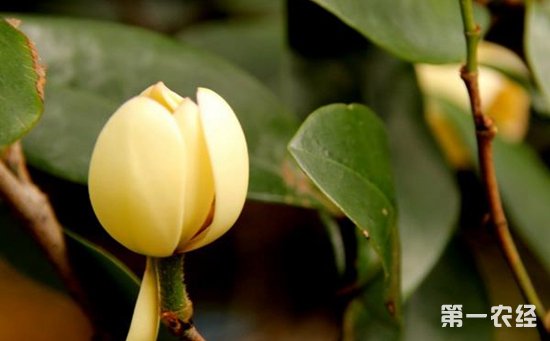
Image: Banana shrub flower
I. Cultivation methods for potted banana shrub flowers
1. Soil:Banana shrub has fleshy roots and cannot tolerate dryness or poor, thin soil, but it also fears waterlogging. It requires well-drained, fertile, slightly acidic loam, and can also adapt to neutral soil. A potting soil made of 4 parts leaf mold, 3 parts garden soil, 2 parts decomposed manure soil, and 1 part sandy soil can be used.
2. Watering:Keep the potting soil moist at ordinary times, but it must never be too wet. Because its roots are mostly fleshy, too much watering or waterlogging in the pot after rain will cause root rot, so humidity should be carefully controlled during the rainy season. During the growing period and before flowering, it needs more water, so water once a day. In summer, during high-temperature weather, water the leaf surface to maintain a certain air humidity. In autumn and winter, because sunshine is shorter, watering once or twice a week is sufficient.
3. Sunlight:In summer, banana shrub plants should not be exposed to the sun and need 30% shade to avoid strong light burning the leaves. They can be placed at an east-facing window or balcony indoors, or outdoors under tree shade or a shade shed. After the weather cools in autumn, they can receive more sunlight. In winter, place them indoors in a sunny, ventilated spot.
4. Temperature:The minimum temperature for banana shrub overwintering should not be lower than 5°C. Once the temperature drops below 5°C, the plant's normal physiological activities will be affected, the root's absorption capacity will weaken, and the plant's tender branches and leaves will wilt. At the same time, the maximum temperature should not exceed 15°C. If the temperature is too high, the plant will consume too many internal nutrients, which is unfavorable for growth the following year. Therefore, in winter, banana shrub is best kept at a room temperature of 5°C to 15°C.
Image: Banana shrub flower
5. Fertilizing:Banana shrub flowers like fertilizer. Mostly decomposed cake fertilizer, bone meal, chicken and duck manure, and fish offal and intestines are composted and mixed with water for application. During the growing season (April to September), apply fertilizer once about every 15 days, and stop fertilizing during the flowering period and after October. If the leaf color is not bright and deep green, apply alum fertilizer water once.
6. Pests:Banana shrub is commonly harmed by scale insects, which can also induce sooty mold. Scale insects can be brushed off with a small brush, or killed by spraying No. 20 petroleum emulsion diluted 150 times with water. Sooty mold can be prevented and controlled by wiping with clean water or spraying a carbendazim aqueous solution diluted 500-1000 times with water.
7. Pruning:Banana shrub flowers should not be pruned excessively. At ordinary times, after flowering, prune leggy branches, diseased and weak branches, and overly dense, overlapping branches that affect the tree shape, and remove the fruit after flowering to reduce nutrient consumption. Before spring sprouting, appropriately thin out some old leaves to stimulate new branches and leaves.
8. Repotting:Repot banana shrub flowers once every 1-2 years, preferably before new leaves emerge each spring, or after flowering, and it can also be done in autumn. In conjunction with repotting, remove an appropriate portion of the compacted old soil, replace it with fertile, loose potting soil, cut off dead branches and overly long old roots, and place sufficient base fertilizer at the bottom of the pot.
Image: Banana shrub flower
II. Precautions for cultivating potted banana shrub flowers
Banana shrub has thick, fleshy roots and does not tolerate transplanting. When transplanting, it is best to keep more of the soil ball and appropriately thin the branches and leaves. If the soil ball breaks apart during transplanting, the branches and leaves must be heavily pruned in time, otherwise the whole plant is likely to wither and die. Banana shrub does not tolerate drought or poor, thin soil, fears waterlogging, and likes fertile, loose, well-drained, slightly acidic loam. During overwintering, banana shrub plants need appropriate ventilation and light transmission to avoid harm from pests such as aphids and scale insects. Water banana shrub flowers at noon when the temperature is relatively high, and maintain appropriate humidity in the greenhouse. After banana shrub flowers fade, if the seeds are not to be kept, promptly cut off the young fruit to reduce nutrient consumption.
[Editor's concluding remarks]Banana shrub flowers grow well in weakly shaded environments and should not be exposed to direct strong light, which requires special attention during care. The above has introduced the cultivation methods and precautions for potted banana shrub flowers, and I hope it will be helpful to everyone!