Under what conditions can the small-leaf goldfish plant produce abundant, brightly colored flowers?
The small-leaf goldfish plant (Columnea microphylla) is a perennial herbaceous or subshrub evergreen plant. Its leaves are extremely small and button-like. The stems and branches are slender and trailing. The flowers are solitary in the leaf axils. The corolla is scarlet with a yellow throat.
(1) It prefers a warm, humid and bright environment. In spring, summer and autumn it can all be placed indoors in a spot with bright diffused light; after buds appear, move it to a spot near a south-facing windowsill with fairly ample light. In winter, place it in a spot indoors with ample light. If it is kept for a long time in a dim spot, the stems and vines will become slender and weak, the leaves will easily drop, and the flowers will be few and pale in color. The optimum growing temperature is 18-22°C; during the winter dormant period the room temperature should be kept at around 15°C. If the temperature stays below 10°C for a fairly long period, it easily causes leaf drop.
(2) During the growing period, apply a dilute cake-fertilizer solution once every 2 weeks. The potting soil needs to be kept moist at all times, and care should be taken to frequently spray water on the stems and leaves to raise the air humidity. In late autumn and early winter, during the flower-bud differentiation period, watering should be reduced appropriately to favor flower-bud formation. In winter there is a brief dormant period, during which watering should be controlled so that the potting soil is kept appropriately dry.
(3) After the flowers fade in spring, prune promptly, which can promote branching, make the plant shape fuller, and produce more flowers. Otherwise the branches and vines become slender with few branches, and flowers appear only at the top of the trailing stems. Generally, repot once every other year after flowering; the potting soil should be mainly leaf mold or peat soil, with 1/5 river sand added, plus a small amount of bone meal as a base fertilizer.
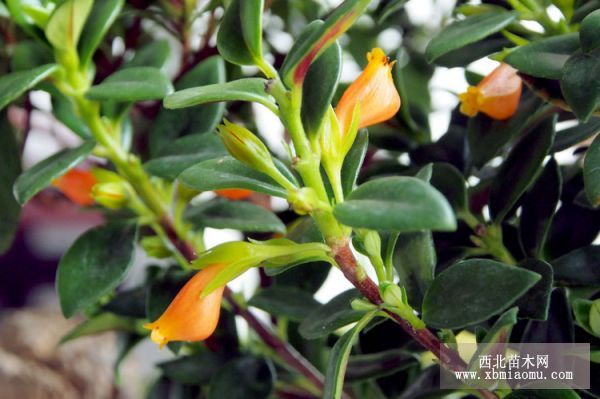
Therefore, apart from the dormant period, at all other times the potting soil must be kept moist and the stems and leaves should be sprayed with water frequently to raise the air humidity. But in late autumn and early winter, during the flower-bud differentiation period, watering should be reduced appropriately to favor flower-bud differentiation. The optimum growing temperature is 18°C-22°C; during the dormant period it is best kept at 14°C-16°C. If the temperature drops below 10°C, the leaf color easily turns yellow and mottled, and buds drop. Generally between December and January of the following year the plant enters the dormant period; during this time give a lower temperature and control watering, but still maintain fairly high air humidity so that it blooms abundantly the following spring. After the buds color up and until the flowering period, spraying should be stopped. In spring and autumn, apply a dilute liquid fertilizer once every 7—10 days.
In autumn, apply mainly nitrogen fertilizer to promote abundant stems and leaves; after spring begins, apply somewhat more phosphorus and potassium fertilizer to favor abundant, brightly colored flowers. After the flowers fade, take care to prune promptly. Pruning not only helps promote branching and makes the plant shape fuller, but also keeps the flowering position moderate, thereby raising its ornamental value. Otherwise the branches and vines become slender; flowers appear only at the top of the trailing stems, which is unsightly. Generally, repot once every other year after flowering. The potting soil is best prepared by mixing equal parts peat soil, garden soil and river sand, plus a small amount of bone meal or cake-fertilizer powder as a base fertilizer. To propagate the small-leaf goldfish plant, cuttings are mostly used; this can be done all year round, but it is best done after flowering. For the specific method, see Question 44 of this book.
How to grow the goldfish plant
How to grow the goldfish plant
Goldfish plant - cultivation methods
[Scientific name] Columnea gloriosa
[Aliases] Columnea, string goldfish, small-leaf goldfish plant, whale plant, button whale plant, small-leaf goldfish plant, goldfish hanging plant, kangaroo hanging plant, kangaroo plant
[Classification] Spermatophyta, Angiospermae, Dicotyledoneae, Scrophulariales, Gesneriaceae, Columnea; the goldfish plant is Convolvulaceae
Goldfish plant
Propagation can use tip cuttings or stem-section cuttings. This can be done all year round, and is best done indoors after flowering. Cut annual branches about 10-15 cm long, keep 3-4 leaves, remove several pairs of small leaves at the base, and insert them into sandy soil. Cover well with glass or plastic film, control the temperature at 20°C, and maintain fairly high air humidity; roots can form in about 3-4 weeks. Two months after surviving, begin pinching to promote more branching and thus more flowers, after which it can be planted out into pots. Seedlings do not bloom in the first year; only in the second or third year do red flowers emerge from the leaf axils at the tips of the trailing branches.
The goldfish plant can be propagated by sowing, division and cuttings. Because seeds are not easily obtained, sowing is mostly not used, and the cutting method is generally commonly used for propagation. In spring and autumn, cut branches about 10 cm long (3-4 nodes) and insert them into a cutting bed made of river sand or vermiculite, maintaining fairly high humidity. At a temperature of 20-25°C, roots form in about one month; after rooting and surviving, strengthen management to promote new shoot growth, and pinch to encourage branching. After 1-2 months it can be potted.
For pot cultivation of the goldfish plant, the substrate is required to be rich in humus, loose and well-drained; generally equal parts of peat soil, perlite and vermiculite are mixed, and the soil should be made slightly acidic to favor growth. During the growing period, apply a liquid fertilizer once every 1-2 weeks; during the peak growth and flowering period, additional phosphorus and potassium fertilizer must be applied. In winter there is a brief dormant period, during which watering can be reduced and the potting soil kept appropriately dry; in winter (that is, the flowering period), watering can be appropriately increased; during the growing period there must be sufficient moisture, the potting soil must be kept moist at all times, and efforts should be made to raise the air humidity. Under high temperature and high humidity, the stems and branches easily become soft-rotted and die. If this happens, promptly cut away the soft-rotted parts. The goldfish plant prefers a bright environment without direct sunlight, so in summer when the light is too strong it must be shaded (50% shading); to promote flower-bud formation, give sunlight in autumn and keep the potting soil slightly dry; during winter dormancy it is best placed in a dry, cool environment to promote flower-bud differentiation; before winter flowering, light can be appropriately increased, and indoors it must be moved to the brightest window to ensure vigorous growth and flowering.
The goldfish plant has dense branches and leaves, and its stems and vines trail naturally; at the peak of flowering, a larger plant can bear more than a hundred flowers at once, and the flowers are large and brightly colored, quite spectacular, making it an ideal shade-loving trailing foliage and flowering plant. It is very suitable as an epiphytic potted plant in greenhouses and indoor gardens, and can also be hung up for appreciation as a household hanging plant.
Goldfish plant - cultivation techniques
Goldfish plant
It is suitable for small and medium-sized potted plants or for indoor hanging and corridor greenery. Its cultivation characteristics are described separately below:
1. For cultivation, use a substrate soil mixed with leaf mold, manure and sand in a 3:1:1 ratio, with a pH value of 6 to 6.5. Apply a dilute compound fertilizer solution monthly; in the two months before the flowering period, apply a phosphorus-potassium fertilizer solution once every half month. Repot once every other year.
2. The optimum growing temperature is 16°C to 28°C; above 30°C, shading and ventilation must be strengthened, otherwise leaf drop will occur; overwintering requires keeping it at least above 10°C.
3. It is shade-tolerant, suitable for a spot with diffused light, and avoids direct strong light. When the surface of the potting soil is dry, water thoroughly; the leaves and the area around the plant can be sprayed frequently with water to enhance air humidity; reduce watering in winter.
4. After flowering, all weak branches, top branches and overly long trailing branches should be pruned; when winter begins, cut off withered flower stems from the base and keep it dry, which favors new flower branches sprouting and growing the following spring.
5. Mainly propagated by cuttings; cut branches with nodes, each section about 8 cm, cut off half of the upper leaves and remove all the lower ones, maintain a semi-shaded, humid environment, and roots can form and it can be potted in about 30 days. It can also be propagated by division, carried out in early spring or late autumn; each clump must have 1 to 2 terminal buds, and plant 2 to 3 plants per pot.
Goldfish plant - cultivation and management
Goldfish plant
The goldfish plant is an epiphytic plant; the growing medium can be equal parts peat moss, perlite and vermiculite mixed together; or materials such as sphagnum moss, fern roots and bark chunks can be used, grown in a porous pot to favor good ventilation and drainage. For indoor cultivation, place the potted plant in a spot with no direct sunlight all day; before flowering it can be moved to a spot with ample sunlight. The goldfish plant is fairly sensitive to low temperature; when the temperature drops below 10°C, the leaf color turns yellow, becomes mottled and drops. It dislikes summer heat; in summer it should still be kept indoors, with attention to ventilation and shading, and kept moist at all times. Watering should follow the principle of "better wet than dry"; in the dry seasons of spring and autumn, when leaf water evaporation is vigorous, increase the frequency of watering, but be careful not to overwater. From December to January of the following year, the plant enters the dormant period; to make it bloom abundantly the next year, the room temperature should be controlled between 14-16°C, and the water supply should be controlled, keeping it appropriately dry. During the growing season, attention should be paid to maintaining a high-humidity environment; a spray method can be used to add humidity, or clean water can be frequently sprayed on the potted plant and the surrounding ground. But when the buds color up or the flowering period begins, spraying should stop immediately, otherwise yellow spots appear on the leaves. During the vigorous growing period, fertilize once every 1-2 weeks, and apply more phosphorus fertilizer to favor flower-bud formation. The goldfish plant tolerates pruning fairly well; if not pruned for a long time, the flowering position moves upward, so after flowering the main and side branches can be lightly cut back to form more branches.
The goldfish plant can be propagated by the cutting method: cut off new branches about 5-6 cm and insert them into a river-sand seedbed. After the cuttings survive, plant the seedlings in a growing soil mainly of humus soil, planting 3-4 plants per pot to lay the foundation for future shaping. To promote branching, simply pinch during the growing period.
In spring, summer and autumn, the goldfish plant should be watered more, and the surrounding ground should be frequently sprayed with clean water; never sprinkle water on the leaves. In summer when the temperature is high, it is best to place the flower pot in a shallow dish holding water. These measures can all avoid leaf drop caused by dry air. Before flowering in winter and spring, the goldfish plant should also be watered somewhat more, so that the flowers open fully and the flower color is bright and beautiful.
Apart from needing fairly ample sunlight in winter, the goldfish plant needs rather more shade in the other seasons; in spring, summer and autumn, 60%-70% of sunlight should be shaded, or it can be hung in an outdoor shade shed, or in a cool, ventilated spot under the shade of a large tree, receiving more diffused light and no direct sunlight. Such an environment is very suitable for its growth.
Before the goldfish plant flowers in winter, the light should be appropriately increased, so that it can bloom abundantly and with bright color. When grown as a household hanging pot, it can be placed in a bright, ventilated room and can be displayed and appreciated all year round.
Do not fertilize the goldfish plant while it is flowering; after the flowers fade, it should be pruned and shaped, and more nitrogen-containing fertilizer applied. During the growing period, apply a thin organic fertilizer solution once every 1-2 weeks, which can make it grow vigorously; before flowering, additional phosphorus fertilizer should be applied, which can make it form more buds and bloom more, enhancing its ornamental effect.
In autumn, apply mainly nitrogen fertilizer to promote abundant stems and leaves; after spring begins, apply somewhat more phosphorus and potassium fertilizer to favor abundant, brightly colored flowers. After the flowers fade, take care to prune promptly. Pruning not only helps promote branching and makes the plant shape fuller, but also keeps the flowering position moderate, thereby raising its ornamental value. Otherwise the branches and vines become slender; flowers appear only at the top of the trailing stems, which is unsightly. Generally, repot once every other year after flowering. The potting soil is best prepared by mixing equal parts peat soil, garden soil and river sand, plus a small amount of bone meal or cake-fertilizer powder as a base fertilizer. To propagate the small-leaf goldfish plant, cuttings are mostly used; this can be done all year round, but it is best done after flowering.