What are the care precautions for Aeschynanthus radicans?
Aeschynanthus radicans gets its name because its flowers resemble open lips. It is a perennial evergreen trailing plant, with branches that hang naturally downward. The flowers grow at the tips of the branches and face upward; the corolla is lip-shaped, red-orange, with a creamy yellow throat.
(1) Aeschynanthus radicans grows well in bright, indirect light. Direct sunlight, especially the intense light of summer, easily causes leaves to turn yellow and scorches leaf tips. However, too dim light also easily causes poor growth and few flowers. Normally, it is best hung near a south-facing window, and around midday in summer a curtain should be drawn for shade. The intensity of light can be judged by changes in leaf shape and color. With strong light, the leaf color turns reddish-brown; with weak light, the leaves become larger and slightly thinner, and the branches weak.
(2) During the growing period, water supply should be adequate, and it is best to keep the potting soil consistently moist. At the same time, frequently spray water on the branches, leaves and ground to raise air humidity and keep the leaves fresh and glossy green. Usually, watering should be even; if it is sometimes too much and sometimes too little, leaf drop is easily caused. In the peak growing seasons of spring and summer, generally apply a dilute cake fertilizer solution about once every half month.
(3) After the flowers fade, promptly cut off the spent flower stalks to reduce nutrient consumption. The optimum growing temperature is 21-26°C, and it is slightly cold-tolerant. In winter, the room temperature should be kept above 10°C. Repot every year or every other year in early spring, and prune at the same time as repotting to encourage new shoots and more flowers. The cut branches can be used for cuttings; cut the branches into sections about 10 cm long, insert them into a sand bed, water thoroughly, cover with plastic film, and after about 1 month they will take root and survive.
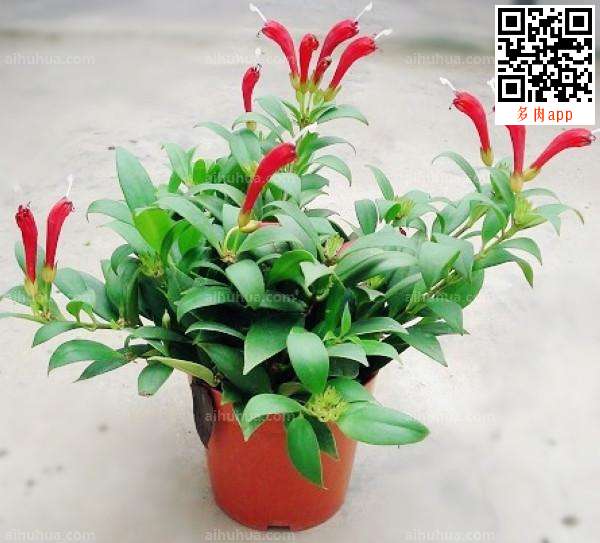
Lippia: cultivation methods and precautions, and an introduction to Aeschynanthus radicans
Aeschynanthus radicans is a recent excellent hanging plant, and both its flowers and leaves have high ornamental value. As a small indoor foliage-and-flower plant, Aeschynanthus radicans has a graceful plant shape, luxuriant stems and leaves, and brightly colored flowers. It can be placed on a desk or displayed hanging, and is a fashionable fine plant for home gardening. It was introduced to China in recent years.
The stems of Aeschynanthus radicans hang down to about 1 m long. The deep green leaves of Aeschynanthus radicans, together with the bright red and unusual corolla, are quite popular with people. The flowering period of Aeschynanthus radicans is mainly in summer.
Morphological characteristics of Aeschynanthus radicans
Aeschynanthus radicans is an epiphytic evergreen trailing vine. It is epiphytic and is often planted in hanging baskets. The stems hang down to about 1 m long. The flowers are borne in pairs at the tips of the branches, with short pedicels, and the corolla is tubular and bright red.
The leaves of Aeschynanthus radicans are opposite, ovate, elliptical or obovate, leathery and slightly fleshy, 4.5 cm long and 3 cm wide, with entire margins, a prominent midrib, and hidden inconspicuous lateral veins. The leaf surface is deep green and the underside is light green. The flowers are axillary or clustered at the top. The flowers are borne in pairs at the tips of the branches, with short pedicels, and the corolla is red to red-orange, about 6.5 cm long. The calyx is tubular, dark purple and covered with fine hairs. Only when it grows to about 2 cm does the corolla emerge from the mouth of the calyx, tubular and bright red, just like lipstick, hence the name.
The stems of Aeschynanthus radicans hang down to about 1 m long. The deep green leaves of Aeschynanthus radicans, together with the bright red and unusual corolla, are quite popular with people.
The flowering period of Aeschynanthus radicans is mainly in summer.
Ecological habits of Aeschynanthus radicans
Aeschynanthus radicans likes a warm, bright, semi-shaded environment with ample sunlight. Although it likes sunlight, it can only receive at most 2-3 hours of direct sunlight per day.
When cultivated indoors, Aeschynanthus radicans is best hung about 1 m from a south-facing window. During the day, keep the room above 24°C, and at night the temperature should be 18-21°C. The potting soil should be loose, well aerated, and kept consistently moist. It is relatively cold-tolerant, but likes a high-temperature environment. It likes well-drained soil. After the flowering period, it can be heavily pruned once, leaving 15 cm, and a dilute fertilizer applied. Spring cuttings root easily. It is grown indoors in pots or as a hanging ornamental. The plant shape is graceful, the stems and leaves are luxuriant, and the flower colors are brilliant.
Cultivation techniques and cultivation management of Aeschynanthus radicans
Aeschynanthus radicans likes a warm, bright, semi-shaded environment. Insufficient light easily causes leggy branches and makes flowering difficult; too strong light turns the leaves reddish-brown. For Aeschynanthus radicans grown at home, it is most suitable to hang it about 1 m from a south-facing window.
For potted plants, slightly acidic soil is preferable. A potting mix made from peat soil, sand and vermiculite can be used, with an appropriate amount of superphosphate added. Leaf mold soil mixed with 2 parts coarse sand to 8 parts can also be used; rotted cow manure and horse manure mixed with 30% coarse coal furnace ash slag can also be used for cultivation.
In hot summer, it can be placed outdoors under a shade shed or in a ventilated spot under tree shade, with about 50% shading; for people living in apartment buildings, the pot can be hung under a balcony frame with bamboo blinds above for shade, or hung on the inner side of a south-facing door or window where indirect light is ample. Aeschynanthus radicans usually needs little fertilizer; apply some rotted liquid fertilizer every two weeks, and it is better to keep it dilute rather than concentrated. When potting, an appropriate amount of livestock hoof and horn pieces and crushed bone pieces can be added as base fertilizer, which can make it grow well.
For example, a 0.1% solution of potassium dihydrogen phosphate and a 20-fold solution of rotted fish offal water or bone water can all be used to promote the opening of autumn flowers. After potting, keep the potting soil moist, but not overly wet, especially when the potting medium is poorly aerated, as the roots easily rot or leaf drop is caused. Frequently spray water mist on the leaves to keep air humidity at about 80%. Avoid wind blowing the branches and tendrils, so that the hanging stems are not worn through by the rim of the flower pot. In autumn, as the weather gradually turns cool, gradually reduce the amount of watering and fertilizing. In winter, the potting soil should be slightly dry. Apart from appropriately applying some fertilizer solution containing a little more phosphorus before budding and flowering, in general fertilizer should be applied sparingly or not at all.
Temperature management
The growing temperature for Aeschynanthus radicans is 18-30°C, with the optimum temperature around 25°C. It has poor cold tolerance, and the overwintering temperature should generally be above 12°C. In winter it needs to be brought indoors to overwinter. If the leaves of Aeschynanthus radicans are found to turn red, it is mainly caused by too low room temperature or too strong light, and at this time the room temperature should be raised promptly. If the room temperature is too low, it can also cause leaf drop and dry, withered branches.
Aeschynanthus radicans is not cold-tolerant and needs to be brought indoors to overwinter in winter. Aeschynanthus radicans is not strict about air humidity, and can adapt as long as the indoor air is not overly dry. Its optimum growing temperature should be around 25°C, and the overwintering temperature should be above 12°C. If the leaves of Aeschynanthus radicans are found to turn red, then either the light is too strong or the room temperature is too low, and at this time the room temperature should be raised promptly. If the room temperature is too low, it will cause leaf drop and dry, withered branches. If the room temperature is suitable, the flowering period of Aeschynanthus radicans will be concentrated from December to February of the following year. At this time, apply less nitrogen fertilizer, increase the intensity of indoor light, and control a lower room temperature, which promotes the flowering of Aeschynanthus radicans. After the winter flowering period, promptly cut off the spent stems that have flowered, which can save the plant's internal nutrient consumption and encourage new shoots, making it produce more buds and flowers.
Cultivation substrate
For potted plants, a loose, fertile, slightly acidic humus soil is preferable. A potting mix made from peat soil, sand and vermiculite can be used, with an appropriate amount of superphosphate added as base fertilizer. Leaf mold soil mixed with 2 parts coarse sand to 8 parts can also be used as a substrate; rotted cow manure and horse manure mixed with 30% coarse coal furnace ash slag can also be used for cultivation. Aeschynanthus radicans needs little fertilizer during growth. When potting, an appropriate amount of livestock hoof and horn pieces and crushed bone pieces can be added as base fertilizer, which can make it grow well.
Watering and fertilizing
When cultivating Aeschynanthus radicans, the potting soil should be kept consistently moist, but water accumulation in the pot must be avoided, especially when the potting medium is poorly aerated, so as to avoid root rot. In winter, the potting soil should be slightly dry. In summer, frequently spray mist on the leaf surface to increase the humidity of the leaf surface and the surrounding environment to benefit its growth.
Aeschynanthus radicans usually needs little fertilizer; apply some rotted liquid fertilizer every two weeks, and it is better to keep it dilute rather than concentrated. When potting, an appropriate amount of livestock hoof and horn pieces and crushed bone pieces can be added as base fertilizer. During the vigorous growth period, Aeschynanthus radicans can be given a rotted organic fertilizer solution once every 15-20 days. After summer, apply more phosphorus and potassium fertilizer. For example, a 0.1% solution of potassium dihydrogen phosphate and a 20-fold solution of rotted fish offal water or bone water can promote the opening of its autumn flowers. In autumn, as the weather gradually turns cool, gradually reduce the amount of watering and fertilizing. Apart from appropriately applying some fertilizer solution containing a little more phosphorus before budding and flowering, in general fertilizer should be applied sparingly or not at all. Under conditions such as suitable room temperature, the flowering period of Aeschynanthus radicans will be concentrated from December to February of the following year. At this time, apply less nitrogen fertilizer.
Pruning and propagation
After the winter flowering period, promptly cut off the spent stems that have flowered and prune the overly long hanging branches once, which can save the plant's internal nutrient consumption and encourage new shoots, producing more flowers the following year.
Cultivation methods and care key points of Aeschynanthus radicans
As a tropical flower, Aeschynanthus radicans has the habit of liking warmth and humidity, and avoids strong direct sunlight. It grows luxuriantly in semi-shade and in a well-ventilated spot by a window or under the eaves. The optimum annual growing temperature for Aeschynanthus radicans is between 20°C and 30°C, and its cold tolerance is weak. During home care, if the temperature is below 15°C, it should promptly be moved to a warm, wind-protected indoor spot, otherwise the leaves are easily damaged by cold and turn yellow and withered. Aeschynanthus radicans is relatively drought-tolerant, and avoids wetness and fears waterlogging. In the hot summer, frequently spray mist on the leaf surface to increase the humidity of the leaf surface and the surrounding environment. Because the flowering period is long and it flowers in summer and autumn, the fertilizer and water supply should be adequate. When cultivating, it is best to bury rotted organic fertilizer at the base, and during the growing period apply a flower fertilizer once a month.
For Aeschynanthus radicans displayed indoors or hung for ornament, generally the flowering period ends after 1-2 months, and the flowers then fade. At this time, the overly long hanging branches can be pruned once to encourage the growth and sprouting of new shoots at the base, producing more flowers the following year. At the same time, propagation can be carried out along with post-flowering pruning. Cut the pruned branches into 8-10 cm lengths, remove some of the lower leaves, insert them obliquely into plain sand, keep them cool and moist, and they will take root in about one month, forming a new plant.
For greenhouse cultivation, the cutting length can be shortened to 2-3 cm, with just 1 pair of leaves. Keep the room temperature at 20-25°C and the humidity above 50%, and in about 10-15 days a large number will take root and survive. In about ten months, when the branches reach more than 30 cm in length, they can bud and flower.
Propagation methods of Aeschynanthus radicans
Aeschynanthus radicans is commonly propagated by cuttings, which can be done throughout the year under conditions of 20°C to 30°C.
Spring cuttings root easily. Cut 10-15 cm long branches from the tips of the branches as cuttings, insert them in clean river sand or vermiculite, keep the soil and air moist, avoid harsh sun exposure, and keep at normal room temperature; they will root in about one month. After rooting, remove the bag, keep the potting soil slightly moist, and they can be transplanted in about 1-2 weeks. Several plants can be planted per pot. When planting, just keep the soil moist; watering must not be excessive, otherwise it easily rots or causes leaf drop. In summer, they can be directly inserted into the potting soil. During vigorous growth, pinch appropriately to promote branching.
Disease control of Aeschynanthus radicans
Aeschynanthus radicans has few pests and diseases, but when cultivated in summer, due to reasons such as hot and humid weather, Aeschynanthus radicans is prone to anthracnose. When the plant develops the disease, small spots often appear on the leaves and gradually expand to form yellow-brown round spots. When the disease is severe, more than half of the leaves wither, blacken and die, and sometimes lesions also appear on the stems. Maintaining good ventilation at the cultivation site, reducing air humidity, and reducing the amount of nitrogen fertilizer can prevent the occurrence of this disease.
The pathogen Corynespora cassiicola (Berk. et Curt) Wei is called Corynespora fungus. The pathogen spores mostly grow on the leaf surface, and can also be produced on the underside, but fewer. Conidiophores are mostly solitary, slender, and unbranched.
At the early stage of the disease, 50% carbendazim 500-fold solution or 65% zineb 500-fold solution can also be used for prevention. In addition, during the cultivation of Aeschynanthus radicans, if calcium fertilizer is lacking, the apical buds will necrose, so superphosphate and the like should be supplemented during cultivation.
In addition, when buying Aeschynanthus radicans, choose one with evenly growing branches, luxuriant branches and leaves, and many densely packed flowers. Usually Aeschynanthus radicans is sold hanging in the air. After buying, the hanging branches and leaves should be rolled up upward and wrapped in newspaper or a bag, otherwise the hanging branches and flowers will be bruised and damaged, affecting the ornamental effect.
Variety classification of Aeschynanthus radicans: Aeschynanthus radicansAeschynanthus radicans
Aliases: Aeschynanthus lobbianus, Lobbs' lipstick plant
Family and genus: Gesneriaceae, Aeschynanthus
Morphological characteristics: Perennial vine. The plant trails, the branches hang down, and the stems are green. Leaves are opposite, long ovate, with entire margins, the leaf surface deep green, and the leaf underside light green. Inflorescences are mostly axillary or terminal, the calyx tubular, dark purple and covered with fine hairs, and the corolla tubular, red to red-orange, extending from the calyx. The flowering period is mainly in summer.
Distribution: Native to the tropical regions from Indonesia to eastern India, and introduced and cultivated in China.
Aeschynanthus marmoratus(Aeschynanthus marmorata)
Leaves ovate, thick, opposite, bright green, with regular dark red zebra stripes on the leaf surface, and purple markings on the leaf underside. Flowers small, pale yellow-green.
Aeschynanthus gracilis(Aeschynanthus micranthus)
Leaves bright green and glossy, flowers deep red and tubular.
Aeschynanthus speciosusAeschynanthus speciosus
Alias: Aeschynanthus pulcher
Family and genus: Gesneriaceae, Aeschynanthus
Morphological characteristics: Perennial epiphytic evergreen herbaceous plant, with creeping and hanging branches, fleshy opposite leaves, ovate-lanceolate, pointed at the tip, with short petioles. Umbels are borne at the stem tips or in the leaf axils, the small flowers tubular, curved, orange-yellow, the corolla base green, and the stigma and anthers often extending beyond the corolla. The flowering period is July-September.
Origin and distribution: Native to Java and other places in Southeast Asia. Cultivated in Taiwan, China and Guangdong, China.
Distribution range of Aeschynanthus radicans
Aeschynanthus radicans is native to Java, the Malay Peninsula, and Borneo.
Uses and purposes of Aeschynanthus radicans: potted plant uses
As a small indoor foliage-and-flower plant, Aeschynanthus radicans has a graceful plant shape, luxuriant stems and leaves, and brightly colored flowers. It can be placed on a desk or displayed hanging, and is a fashionable fine plant for home gardening.
Garden uses of Aeschynanthus radicans
Aeschynanthus radicans is suitable for hanging in pots. It is a foliage-and-flower plant and is also often used as a beautiful garden plant variety.
Cultural background of Aeschynanthus radicans: origin of the name
The corolla of Aeschynanthus radicans emerges from the mouth of the calyx, is tubular and bright red, just like lipstick, hence the name.
Pictures of Aeschynanthus radicans
Is Aeschynanthus radicans toxic? Key points for cultivating Aeschynanthus radicans
Aeschynanthus radicans is an excellent hanging plant introduced in recent years, and both its flowers and leaves have high ornamental value. Today we will talk about whether Aeschynanthus radicans is toxic and the key points for cultivating Aeschynanthus radicans.
Is Aeschynanthus radicans toxic?
Before discussing whether Aeschynanthus radicans is toxic, let us first understand its morphological characteristics. Aeschynanthus radicans is an evergreen vine, epiphytic, and often planted in hanging baskets. Leaves are opposite, ovate, elliptical or obovate, leathery and slightly fleshy, the leaf surface deep green and the leaf underside light green. Flowers are axillary or clustered at the top. The flowers are borne in pairs at the tips of the branches, with short pedicels, and the corolla is China red to red-orange. The calyx is tubular, dark purple and covered with fine hairs. The corolla emerges from the mouth of the calyx, tubular and bright red, just like lipstick, hence the name.
The deep green leaves of Aeschynanthus radicans, together with the bright red and unusual corolla, are deeply loved by people. It is a fine hanging flowering plant for family rooms. It can absorb the harmful gas formaldehyde. Spider plant itself also has the function of absorbing toxic gases. Generally, keeping a pot of Aeschynanthus radicans can absorb well the toxic gases emitted in the air from smoking and building materials. Therefore, Aeschynanthus radicans is not toxic, but is an excellent ornamental plant that can effectively purify the air.
Key points for cultivating Aeschynanthus radicans
1. Potting soil
For potted plants, slightly acidic soil is preferable. A potting mix made from peat soil, sand and vermiculite can be used, with an appropriate amount of superphosphate added. Leaf mold soil mixed with 2 parts coarse sand to 8 parts can also be used; rotted cow manure and horse manure mixed with 30% coarse coal furnace ash slag can also be used for cultivation.
2. Watering
The potting soil of Aeschynanthus radicans should be kept consistently moist, but water accumulation in the pot must be avoided, especially when the potting medium is poorly aerated, so as to avoid root rot. In winter, the potting soil should be slightly dry. In summer, frequently spray mist on the leaf surface to increase the humidity of the leaf surface and the surrounding environment to benefit its growth.
3. Temperature
The growing temperature is 18-30°C, with the optimum temperature around 25°C. It has poor cold tolerance, and the overwintering temperature should generally be above 12°C. In winter it needs to be brought indoors to overwinter. If the leaves of Aeschynanthus radicans are found to turn red, it is mainly caused by too low room temperature or too strong light, and at this time the room temperature should be raised promptly. If the room temperature is too low, it can also cause leaf drop and dry, withered branches.
4. Disease control
Aeschynanthus radicans has few pests and diseases, but when cultivated in summer, due to reasons such as hot and humid weather, Aeschynanthus radicans is prone to anthracnose. When the plant develops the disease, small spots often appear on the leaves and gradually expand to form yellow-brown round spots. When the disease is severe, more than half of the leaves wither, blacken and die, and sometimes lesions also appear on the stems. Maintaining good ventilation at the cultivation site, reducing air humidity, and reducing the amount of nitrogen fertilizer can prevent the occurrence of this disease.
5. Pruning
After the flowering period of Aeschynanthus radicans ends, the flowers then fade. At this time, the overly long hanging branches can be pruned once to encourage the growth and sprouting of new shoots at the base, producing more flowers the following year.
6. Precautions
During home care, if the temperature is below 15°C, promptly move it to a warm, wind-protected indoor spot, otherwise the leaves will turn yellow and wither.
More information