How to grow campanula? Detailed guide to cultivation methods and precautions
Campanula, also known as bellflower and tile-tube flower, belongs to the genus Campanula in the family Campanulaceae. Native to southern Europe, it is cultivated in Jiangsu, Hubei, Fujian, Taiwan, China, and Yunnan. The plant has a sturdy form, with bell-shaped flowers resembling wind chimes, and bright, elegant colors. It is very popular in Europe and is a common herbaceous flower in small courtyards in late spring and early summer, often used to express health, gentleness, and loveliness.
Biennial herbaceous plant, cold-tolerant, intolerant of heat, prefers sunny, fertile, sandy loam soil with good drainage, but requires plenty of water during the growing period. It grows well in neutral or alkaline soil. It blooms when the plant reaches over 1 m in height.
Campanula is mainly used as a potted flower, and can also be used in open ground for flower borders. Campanula is suitable for arranging in small courtyards as flowerbed and flower border material. If campanula and ornamental sunflower are used as the main materials, paired with ivy, Japanese climbing fern, and baby's breath in a basket arrangement, it expresses a lively and flourishing joyful atmosphere. If purple campanula is used as the main flower, paired with white lilies, delphiniums, and asparagus fern in a flower arrangement, it will appear serene and softly beautiful.
As an annual flower, campanula overwinters in warm winter regions and can be used for flowerbeds, rock gardens, or border or edge planting in gardens. Potted campanula in 15-20 cm pots can be maintained in partial shade to full sun.
◇Sowing time: January to December, suitable germination temperature: 18-25°C. The seeds are very fine, and can be sown in peat trays or pots. Cover the seeds with soil about 2-3 times the seed diameter. After sowing, seedlings emerge in 10-20 days. When the true leaves unfold, thin the seedlings so they do not touch each other. Sunlight must be sufficient and the temperature not too high. Apply fertilizer 2-4 times as it grows. When there are 3-4 true leaves, transplant. For pot cultivation, repot once every spring, cut back the branches to encourage side branches and make it bloom more.
◇Cultivation key points: suitable growing temperature: 5-20°C. Plant out from early to mid-September. For field planting, use a bed width of 50 cm and plant in a single row with a spacing of 25 cm. Or use 6-7 inch pots for pot cultivation and overwinter in a cold frame. Fertile neutral soil is best. In spring of the following year when buds sprout, appropriately apply the three essential nutrients. Apply complete fertilizer 3-5 times.
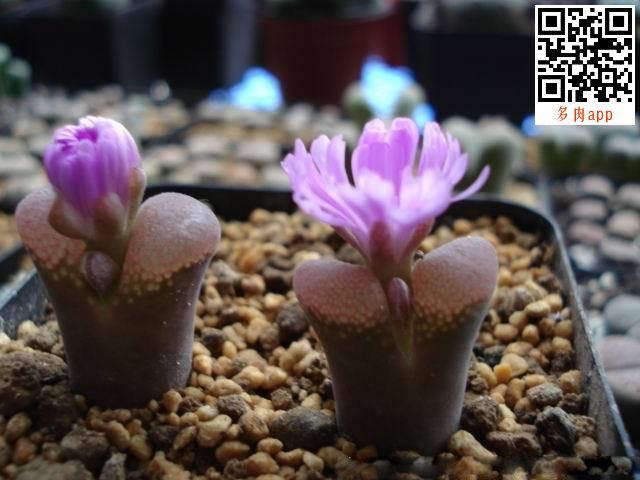
The care of the succulent plant Fengling jade (Frithia pulchra) is basically similar to that of Lithops. In comparison, it is even easier to grow than Lithops, mainly because it does not demand much from the soil; as long as it drains and breathes well, that is enough. Fengling jade has no obvious dormancy period in summer, can tolerate high temperatures, and resists strong light, because the writer's Fengling jade has been exposed from spring to summer and has basically adapted to the environment. Other growers should not expose theirs to sudden full sun in summer; do it gradually, otherwise it can easily get sunburned. Fengling jade is more tolerant of low temperatures than Lithops. If not exposed to the open air, at minus 4°C, with dry potting soil, every Fengling jade in the sunroom is healthy.
The skin-shedding period of Fengling jade is relatively long, gradually extending to mid-April, about a month later than Lithops. After shedding, Fengling jade is given normal care. Fengling jade is tougher than Lithops; whether watered more or less, there is generally no big problem, and few die. Its disease resistance is also very good. In summer, Fengling jade does not go dormant, and no obvious dormancy can be seen. During this period, you can give relatively less water, avoid the hot midday, and water after the sun sets. The writer generally chooses to water in the morning. Office workers can water after getting off work, or after dinner from 8 to 9 p.m., when the potting soil is no longer very hot, which has no effect on the roots of Fengling jade. By late September to mid-October, Fengling jade will slowly bloom. There are two flower colors: pink and pure white. When the temperature drops below 5, water should gradually be cut off, until spring when the temperature rises and the skin has shed, then start watering again. During this period, if the potting soil is too dry, you can appropriately mist it in sunlight. The flowers of Fengling jade are quite attractive to look at.
Is campanula poisonous? Can campanula be grown indoors? / Non-toxic / Pay attention to techniques when growing indoors
Because the flowers of campanula closely resemble wind chimes, many people grow it at home for ornament. However, during care and management, contact with the plant itself is unavoidable, and sometimes children or pets at home will touch it. Will it affect human health? Is campanula poisonous? Can campanula be grown indoors? The editor will answer for everyone.
Is campanula poisonous?
1. Plant / Non-toxic
Campanula belongs to the genus Campanula in the family Campanulaceae. Its leaves, flowers, roots, stems, and so on are all non-toxic. Many people mistakenly believe campanula is poisonous because another plant that looks similar to it, lily of the valley, is toxic. In fact, lily of the valley belongs to the genus Convallaria in the family Asparagaceae and is not the same plant as campanula at all.
2. Scent / Non-toxic
Among the effects and functions of campanula, its flowers are the most attractive. They are not only graceful in form but also give off a pleasant fragrance. As for the scent, is campanula poisonous? The answer is non-toxic. Its scent does not harm human health; instead, it can regulate the atmosphere, help people relax, and reduce stress.
Warm reminder: Campanula is a non-toxic plant, and it also has the effect of clearing heat and detoxifying. However, for health and safety, growers should not take it without a physician's guidance. If allergic to the flower's scent, move the campanula outdoors and keep the environment ventilated.
Can campanula be grown indoors?
Since campanula is both a non-toxic plant and highly ornamental, it is very suitable for growing indoors. Indoors it can also play a role in purifying air and beautifying the home, and it helps people sleep and rest. However, some techniques should be noted when growing it indoors.
How to grow campanula indoors
1. Pay attention to light. Campanula needs sufficient light for growth and flowering, but it should not be placed on a south-facing balcony or windowsill. The best position is a bright place where scattered light can be seen, ensuring a certain amount of light without making the light too dim.
2. Never let water accumulate. Campanula is relatively drought-tolerant and not tolerant of waterlogging, so do not water too much. Avoid soil that is too moist, and never allow water to accumulate in the pot. The principle is to prefer dry over wet. During the rainy season, reduce watering and guard against waterlogging.
3. Repot regularly. Campanula requires soil that is breathable and moderate in acidity and alkalinity. To ensure good soil conditions, generally replace the potting soil once every 2-3 years. Use soil mixed with garden soil, fine sand, and organic fertilizer, and avoid soil that is too acidic or too alkaline.