How to Care for Potted Poinsettia? A Detailed Guide to Care Methods
Poinsettia is also known as fire-on-the-mountain, ivory red, and so on. It is a semi-evergreen shrub. The stems contain white milky sap. The inflorescence is terminal, and the bracts near the inflorescence are scarlet. The flowering period falls during the Christmas season in mid-to-late December.
For potted poinsettia, it is best to repot once every year in early spring. The potting soil can be made by mixing 4 parts leaf mold, 3 parts garden soil, 2 parts sandy soil, and 1 part cake fertilizer powder. Carry out appropriate pruning together with repotting. Poinsettia is afraid of both drought and waterlogging, so watering should be even, avoiding both dryness and excessive moisture, otherwise the lower leaves of the plant are prone to turning yellow and dropping. Each watering should soak through; wait until the surface of the potting soil looks dry before watering a second time. When new buds have just sprouted, the water requirement is low, so do not water heavily, otherwise root rot easily occurs. In summer, when temperatures are high and the branches and leaves are in a period of vigorous growth, the water requirement is high, so it is best to water thoroughly once every morning, and in the evening, depending on whether the potting soil is dry, water again as needed, but with a smaller amount. In spring and autumn, generally water once every 1-2 days.
To keep poinsettia growing vigorously, pay attention to timely and moderate fertilization. During the growth period, if nitrogen fertilizer is insufficient, leaf drop will occur, so in addition to applying base fertilizer, around the start of summer and the grain in ear period, which are the growth periods for new buds and new branches, it is best to apply a dilute cake fertilizer solution once every 2-3 weeks. From mid-to-late August until flowering, apply a liquid fertilizer combining nitrogen and phosphorus about once every 10 days to promote bract growth and make the bract color more brilliant. For nitrogen fertilizer, nitrate nitrogen should be chosen; ammonium nitrogen should not be applied.
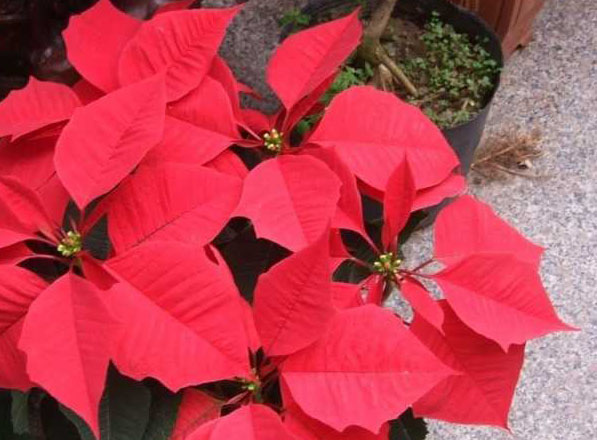
Poinsettia likes ample sunlight. Throughout the year, except for small newly transplanted seedlings, it should be grown in a place with ample sunlight and good air circulation. When the temperature is above 33°C, pay attention to providing appropriate shading to prevent direct strong light. In the hot summer, when the weather is stuffy and hot, and after rainy overcast days turn clear, also pay attention to avoiding exposure to intense sun, but at this time it is necessary to mist the leaves frequently to prevent leaf curling, yellowing, or leaf drop.
Poinsettia is not cold-tolerant; after being hit by frost, the leaves will turn yellow and drop, so in northern regions it should be brought indoors in early-to-mid October. After bringing it indoors, place it in a sunny spot. The room temperature should not be lower than 10°C, and keeping the potting soil appropriately dry will allow it to overwinter safely.
In addition, when growing poinsettia, avoid bruising it and causing the milky sap to flow out. If the stems and other parts are bruised, white latex (toxic) will flow out. If too much latex flows out, it will affect its normal growth.
How to grow potted poinsettia at home?
Poinsettia (scientific name: Euphorbia pulcherrima Willd. et Kl.): a shrub. Roots cylindrical, extremely many-branched. Stems erect, 1-3 in height, 1-4 cm in diameter, hairless. Leaves alternate, ovate-elliptic, long elliptic, or lanceolate, green, margins entire or shallowly lobed or wavy-shallowly lobed, leaf surface covered with short soft hairs or hairless, leaf underside covered with soft hairs; bracts 5-7, narrowly elliptic, 3-7 cm long, 1-2 cm wide, usually entire, very rarely with shallow wavy marginal splits, vermilion. Inflorescences several, arranged in cymes at the branch tips; involucre urn-shaped, pale green, margin toothed and 5-lobed, lobes triangular, hairless. Capsule, trigonous-round, smooth and hairless. Seeds ovate, gray or pale gray, nearly smooth; without caruncle. Flowering and fruiting period from October to April of the following year. The simplest and most feasible method for potted poinsettia at home is cutting propagation. ① It can be done from April to September, but the climate in May to June is most suitable. ② For the cutting medium, a mixed medium of perlite and plant ash in a 1:1 ratio is ideal. ③ Use a plastic flowerpot with a diameter of 12-15 cm as the cutting container. ④ Select 1-year-old branches for cuttings, cut them into sections about 10 cm long, cut off half the leaves, and wash away all the latex flowing from the wounds. ⑤ Insert the prepared cuttings into the medium (place a layer of water-soaked expanded clay at the bottom of the pot, then add soaked mixed medium to eight-tenths full), with a depth of half the cutting, press firmly by hand, water thoroughly, and finally tie a plastic bag tightly to retain moisture, place in a spot with diffused light indoors or in a shaded spot outdoors, and gradually expose to light after one week.How to Propagate Potted Poinsettia at Home (with pictures)
The simplest and most feasible method for potted poinsettia at home is cutting propagation.① It can be done from April to September, but the climate in May to June is most suitable.
② For the cutting medium, a mixed medium of perlite and plant ash in a 1:1 ratio is ideal.
③ Use a plastic flowerpot with a diameter of 12-15 cm as the cutting container.
④ Select 1-year-old branches for cuttings, cut them into sections about 10 cm long, cut off half the leaves, and wash away all the latex flowing from the wounds.
⑤ Insert the prepared cuttings into the medium (place a layer of water-soaked expanded clay at the bottom of the pot, then add soaked mixed medium to eight-tenths full), with a depth of half the cutting, press firmly by hand, water thoroughly, and finally tie a plastic bag tightly to retain moisture, place in a spot with diffused light indoors or in a shaded spot outdoors, and gradually expose to light after one week.