What kind of growing environment do narcissus flowers need
Narcissus prefers a warm, humid climate and dislikes scorching high temperatures; it likes moisture and is fairly cold-tolerant. Narcissus is an autumn-planted bulbous flower, with the habit of growing in autumn and winter, blooming in early spring while storing nutrients, and going dormant in summer. During the dormant period, flower bud differentiation takes place at the growing point of the bulb.
1. Light. Narcissus is a short-day flower; as long as it gets 10 hours of light per day, it can develop normally. If light is insufficient, the leaves tend to grow leggy and it blooms little or not at all; if light is too intense, that is also bad for its growth.
2. Temperature. Narcissus has different temperature requirements at different growth stages. In the early stage it likes cool conditions, in the middle stage it is cold-tolerant, and in the late stage it likes warmth. When the temperature is 20-24 degrees and the relative air humidity is 70%-80%, it is most suitable for bulb enlargement. The optimum temperature for flower bud differentiation is 17-20 degrees, with relative air humidity of 80%. When the temperature exceeds 25 degrees, flower bud differentiation will be inhibited, affecting flowering.
3. Water. Narcissus likes water and moisture, and needs more water during the period of vigorous growth. In the mature stage, its water requirement decreases relatively.
4. Soil. For open-field cultivation, a deep, loose, organic-rich sandy loam with strong water retention should be chosen; it can grow well in soil with a pH of 5.0-7.5.
What is the flower language of narcissus flowers
Chinese narcissus: its flower language is sentimental, missing you. It also symbolizes longing and reunion.
Western narcissus: its flower language is longing for love, loving you, purity.
Yellow narcissus: its flower language is reliving love.
Mountain narcissus: its flower language is beautiful times, thriving and flourishing.
Autumn crocus: its flower language is “youth without regret”.
The symbolism of narcissus flowers
1. “Purity”, or “pure love”, used specifically for women, praising their virtue.
2. “Auspiciousness”, used for relatives, friends and their families, wishing them good luck.
3. Narcissus flowers blooming during the New Year symbolize reunion. So the symbolism of narcissus is “longing and reunion”. At different times, it carries different meanings.
What to do if narcissus leaves go soft
1. Causes
Narcissus leaves go soft because of leggy growth; when the plant grows wildly, its open flowers become small.
2. Prevention and control methods
Sunlight control method: ensure sufficient sunlight by placing the narcissus outdoors or on a balcony in the sun, and at night bring the narcissus from outdoors back inside. This way, the narcissus leaves can grow stoutly and flowers will not fall over
Chemical control method: pour two percent salt water into the flowerpot; this can control the wild growth of narcissus, and doing so also makes its flowering period fairly long; quantitatively injecting chemical agents into the pot can better control the wild growth of the leaves, keeping plant height at around 15 cm.
The difference between narcissus and hyacinth
1. Distinguishing by appearance
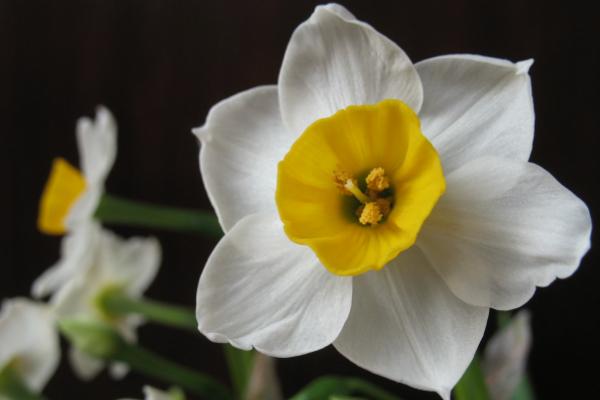
Narcissus: its leaves are flat and ribbon-shaped. The leaves are green with parallel veins, looking very neat. Generally, a narcissus plant has about 5 to 9 leaves. Its flowers are white, with the center and the lowest part of the petals yellow, looking delicate and fresh. A flower has about 6 petals, roughly oval in shape. It is fragrant when blooming.
Hyacinth: its leaves are very thick and fleshy, green, with depressions on the leaves. Hyacinth flowers grow on a flower stem, and the scape bears inflorescences, each with about 10 to 20 small flowers. The flower colors are many and varied. Common ones include blue, pink, yellow and many other colors. Its bulbs look very much like garlic.
2. Distinguishing by region
Narcissus: this is a flower with a long history of cultivation in our country. It was first introduced to China from Italy during the Tang Dynasty, and over time it gradually became a distinctive flower of our country. Nowadays it is mostly distributed in the southeastern coastal areas of our country.
Hyacinth: it originated in Europe, and is widely distributed in the Netherlands, along the Mediterranean coast, and in Asia Minor, but with widespread popularity, it can now be seen almost everywhere in the world. The Netherlands is now its main producing area, and it has even been designated the national flower.
3. Different main values
Narcissus: for such a beautiful flower, its primary value is naturally ornamental. It is said to have the function of absorbing noise. In addition, narcissus can also be used medicinally, able to clear heat and detoxify, reduce inflammation and swelling, and is widely used.
Hyacinth: its flowers are beautiful and elegant, and besides that, the flower colors are diverse, so it is often used for decoration, suitable for both flower beds and the home. In addition, this flower is also often used as a cut flower, for water culture, and so on. It is said that the fragrance of hyacinth flowers has a calming and spirit-focusing effect, able to both eliminate fatigue and calm the emotions, so it is often used to extract and make aromatic oils.
Open-field planting method for narcissus flowers
1. Plowing and flooding the field
Loosen the soil in August-September, then flood the field, and drain it after about 1-2 weeks. Then plow repeatedly to increase fertility, reduce unnecessary pests and diseases, and increase the soil's air permeability.
2. Fertilizing and making beds
Use a large amount of chemical organic fertilizer as base fertilizer, requiring 5000-1000 kg per mu, and 3-year cultivation is needed; the bed surface should be neat and smooth, with smooth water flow.
3. Bulb castration
In order to meet the need for more blooms, the bulbs need to be castrated; the principle is the same as bud removal in plants.
4. Disinfection treatment
For disinfection and soaking the bulbs, use a 100-fold dilution of 40% formalin, soaking the bulbs for about 5-10 minutes.
Narcissus flowers like a warm, humid growing environment, and the cultivation method is also very simple. A generally simple cultivation method is water culture of narcissus; after all, it has few growing requirements, and a basin of clean water can let it survive and bloom until it dies. Flower lovers who need it should quickly grow a pot and put it in the living room or study at home.
How to grow narcissus flowers How to plant narcissus flowers
Growing narcissus flowers is actually not very different from growing some other flowers and plants. Usually it follows roughly the same process: first select the seeds, then cultivate them to take root and then sprout, grow and then bloom. But exactly how to make the growth process go more smoothly is our focus today.
How to grow narcissus flowers
1. There are particular things to pay attention to when selecting bulbs, mainly the three key points of looking at shape, observing color, and pressing to feel. Looking at shape: high-quality narcissus bulbs are generally large, flat in shape, hard in texture, with relatively wide spacing between the longitudinal vein stripes on the surface, the middle membrane stretched very tight, bright skin color, a broad and thick root plate, and symmetrical small bulbs growing beside the main bulb; observing color: from the outside, bulbs that are dark brown, with intact coating, bright luster, and no traces of rot or pest damage are top grade; pressing: pressing is the main means of selecting and identifying how many flower scapes a narcissus has. You can pinch the bulb with your thumb and index finger and press slightly hard. If the feel of the outline is columnar, elastic, and fairly solid, it is a flower scape; if the feel is soft and loose, the outline is flat, and the elasticity is slightly poorer, then it is mostly a leaf bud.
2. Choose an appropriate growing environment. Narcissus likes sunlight and warmth, requires high air humidity, is not very cold-tolerant, and fears heat; during the vegetative growth period it needs moist but not waterlogged sandy soil. Unlike other perennial herbaceous flowers, narcissus has the characteristics of starting growth in autumn, blooming in winter, storing nutrients in spring, and going dormant in summer.
3. Correctly choose water culture or soil culture to cultivate narcissus. Water culture means cultivating it by the shallow-basin water immersion method. Put the sprout-forced narcissus upright into a shallow narcissus basin, add water to submerge one third of the bulb as appropriate. Quartz sand, pebbles, etc. can be used in the basin to fix the bulb. During the day, the narcissus basin should be placed in a place with sufficient sunlight, and at night move it indoors and pour out the water in the basin to control leggy leaf growth. The next morning, add clean water again, and be careful not to change the direction of the bulb. During the water culture period of narcissus, especially sufficient light must be given; place it in a sunny spot during the day and under a lamp at night. This can prevent the stems and leaves of narcissus from growing leggy, making the narcissus leaves short, broad, thick and sturdy, with a rich green leaf color and fragrant blooms. Water-cultured narcissus generally does not need fertilizing. If conditions permit, applying a little quick-acting phosphorus fertilizer during the flowering period can make the flowers bloom better. As long as you master the care conditions for narcissus, you can make “flowers bloom as you wish”; otherwise flowering will be delayed, or it will even only grow leaves without blooming.
The soil culture method is less commonly used by households, that is, using the cultivation method of most moisture-loving flowers to cultivate narcissus. In mid-to-late October, use fertile sandy soil to plant large bulbs into a small flowerpot with holes, planting half and leaving half exposed. Some fine sand should be placed under the bulb in advance to help drainage.
How to plant narcissus flowers
1. First, after buying the narcissus seeds, wash them clean.
2. Take out the water culture holder and put the narcissus in, with the roots at the bottom and the top of the head facing up.
3. Take out a fish tank, fill it with water, and then put the prepared narcissus water culture holder on it.
4. After putting it on, we check whether the water has reached the roots. If it has not yet reached them, we continue adding water. Once it reaches the roots, we stop adding water. It must not go above the roots. Then after this is done, we take off the water culture holder and put in the colored stones. Putting in roughly enough is fine; do not put in too many.
5. Then you can drip a few drops of nutrient solution in, but do not drip too much or it will be bad.
Note: when the water gets dirty, be sure to change it; do not wait until it turns completely yellow before changing the water. Give it plenty of sunlight, and if you have time, change the water every day. Generally, it can bloom in about 30 days.
Propagation methods for narcissus flowers
1. Offset bulb propagation: this is the most commonly used method. Offset bulbs grow on both sides outside the bulb, connected to the mother bulb only at the base, and easily separate from the mother on their own. In autumn, separate them from the mother bulb and plant them separately; new bulbs are produced the following year.
2. Offset bud propagation: offset buds are buds wrapped inside the bulb. Only when bulb castration is carried out do they separate from the mother along with the dug-out broken scales. Pick out the white buds and sow them in the seedbed in autumn; new bulbs are produced the following year.
3. Twin-scale propagation: use a bulb disc with two scales as propagation material, called twin-scale propagation. The method is to first place the bulb at a low temperature of 4C-10C for 4-8 weeks, then at room temperature cut the bulb disc smaller so that each piece has two scales, and cut off the upper end of the scales leaving 2 cm as propagation material. Then use a plastic bag holding vermiculite with 50% water content or sand with 6% water content, put the propagation material into the bag, seal the bag opening, and place it in a dark place at 20C-28C. After 2-3 months, small bulbs can grow, with a bulb formation rate of 80%-90%. This method can be carried out in all four seasons, but April-September is better. The survival rate of the small bulbs after transplanting can reach 80%-100%.
4. Tissue culture: use MS medium, with 30 grams of sucrose and 5 grams of activated charcoal added per liter, using shoot tips as explants; a stem disc with twin scales 5X10 mm can also be used as explants, pH5-pH7, cultured at 25C. Ten days after inoculation, small protrusions appear; after 20 days they become small bulbs; after 1 month they are transferred to a medium containing NAA 0.1 mg 1/2MS, and after 6-8 weeks roots and leaves are produced. Transplanted to the field, they can achieve 100% survival.
What do narcissus flowers symbolize
Narcissus flowers at the New Year symbolize -- longing, expressing reunion.
Narcissus flowers symbolize longing for loved ones. With its ice-white and pink hues, orchid-like leaf fragrance, and tall, elegant stems and leaves, at the end of the year when the weather is cold and the flowering season is fading, it opens ice-flesh, jade-quality blossoms, carrying a light, elegant fragrance that makes people feel relaxed and happy.
The care of narcissus flowers is very particular; it has always followed the principle of reaping what you sow, and good effort brings good returns. So the more careful we are during the planting process, the better the narcissus is likely to grow. At the same time, narcissus is a flower with very good symbolism in our country, and growing it well is also very beneficial for improving the home environment.