How to grow potted carnations so they thrive
Carnation (Dianthus caryophyllus)
Other names: carnation, lion's-head pink, musk pink, large-flowered pink, musk pink, Dutch pink
Uses: for flower beds, pots and container seedlings, and cut flower production.
Seed weight: common seed, 5OO seeds/gram.
Sowing period: July to August.
Sowing substrate: loose humus soil, with a light application of thin fertilizer (compound fertilizer O.25-O.5 kg/cubic meter, iron, trace elements), excellent drainage (O-2O% vermiculite), a relatively low EC value in the substrate (less than O.75), pH: 6.O-6.5.
Germination: at a temperature of l8°C-22°C, germination occurs in 7-l4 days.
Germination conditions and management: maintain a relatively low EC value in the substrate, pH 5.8-6.5. Before sowing, treat the growing substrate with a fungicide to prevent Fusarium. No covering is needed after sowing; the seeds need light to germinate. The growing substrate moisture must be consistent and humidity must be high (relative humidity above 95%), for good germination uniformity. After the cotyledons open (growth stage ii), lower the soil moisture and reduce the temperature to l6°C.
Temperature: day temperature l3°C-l6°C, night temperature lO°C. In spring, plants begin to grow at l5°C-l8°C for 7-9 weeks. At low temperatures of lO°C-l5°C, the cultivation time will be prolonged. The "Floristan" series, when it has grown 8 true leaves, undergoes vernalization at 5°C for 6-9 weeks to promote flowering. Avoid too great a temperature fluctuation to prevent the calyx from suddenly splitting.
Cultivation tips: needs a dry, sunny and well-ventilated growing environment. The root system is sensitive to a high-moisture growing substrate. Avoid watering over the top of the plant. After transplanting when the plant has grown 4-6 pairs of true leaves, it needs pinching, which helps the plant branch and improves plant quality.
Variety introduction
Floristan (floristan) grows about 7O cm tall, with double flowers and brilliant colors, and can be used as a cut flower. The stems are long, upright and robust, with strong resistance. It requires vernalization. The experience content is for reference only. If you need to solve specific problems (especially in fields such as law or medicine), it is recommended that you next consult professionals in the relevant field.
How to grow potted carnations
Are carnations easy to grow? Friends who have never grown carnations all have this worry, so let me get straight to the point and share a few little tips from the carnation growing method: 1. Pot selection tips: choose a tall pot with a large inner diameter. 2. Watering principle: water thoroughly when you water, and do not water if the pot surface is not dry. 3. Pay attention to light, and avoid drought and waterlogging. 4. Carnations are in a semi-dormant state in midsummer, so avoid blazing sun exposure... Next let us learn about the precautions for growing carnations.1. To prevent carnation leaves from withering, control light and temperature well: some flower friends report that during the growing process, phenomena such as leaf withering occur. This problem is mainly caused by poor control of temperature and light conditions. When the temperature is higher than 30°C, it easily causes withering symptoms. The most suitable environmental temperature for carnation growth is 13-25°C, and the light condition should be controlled at 6-8 hours per day. This can ensure the normal growth of potted carnations. Liking strong light is an important characteristic of carnations. Whether it is indoor overwintering, potted summering, or greenhouse forcing cultivation, sufficient light is needed, and it should all be placed in a sunny position exposed to direct light.
2. To avoid root rot in carnations, master the watering principle well: why do some potted carnations show root rot? Potted plants have a common trait: they like a well-ventilated and well-drained environment. Excessive watering easily causes root rot, so the watering frequency must be controlled well. Avoid water accumulation. During the rainy season, pay attention to loosening the soil and draining water. Apart from timely watering during the peak growing and flowering seasons, at ordinary times water less, just enough to keep the soil moist. If conditions permit, the air humidity can be kept at around 75%. (For those who have a humidifier at home, this should not be hard to control.) Once again, a reminder of the carnation watering principle: do not water if the pot surface is not dry, water thoroughly when you water, and avoid waterlogging.
3. If you want carnations to grow healthily, pay attention to fertilizing: if you choose to plant carnation plants. Pay attention to choosing a clayey soil that is well drained, rich in humus, has good fertilizer retention and is slightly alkaline. Before planting, first apply sufficient base fertilizer containing potassium, calcium, nitrogen and phosphorus at the bottom of the pot (or apply a sufficient amount of baked fertilizer and bone meal). During the growing period, liquid fertilizer must also be applied continuously, generally once every 10 days or so with rotted thin fertilizer water, and once after flower harvesting. Fertilizing is prohibited during the high-temperature period in summer, otherwise it easily causes withering and death.
4. Methods to make carnations branch more and bloom more: to promote branching, remove the top when the plant is 15-20 cm tall. Generally keep 6-7 lower side buds, then pinch again once, and finally make the plant have 12-14 side branches. When budding, keep only one bud at the top of each branch, and remove all the lower axillary side buds and side shoots. The second pinching must be done before mid-August. After the first flowering, promptly cut off the flower stalks, keeping only two buds at the base of each branch. Through such repeated pinching, the plant shape can be made graceful, with abundant flowers and brilliant colors.
5. Carnation propagation method: carnations are most suitable for cutting propagation. The timing of cuttings is not limited; apart from excessively hot weather, they can be propagated in other seasons. Among these, cuttings in early February have the highest survival rate.
Carnation benefits and effects:
1. Carnation has the effects of beautifying the face, whitening the skin, and removing spots and wrinkles, and can be used to regulate female endocrine disorders.
2. Carnation contains various trace elements needed by the human body, can improve blood circulation, promote the body's metabolism, and has the effects of strengthening the kidneys and enriching essence, treating consumptive disease, cough, and excessive thirst.
3. Carnation has the effects of clearing the heart and removing restlessness, and reducing inflammation and irritability. It has a clear effect on treating headaches and toothaches.
4. Carnation can calm the nerves and quench thirst, promote body fluid and moisten the throat, strengthen the stomach and relieve indigestion, regulate blood lipids, and aid weight loss.
Precautions for carnation: please place it in a cool and dry place indoors, and avoid children taking it by themselves.
When brewing carnation, it is suitable to pair with: forget-me-not, stock, rose king, peony flowers, wintersweet flowers.
Introduction to the brewing and drinking method of carnation: take 3-4 carnation flowers, brew with boiling water for three minutes and it is ready.
How to grow potted carnations, carnation growing methods and precautions/5 points
Carnations are certainly familiar to everyone. They are often given to mothers, and are a flower with a beautiful flower shape and rich symbolism, which has also attracted many people to grow them. In life, many people want to grow carnations indoors, so how do you grow potted carnations? Compared with other flowers, carnations are not easy to grow. The following is a summary of carnation growing methods and precautions. Friends who want to grow them might as well take a look~
1. How to grow potted carnations, light is the key
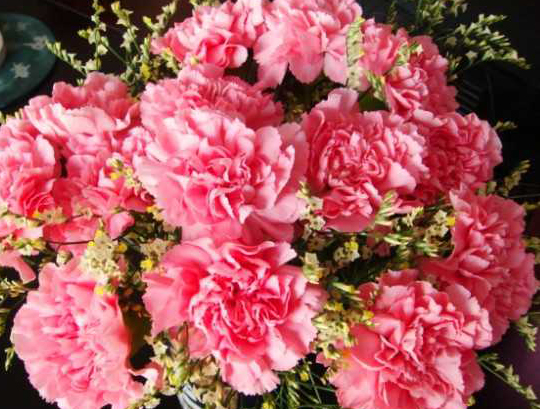
As people's understanding of the environment deepens, many people choose to grow plants at home, on the one hand to purify the air, and on the other hand for beauty. Carnations paired with asparagus fern and other accompanying leaves in a vase echo each other interestingly and are an excellent choice for decorating interiors, so many friends who are new to growing flowers choose carnations. So how do you grow potted carnations? Soil, watering and fertilizing are essential, but light is the most important!
2. Carnation growing methods and precautions
1. Soil, sandy loam
Although carnations can be grown hydroponically, first they must be grown in soil, so creating a loose, breathable root-zone environment that also has a certain fertilizer- and water-retention capacity is crucial for carnation cultivation. Carnation is a fibrous-root herbaceous flower, and its roots like to grow in loose, fertile, well-aerated soil or medium, so the soil for growing carnations is best sandy loam.
Precautions: the soil air-filled pore space should ideally be about 30%; heavy and waterlogged soil is unfavorable for carnation growth and needs improvement, the core of which is coordinating the relationship among the solid, liquid and gas phases in the soil.
2. Light, 6-8 hours/day
In terms of light requirements, carnations can be said to have the highest demands among all plants. Although other flowers like light, they generally cannot be exposed to direct strong light. But carnations are different: apart from the seedling stage or full flowering stage, there is no need to worry about any strong light exposure. Not only that, the longer the accumulated sunshine hours, the better for carnations. That is really tough!
Precautions: liking strong light is an important characteristic of carnations. Whether it is indoor overwintering, potted summering, or greenhouse forcing cultivation, sufficient light is needed, and it should all be placed in a sunny position exposed to direct light, and the light condition should be controlled at 6-8 hours per day.
3. Temperature, 13-25°C
In carnation growing methods, temperature control is also crucial. It not only has a qualitative and quantitative effect on carnation growth and development, but also affects its growth speed, the morphology and size of flowers, leaves and stems, cut flower yield and cut flower longevity, and other aspects. Carnation is a cool-loving plant, and the most suitable temperature for growth and development is 13-25°C, with the day-night temperature difference kept within 10°C.
Precautions: if the daytime temperature is too high, carnations show phenomena such as narrow leaves, small flowers and poor branching; if the nighttime temperature is too high, abnormal reactions such as weak stems and small flowers with good flower color appear. When the summer temperature is higher than 35°C, or the winter temperature is lower than 9°C, growth is slow or abnormal, or even stops.
4. Watering, not too much
Unlike jasmine, which needs frequent watering, carnation is a shallow-rooted flower, and the planting depth should not exceed 2 cm. After planting, water once thoroughly, and later water thoroughly again when the pot soil becomes dry. Carnations are not tolerant of moisture. Apart from increasing the watering amount during the vigorous growth period, flowering period and midsummer, watering should generally not be excessive; keeping the soil at a certain moisture level is enough. During the flowering period, avoid the soil being too dry or too wet.
Precautions: excessive watering easily causes root rot in carnations, so the watering frequency must be controlled well to avoid water accumulation, and during the rainy season pay attention to loosening the soil and draining water. Apart from timely watering during the peak growing and flowering seasons, at ordinary times water less, just enough to keep the soil moist. If conditions permit, the air humidity can be kept at around 75%.
5. Fertilizing, once/10 days
Carnations have a long growing period and need continuous replenishment of soil fertilizer. The principle for topdressing is thin fertilizer applied frequently; for potted plants, apply topdressing once every 7-10 days. During the two growth peaks of the plant, the number of topdressings can be increased. Fertilizers can be cake fertilizer water, chicken manure water, or alternately organic fertilizers such as barnyard manure, compost and bone meal.
Precautions: pay attention to choosing a clayey soil that is well drained, rich in humus, has good fertilizer retention and is slightly alkaline. Before planting, first apply sufficient base fertilizer containing potassium, calcium, nitrogen and phosphorus at the bottom of the pot. During the growing period, liquid fertilizer must also be applied continuously, generally once every 10 days or so with rotted thin fertilizer water, and once after a week. Fertilizing is prohibited during the high-temperature period in summer, otherwise it easily causes withering and death.
3. Precautions for growing carnations
In the precautions for growing carnations, we have already mentioned some points, but if you want to grow carnations beautifully, flower friends also need to pay attention to the following points:
① During the vigorous spring and autumn growth periods, the soil should be kept moist to meet the needs of growth and development. During the high-temperature period in summer, growth is inhibited, so watering should be restrained and ventilation strengthened, so as to keep the pot soil slightly dry.
② Generally, move into the greenhouse around the time of frost descent (mid-October), and the most suitable temperature regulation is 10-20°C. To force or delay the flowering period, the temperature can be appropriately raised or lowered. Try to reduce the humidity in the greenhouse to reduce the occurrence of diseases.
③ When the winter temperature is lower than 9°C, carnations grow slowly or show abnormal behavior or even stop growing. So they should be moved indoors and grown in a place with sufficient sunlight and good ventilation. If the temperature is suitable, the flowering period can be extended to March of the following year.
④ During the seedling stage, pinching should be carried out l-2 times to promote branching, so that each plant has about 10 side branches. Through pinching, the plant shape is graceful and flowering is abundant. As the branches grow, supports should also be set up to prevent lodging. During the growth period, promptly remove the side buds and small flower buds produced on each branch, keeping only one flower bud at the top of each branch, so that nutrients are concentrated in supplying the top bud.