Cultivation Methods and Care Tips for Chaenomeles speciosa
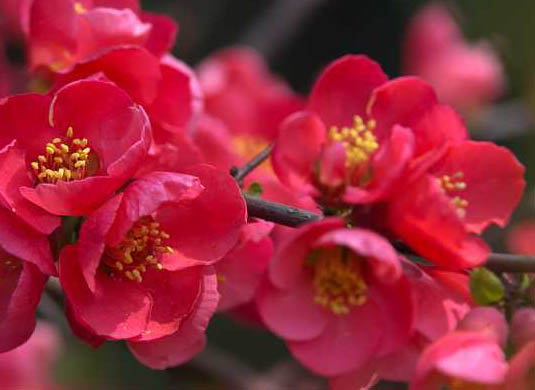
Chaenomeles speciosa, also known as tie jiao hai tang (iron-footed crabapple). A deciduous shrub in the rose family (Rosaceae). Leaves elliptical to ovate, glossy on the surface; flowers open before the leaves or at the same time as the leaves, 3-5 blooms clustered at the nodes of 2-year-old branches, vermilion red, later fading to pale pink, with extremely short pedicels. Fruit nearly spherical, yellow when ripe, fragrant. Blooming period March to May, fruit ripening period September to October; there are single-flowered, double-flowered and dwarf varieties. It prefers a cool, humid environment and plenty of sunlight; it is relatively cold-hardy and drought-tolerant, but not tolerant of shade or waterlogging. It thrives in deep, fertile, well-drained, slightly acidic sandy loam.
(1) Chaenomeles speciosa has strong suckering ability and tolerates pruning well. It is commonly propagated by division, layering and cuttings. Spring division can be combined with transplanting: dig up the whole plant along with the mother plant, leaving 2-3 stems per plant, or dig up suckers around the mother plant for planting out. Layering is mostly done in early spring: bend a strong, long branch down to the ground, open a trench and lay it in the trench, cover with soil and firm it, then cover with grass to retain moisture; roots will form in about 2 months, and the following spring it can be separated from the mother plant and planted elsewhere.
(2) Chaenomeles speciosa is a sun-loving tree, so the planting site should be chosen in a spot with plenty of sunlight. If light is insufficient, it easily causes leggy branches and leaves, affecting flowering. Before planting, long branches should be appropriately shortened to make the plant compact and grow uniformly. Apply barnyard manure, decomposed chicken and duck manure, soybean cake, etc. into the pit as a base fertilizer.
(3) Do not water too much normally; if the soil is not excessively dry, there is no need to water frequently. In northern regions, before winter each year, water thoroughly to protect against freezing, and apply decomposed organic fertilizer. In areas where winter temperatures drop below -20°C, the plants need to be covered with soil to protect them through the winter.
(4) Chaenomeles speciosa flowers and fruits on 2-year-old branches. Therefore, do not shorten 1-year-old branches; after flowering, moderately shorten the flowering branches to encourage more side shoots and increase the number of flowers. During winter and spring, overlapping branches and diseased or pest-infested branches can be pruned out, and leggy branches shortened, so that nutrients are concentrated and consumption is reduced, which favors more flowering. For plants that have already flowered, apply liquid fertilizer 3-4 times a year. Applying more phosphorus fertilizer before flowering makes the flower colors more brilliant. Chaenomeles speciosa is susceptible to rust disease, so timely spraying for prevention and control should be noted.
How to plant Chaenomeles speciosa? Key points of Chaenomeles speciosa cultivation techniques
Chaenomeles speciosa has a long cultivation history in China; it originated in southern North China, eastern Northwest China and Central China, but is now cultivated all over the country. Its flower colors are very rich and varied, including vermilion, peach red, moonlight white and other colors, and some varieties have pink and white mixed colors; combined with its smooth, translucent petals, it is very beautiful and thus loved by people. Chaenomeles speciosa blooms from March to April, and the fruit ripens in October.
I. Habits of Chaenomeles speciosa
Chaenomeles speciosa has strong adaptability and is cold-hardy; it can overwinter outdoors in North China, but it is very sensitive to temperature. In the same location, plants grown in a wind-sheltered, sunny spot bloom 4-6 days earlier than those in shade. It is not demanding about soil but is not tolerant of waterlogging; it dislikes dampness and tolerates drought. Excessive soil moisture often makes plants thin and weak, with slender, sparse branches and leaves, and markedly reduced stress resistance. Poor soil drainage and standing water often cause root rot and, in severe cases, suffocation and death. Chaenomeles speciosa is a sun-loving species and requires ample light, yet it can still grow well and bloom normally in slightly shaded spots.
II. Propagation of Chaenomeles speciosa
Chaenomeles speciosa is commonly propagated by division and cuttings; although sowing is possible, it is rarely used. Division is done in early spring. After the soil thaws and the weather warms, dig out the entire clump, shake off the soil from the roots, then use a sharp knife to split the clump from the middle, finally dividing it into small clumps each with 2-4 branches and roots at the base. Cut off the branches damaged during division at the root crown, and shorten the rest to about 10 cm. Plant them in a prepared seedbed, strengthen management, and after 1-2 years of careful cultivation they are ready to leave the nursery.
Chaenomeles speciosa cuttings are propagated in June-July. Select relatively thick new branches and cut them into 12-15 cm long cuttings, then insert them into river sand, vermiculite or other substrates. For mass propagation, choose well-drained sandy loam and make beds to insert the cuttings directly into the soil. After cutting, shade them and water, keeping the soil surface moist; new roots can grow in about 40 days. After rooting, reduce misting and gradually extend the light exposure time, finally removing the shade frame. In places with cold winters, open-ground cuttings of Chaenomeles speciosa need to be covered with grass or given other cold-protection measures to overwinter until transplanting the following spring. If cuttings are inserted in pure sand or vermiculite, they should be transplanted promptly after rooting; otherwise, the new roots grow too long and the cuttings lack nutrients for a long time, which is unfavorable for transplanting and growth. Alternatively, layer them in spring and they will root after 1 month; after leaf fall in autumn, cut them from the mother plant and plant separately.
III. Cultivation and Management of Chaenomeles speciosa
Cultivation and management are relatively simple, as Chaenomeles speciosa has no strict soil requirements; ordinary loam or sandy loam will grow well, but alluvial soil and gravelly soil are best. When grown in pots, the potting soil should be fertile garden soil mixed with some coarse sand. Chaenomeles speciosa tolerates both drought and poor, thin soil, so cultivation and management are relatively extensive. To make the clump flourish and produce many brightly colored flowers, appropriate water and fertilizer management should be carried out. Because it is sensitive to water and fertilizer, excessive water and fertilizer often cause rampant growth and fewer flowers. Under normal management, apply organic fertilizer (decomposed barnyard manure or compost) once a year in autumn at the root zone of the clump. If the plant is not very thin and weak, there is no need to apply additional fertilizer during the growing season; simply increasing the amount of organic fertilizer in autumn is sufficient.
Chaenomeles speciosa grows vigorously and the clump easily becomes too dense, so pruning is an important management task. The main purpose of pruning is to improve ventilation and light conditions inside the clump, prevent dense branches from affecting growth, control vegetative growth, and promote flower bud formation. When pruning, note that Chaenomeles speciosa flowers and fruits on 2-year-old branches, so after new branches emerge they should not be shortened; in the young tree stage, wait until after flowering before shortening the flowering branches, so as to encourage more side shoots, help the tree take shape as quickly as possible, and also increase the flowering sites for the third year. To make the tree structure clear, after planting it is best to keep only 3 main branches and cut off excess branches from the base, thus forming a "three-main-branch open-center" tree form, with side branches growing from the upper ends of these 3 main branches. This training method can both maintain a low shrub-like tree shape and prevent excessive density and disorder.
For potted Chaenomeles speciosa, because the root system is limited by the pot, attention must be paid to water and fertilizer management; otherwise growth is affected and few flowers are produced. Generally, apply organic fertilizer once each year in late autumn or early winter, and apply liquid fertilizer once after flowering in spring. The additional fertilizer should not be too concentrated; decomposed cake fertilizer water, etc. can be used. Watering should keep the soil moist.
IV. Ornamental Value and Applications of Chaenomeles speciosa
Chaenomeles speciosa has slanting, crisscrossing branches, brilliant flower colors, and a splendid brocade-like appearance; its flowers come in clusters of three to five, and its large, fragrant yellow fruits make it an excellent species for both flower and fruit display. It is suitable for group planting at courtyard wall corners, lawn edges, around tree groves, and beside ponds and streams; it can also be planted in front of evergreen shrubs as a flowering hedge or flower cluster, and can also be made into old-trunk bonsai. Common horticultural varieties include the white-flowered type, rose type, vermilion type, and dwarf type.
The above are the key points of Chaenomeles speciosa cultivation techniques. To learn more about the planting and care of nursery stock and flowers, you can follow Huinong Xuetang!
Chaenomeles speciosa Chaenomeles speciosa Illustrated Guide: How to grow Chaenomeles speciosa / How to propagate Chaenomeles speciosa
Chaenomeles speciosa ProfileChaenomeles speciosa Chaenomeles speciosa
Cultivation Methods and Precautions for Chaenomeles speciosa, Introduction to Chaenomeles speciosa
Chaenomeles speciosa is a plant in the genus Chaenomeles of the rose family (Rosaceae). Its stems grow in clumps, the branches have thorns, its pedicels are extremely short, and the flowers cling closely to the branches, hence the name. It became widely familiar to people from the Ming Dynasty "Qunfang Pu". Its flowers are fresh, plump and dazzling, and it is one of the main spring flowering trees in gardens. It can be planted singly in gardens to arrange flower borders, planted in rows as a flowering hedge, or grown in pots for ornament; it is an ideal material for flowering and fruiting tree-stump bonsai. The fruit is called wrinkled papaya, and when used as a Chinese medicinal material it is abbreviated as papaya; it is one of China's unique rare fruits and has high medicinal and edible value.
The name Chaenomeles speciosa became widely familiar to people from the Ming Dynasty "Qunfang Pu", which records: "There are four varieties of crabapple, all woody: Xifu crabapple, pendulous crabapple, papaya crabapple and Chaenomeles speciosa." In fact, both Chaenomeles speciosa and papaya crabapple are plants of the genus Chaenomeles, unlike Xifu crabapple and pendulous crabapple, which can be directly called crabapple or crabapple flower; when naming them, a qualifier must be added to show the difference.
Chaenomeles speciosa has a very long cultivation history in China; according to textual research, the "mao" in the "Erya" is this plant. Its flower colors are diverse, including vermilion, peach red, moonlight white and other colors, and some varieties have pink and white mixed colors; together with its smooth, translucent petals, it is very beautiful. Its branches are pitch-black and curved like iron wire, which greatly suits the aesthetic tastes of the ancients; it is an excellent material for making traditional-style bonsai, and this trend also influenced Japan and Korea. The Japanese horticultural world attaches great importance to the cultivation of Chaenomeles speciosa and has bred new horticultural varieties. The fruit of Chaenomeles speciosa has a peculiar shape, like an upside-down pear, hence it is also called "iron-footed pear"; because its fruit, compared with the fruit of papaya crabapple - the papaya - becomes slightly wrinkled after ripening, it is also called "wrinkled papaya". As for being called "Chuan papaya" and "Xuan papaya", that is because Sichuan and Xuancheng in Anhui abundantly produce this plant.
Morphological Characteristics of Chaenomeles speciosa
Deciduous shrub, up to 2 m tall, with branch thorns; branchlets cylindrical, spreading, stout, purplish brown when young, hairless, dark brown when old. Leaf blades ovate to elliptical, rarely oblong, 3-10 cm long, 1.5-5 cm wide, apex acute, rarely rounded-obtuse, base cuneate to broadly cuneate, margin with sharp fine serrations, teeth spreading, surface slightly shiny, dark green, hairless, abaxially pale green, hairless; petiole 1-1.5 cm long, hairless; stipules large, leaf-like, ovate or kidney-shaped, margin with sharp double serrations, hairless. Flowers 2-6 clustered on 2-year-old branches, diameter 3.5-5 cm, opening before the leaves or at the same time as the leaves; pedicel thick and short, 3 mm long or nearly sessile, hairless; hypanthium glabrous outside; calyx lobes erect, nearly semicircular, apex rounded-obtuse, entire or with wavy teeth, margin with yellow-brown cilia, glabrous outside, sparsely pubescent inside, half as long as the hypanthium; petals nearly circular or obovate, with short claws, 1-1.5 cm long, scarlet or pale pink; stamens 35-50, erect, 1-1.3 cm long, filaments slightly reddish; styles connate below the middle, hairless, nearly as long as the stamens, stigma capitate. Pome spherical to ovoid, diameter 3-5 cm, yellow or yellow-green, with inconspicuous sparse spots, fragrant, fruit stalk short or nearly absent. Blooming period April, fruiting period October.
Plant height about 2 m, branches erect or spreading, thorny. Leaves ovate or elliptical, stipules large and conspicuous. Flowers rice-red, opening before the leaves or at the same time as the leaves.
Ecological Habits of Chaenomeles speciosa
Sun-loving, relatively cold-hardy, not tolerant of flooding, not selective about soil, but prefers fertile, deep, well-drained soil. Chaenomeles speciosa is a deciduous shrub in the rose family (Rosaceae), genus Chaenomeles, up to 2 m tall; flowers in clusters of 3 to 5 on 2-year-old old branches, blooming before the leaves or with the leaves, flower colors red, pink and white, diameter about 3 cm to 5 cm. Fruit ovoid to spherical, 4 cm to 6 cm in diameter. Blooming period March to April; if light and humidity conditions are suitable, it can bloom in January to February, and the fruit ripening period is September to October.
Cultivation Techniques of Chaenomeles speciosa Cultivation Techniques
Chaenomeles speciosa has strong adaptability and is managed extensively. Flowers are borne on 2-year-old branches; after flowering, the tops of the previous year's branches can be cut off, leaving only about 30 cm, to promote more new branches and create conditions for more flowering the following year.
Chaenomeles speciosa has clustered stems, thorns on the branches, extremely short pedicels, and flowers clinging closely to the branches. The tree has a graceful posture and beautiful flowers, with double-flowered and semi-double-flowered varieties; the fruit is spherical or pear-shaped, yellow when ripe in autumn, fragrant, and can be picked and placed on a tray and displayed on a table for ornament. Chaenomeles speciosa can be planted in gardens and is also excellent material for potted ornament and bonsai making.
Care and Management
Chaenomeles speciosa is relatively simple to manage. Because it flowers mainly on short branches, before spring sprouting the long branches should be appropriately shortened and pruned into a hemispherical shape to stimulate more new shoots. During summer growth, the growing branches should also be pinched. In the course of cultivation and management, pay attention to watering in the dry season; in the hottest days it is best to apply decomposed organic fertilizer once, or an appropriate amount of compound fertilizer (N, P, K elements). For potted flower forcing, suitable plants can be dug up and potted from September to October, first placed in a cool, ventilated place for a period of care, then after winter begins moved into a 15°C to 20°C greenhouse, frequently misting the branches; after about 25 days they can bloom, and can be used for New Year's Day and Spring Festival ornament.
Distribution Areas of Chaenomeles speciosa
Produced in China's Shaanxi, southern Gansu, Henan, Shandong, Anhui, Jiangsu, Zhejiang, Jiangxi, Hunan, Hubei, Sichuan, Guizhou, Yunnan, Guangdong and other provinces, and cultivated throughout the country. Also distributed in Myanmar, Japan and Korea. The main cultivation bases are in Jiangsu, Zhejiang, Anhui, Hunan and other places.
Disease and Pest Control of Chaenomeles speciosa
During the growth of Chaenomeles speciosa, diseases and pests are very likely to occur, often causing early leaf drop, deformed fruit, weakened growth vigor, and reduced ornamental value, bringing difficulties to care and management. According to the author's more than 3 years of investigation and research mainly in the Suzhou area and the East China region of Jiangsu, Zhejiang, Shanghai and Anhui, the diseases and pests that occur year-round in the adult stage of Chaenomeles speciosa, cause serious damage, and must be controlled mainly include one disease and two insects, namely crabapple rust, lace bug and aphid.
Occurrence and damage characteristics of the main diseases and pests: In the early stage of crabapple disease, yellow-green small spots appear on the upper surface of the leaves, later gradually expanding into orange-yellow lesions. On the upper surface of the lesions, tiny black particles the size of needle tips appear, and on the underside of the leaves hard yellow whisker-like structures grow, namely the rust sporophores of the pathogen. In the later stage, the yellow whisker-like structures darken in color, gradually mature and become powdery, and the lesions on the upper surface of the leaves expand, forming dark brown necrotic spots that can fall out to form perforations. From August to September, after the rust spores mature, they spread with the wind to Chinese juniper, invade the tender shoots and overwinter. The damaged parts of Chinese juniper show pale yellow spots, later rising into gray-brown bean-like small galls that swell in the middle, with a rough surface, brownish. The disease is more serious when crabapple, apple and Chinese juniper are mixed-planted.
Propagation Methods of Chaenomeles speciosa
Chaenomeles speciosa is mainly propagated by division, cuttings and layering; sowing is also possible. Seed propagation can produce large numbers of uniform seedlings, but it is not easy to maintain the original variety characteristics. Chaenomeles speciosa has strong tillering ability, so the mother plant can be dug up and divided in autumn or early spring, dividing it into plants with 2 to 3 stems each; after planting, division can be carried out again after 3 years. Generally, after division in autumn, heel them in to promote wound healing, and they can be planted out the following spring and bloom the next year. Hardwood cuttings are taken at the same time as division, and during the growing season softwood cuttings can also be taken: take sections about 15 cm long, insert them into plain sand or plain soil, water thoroughly and keep moist; after more than a month they can leaf out. Cutting seedlings can bloom in 2 to 3 years.
Flower Language of Chaenomeles speciosa
Flower language of Chaenomeles speciosa: ordinary, passionate. Its flower language also includes: precocious, radiance of the fairy, pioneer, leader.
Dietary Therapy or Medicinal Value of Chaenomeles speciosa
The medical information and health dietary therapy information on Hugarden Network is for reference only and cannot be used as a basis for diagnosis or medical treatment. Any health problem should be consulted with professional medical staff, and the treatment of any disease should follow doctor's advice.
Ultimate flower-protecting mission: to love yourself, start from reality, and strictly follow doctor's advice. For disease, do not be careless, do not delay, do not give up hope; face it bravely, warm the silent world with love, and care for the flower field in your heart with your heart.
Ornamental Value
The Ming Dynasty "Qunfang Pu" records: "There are four varieties of crabapple, all woody." These four varieties are: Xifu crabapple, pendulous crabapple, papaya crabapple and Chaenomeles speciosa. As one of the traditional crabapples, Chaenomeles speciosa has flower colors mixing red and yellow, setting each other off delightfully, "commanding all the spring scenery and most elegant"; it is a good flowering and fruiting ornamental tree. It is mostly cultivated in courtyards for landscaping, and also used as hedge material; it can be planted alone or in groups with winter jasmine and forsythia. It is also often used as bonsai; an excellent ornamental flowering tree for potted courtyards. Its flowers are fresh, plump and dazzling, and with its smooth, translucent petals, it is truly very beautiful.
Ornamental Characteristics
Flower-viewing season: spring
Chaenomeles speciosa has diverse flower colors, including vermilion, peach red, green, multicolored moonlight white and other colors, and some varieties have pink and white mixed colors; together with its smooth, translucent petals, it is truly very beautiful.
Medicinal Value
The fruit of Chaenomeles speciosa is called wrinkled papaya, also known as Chuan papaya and Xuan papaya; when used as a Chinese medicinal material it is abbreviated as papaya (definitely not papaya/Carica papaya, please do not confuse them!). It is one of China's unique rare fruits and has high medicinal and edible value.
Chuan papaya blooms in late January. The flowers are of two kinds, red and white. The ripe fruit goes on the market in September and October. The fruit is apple-shaped, with a yellow surface when ripe and pink in the sunlit portion. Single fruit weight is 200-350 grams, and yield in the full production period is 2000-2500 kg per mu.
Chuan papaya fruit is extremely rich in nutrients. Every 100 grams of fresh fruit contains 2741 mg of vitamin, 3237 No/g of anti-aging substances, and is also rich in protein, tartaric acid, phosphorus, iron, calcium, etc. It is a superior raw material for processed fruit products and medicinal products, and can be used to make preserved fruit. The preserved fruit made from it has a unique taste, pure sweet-and-sour flavor that is pleasant, and a special fresh fruity fragrance; the flesh has little fiber, contains no stone cells, has a relatively firm texture, and stores and transports well.
Chuan papaya has high medicinal value and has the functions of relaxing sinews and activating collaterals, and harmonizing and transforming dampness. Traditional Chinese medicine believes that wrinkled papaya can dredge meridians and collaterals, dispel wind and invigorate blood, and has the effects of strengthening, stimulating, relieving pain, calming the liver, harmonizing the spleen, transforming dampness and relaxing sinews. It mainly treats heatstroke, cholera with cramps, beriberi edema, damp impediment and other conditions; soaked in liquor (papaya wine) and taken, it treats rheumatic joint pain.
Garden Applications
Chaenomeles speciosa is not only an excellent ornamental flowering tree for potted courtyards, but also occupies an important position in garden applications. In Jiangsu, Anhui, Shandong, Beijing, Tianjin, Shanghai, Zhejiang and other places, Chaenomeles speciosa is one of the important ornamental flowers in spring. Its transplant survival rate is extremely high, its flowering period is long, its ornamental value is high, and the effect after planting is shown quickly.
Chaenomeles speciosa Pictures