Nymphaea 'Colorado' is an excellent aquatic flower variety.
Nymphaea 'Colorado' (nymphaea‘colorado’) is an excellent water lily variety bred by horticulturists in various countries; its flowers are large and it blooms abundantly. Every year in early spring in February, when the aquatic world has just awakened, Nymphaea 'Colorado' has already quietly opened. One water lily flower after another stands proudly on the clear water surface, full of passion, with fragrance spreading all around. Tourists seeking spring and out enjoying the greenery, strolling among the water lily flowers, can feel a strong breath of spring. Nymphaea 'Colorado' does not die back in winter in South China; its flowering period is from February to November, as long as 10 months, making it a very excellent large flower variety for landscaping and beautification.
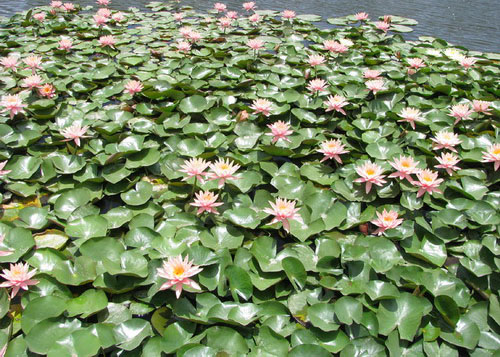
Nymphaea 'Colorado' flower
Water lily Nymphaea alba water lily illustrated guide: how to grow water lilies / how to propagate water lilies
Water lily profileWater lily Nymphaea alba
Aliases: Ziwulian, water celery flower, Ruilian, water ocean flower, small lotus flower
Classification: aquatic flower
Family and genus: Plantae, Angiosperms, Dicotyledons, Nymphaeales, Nymphaeaceae, Nymphaea
Peak flowering period: spring and summer
The water lily is a perennial aquatic herb; its rhizome is thick and fleshy. The leaf stalk is cylindrical and slender. The leaves are elliptical, floating on the water surface, with entire margins, a heart-shaped leaf base, dark green on the surface and dark purple on the underside. The leaves are of two types: floating leaves are round or ovate, with a curved notch at the base, heart-shaped or arrow-shaped, and there are often no emergent leaves; submerged leaves are membranous and fragile. The water lily flower is solitary, floating on or raised above the water surface; there are four sepals, green; petals are usually eight. The fruit is obovate, about 3 cm long. The flowers are large and beautiful, floating on or rising above the water surface, opening by day and closing at night; sepals nearly free; petals white, blue, yellow or pink, in multiple whorls, sometimes the inner whorls gradually becoming stamens; anther...
Water lily cultivation methods and precautions, introduction to water lilies
The water lily is a perennial aquatic herb; its rhizome is thick and fleshy. The leaf stalk is cylindrical and slender. The leaves are elliptical, floating on the water surface, with entire margins, a heart-shaped leaf base, dark green on the surface and dark purple on the underside. The leaves are of two types: floating leaves are round or ovate, with a curved notch at the base, heart-shaped or arrow-shaped, and there are often no emergent leaves; submerged leaves are membranous and fragile.
The water lily flower is solitary, floating on or raised above the water surface; there are four sepals, green; petals are usually eight. The fruit is obovate, about 3 cm long. The flowers are large and beautiful, floating on or rising above the water surface, opening by day and closing at night; sepals nearly free; petals white, blue, yellow or pink, in multiple whorls, sometimes the inner whorls gradually becoming stamens; connective with or without appendages; carpels ring-shaped, adnate and half-sunken in the fleshy cup-shaped receptacle, partly fused with it in the lower part, the upper part extending into the style, the stigma forming a concave stigma disc, ovules anatropous, pendulous on the inner wall of the ovary. The berry is spongy, irregularly dehiscent, maturing under water; seeds hard, wrapped in a gelatinous substance, with a fleshy cup-shaped aril, embryo small, with a small amount of endosperm and abundant perisperm.
The water lily is distributed from Northeast China to Yunnan, and west to **; it is also found in Korea, Japan, India, the Soviet Union and North America. It grows in still water bodies such as ponds and lakes. It is often cultivated as an ornamental plant in the water bodies of many parks; the rhizome can be eaten or used for brewing wine, and is also used as medicine to treat chronic infantile convulsions; the whole plant can be used as green manure.
Morphological characteristics of the water lily
The leaves of the water lily are round or nearly round, or ovate, while some varieties are lanceolate or arrow-shaped; the leaf margins are entire, but the leaf margins of tropical water lilies are wavy; the upper surface of the leaf is green and glossy, the underside is purplish red, and the upper surface of some varieties has dark brown spots or mottled coloration; the veins are obvious or not very obvious. In a few varieties of tropical water lilies, small plantlets grow between the top of the large notch and the point where the leaf stalk attaches, which is called "vivipary".
The water lily flower is composed of organs such as sepals, petals, pistils and stamens, style, carpels and flower stalk. The flower is solitary and bisexual. Its sepals number 4~5, green or purplish red, or green with black dots, and are lanceolate, narrowly ovate, or oblong in shape. The flower buds are long peach-shaped or peach-shaped; the petals are usually ovate, broadly ovate, oblong, long-round, obovate, broadly lanceolate, etc., with the petal tips slightly pointed or slightly blunt. Flower colors include red, pink, blue, purple, white, etc. Petals may be single, multiple or double. Thus the size, shape and color of the petals all vary with the variety. This forms the gorgeous flower forms. The ovary is superior to perigynous; before the flower opens the stamens wrap around the upper part of the carpels, and after maturity they open into a sickle shape; the sepals, petals and stamens are spirally arranged above the receptacle and ovary wall. The carpels are arranged in a ring and embedded within the receptacle in a connate state, the upper styles are separate, the stigmas are thread-like, with a milky protrusion as the center, funnel-shaped, secreting stigmatic fluid at maturity, and the stigmatic fluid mainly contains glucose, fructose and amino acids to attract insects for pollination.
The fruit of the water lily is ovate to hemispherical, matures in water, and dehisces irregularly; the seeds are small, elliptical or spherical; most have an aril.
Water lilies come in blue, purple, pink, golden yellow and so on. Usually most are purple. The stamens of the fire lily are mostly yellow or purple. This flower only opens for seven days each year; the outside of the fire lily is purple petals, in the middle there are only many golden tendrils, and inside there is a flower bud about to bloom, which only opens at the very moment before withering. It is the most delicate flower of Grandia.
The flowering period of the water lily is mainly spring and summer; the outdoor flowering period is actually from June to September.
Ecological habits of the water lily
The water lily likes strong light and good ventilation, so the water lily flowers close at night and open again in the morning. In ponds with tree shade on the bank, although it can bloom, it grows weakly. It is not strict about soil quality, and grows normally at pH 6-8, but likes loam rich in organic matter. During the growing season, the pond water depth should preferably not exceed 80 cm. It sprouts and grows leaves from March to April, blooms successively from May to August, each flower opening for 2~5 days, opening during the day and closing at night. It sets fruit after flowering. The stems and leaves wither from October to November. It sprouts again the following spring. During the growing season, the pond water depth should preferably not exceed 80 cm. In the Yangtze River basin it sprouts from late March to early April, forms buds in late April or early May, has its peak flowering period from June to August, enters the yellow-leaf period from October to November, and enters dormancy after November. It grows in ponds and lakes, and is often cultivated in the pools of some parks.
The opening time of the water lily: most water lilies open near noon and close in the evening, so a poet once wrote: "Do not misunderstand, we do not like to sleep, we just dislike the evening gloom, and close our flowers at night; once past midnight, we open again very early, welcoming the rising sun and the arrival of vigor ahead of time."
Water lily cultivation techniques and cultivation management
Water lilies can be grown in pots or in ponds. For pond cultivation, drain the pond water in early spring, apply base fertilizer, then add new pond mud and then fill with water. Water should be added in several rounds until sufficient. As new leaves grow, gradually add water; during the flowering season, the water depth can be kept at 70~80 cm. In winter, more water should be added, keeping the water depth above 110 cm, so that the rhizome can overwinter safely. For potted plants, choose a pot with an inner diameter and depth of at least 40 cm x 60 cm; around the Spring Equinox each year, repot and change the soil while dividing the clumps, and add decomposed bean cake residue or bone meal, hoof pieces and other fertilizers rich in phosphorus and potassium at the bottom of the pot as base fertilizer; under the rhizome, place at least 30 cm of fertile river mud, cover with soil until the top bud is just covered, then place it in a pond or vat, keeping the water depth at 40~50 cm. In the hot season, the water layer must be kept clean; if it stays too long, change the water to prevent the growth of aquatic algae that would affect the ornamental value. After flowering, remove the spent flowers in time and apply additional fertilizer as appropriate. Potted plants kept indoors must be moved into a cold room or to the bottom of deep water to overwinter in winter. During the growing period, give sufficient light and do not keep them in shade for a long time.
Pot cultivation
Around the Spring Equinox each year, place decomposed bean cake or bone meal, hoof pieces and other fertilizers at the bottom of the flower pot, and put more than 30 cm of fertile river mud on top. Then plant the rhizome with buds horizontally into the river mud, cover with soil until the top bud is covered, add 1 cm of coarse sand and small pebbles, then add water in the pot or vat. Change the water in time during the hot season to avoid the production of algae that would affect its beauty.
Tropical water lilies must be planted upright. The covering soil and sand should not exceed the top bud.
Pond cultivation
In early spring, drain the water completely, apply base fertilizer, then add new pond mud, and fill with sufficient water for planting. In winter, keep the water depth above 1.1 m so that the rhizome can overwinter safely.
The water lily is a water-surface greening material that is appreciated for both flowers and leaves; it can decorate fountains, courtyards and so on, bringing people coolness in the scorching summer, and it also has the effect of purifying water in sewage treatment. It has been promoted in many places and is a rare plant for beautification and purification.
Attention should be paid to the planting angle of the rhizome: tropical water lilies are placed upright, hardy water lilies are placed flat (except Ziwulian).
Key cultivation points
Choose good cultivation soil
The water lily likes humus-rich, fertile clay soil. Therefore, for cultivation it is best to choose sludge that has long accumulated in rivers or ponds.
Choose good seed rhizomes
Water lilies are mostly cultivated by division. The quality of the seed rhizome selected is also a key link in the success or failure of cultivation. For the underground rhizome used for planting, choose a section that is vigorous and robust, virus-free, undamaged and not rotten, and bearing new buds, and cut it into sections 6~10 cm long.
Plant appropriately shallowly
If the underground stem used for planting is buried too deep in the mud, first, the soil temperature is rather low, and second, oxygen is scarce, which is not conducive to early growth and rapid development. The cultivation depth is generally kept moderate by keeping the new buds on the underground stem level with the soil surface.
Sufficient light
The water lily likes a climate with sufficient sunlight, warmth and humidity, and good ventilation. Water lilies grown in pots or vats must be placed in a position with sufficient light so that they receive full sunlight.
Planting time
Tropical species are usually one month later than ordinary species, with May to June as the suitable period. At this time the old bulb's new buds are just about to appear, and it must not be later than the end of June. The bulbs or tubers of water lilies are black in appearance, and it is very hard to distinguish good from poor. To distinguish good from poor, you can cut the skin with a small knife; those with white and hard flesh are good bulbs, and seed bulbs that have already produced tender buds are the most reliable. Long-stored dry bulbs or rotten bulbs must never be used.
Soil and planting methods
Planting requires heavy clay soil, and good sunlight is best. Otherwise, the method of replacing soil with clay soil can also be used for cultivation. Before planting, first apply base fertilizer in the planting hole, and spread a thin layer of soil to cover the base fertilizer. Plant the bulb (or seedling), fill the planting hole with soil up to the tip of the bud, and pile small pebbles over the entire surface of the hole to prevent the bulb from floating and to prevent the pond water from becoming turbid. Fill with water to a level 3 cm above the pond bottom, and thereafter increase the water whenever the leaves grow taller.
Post-planting management
About one week after planting, small buds begin to appear; before they extend above the original water level, increase the pond water depth to 30~45 cm. The newly born tender leaves are curled, and the leaf stalks extend to the height of the water depth before the leaves unfold; at this point the water depth must be decided. Once the leaves float on the water surface, a certain depth must be maintained at all times thereafter. Always pay attention to the water depth, and if it is seen to decrease, immediately add water to the certain depth. During management, if yellow withered leaves are seen, remove them in time; otherwise no special care is needed.
Overwintering treatment
After autumn the leaves and stalks in the water begin to wither, and in deep winter only the roots remain. If they are left in the pond and the pond water is not reduced, tropical water lilies are at risk of cold damage and death. Therefore, as soon as autumn begins, dig them all out of the pond and collect them, plant the roots densely in extra-large square pots, and store them indoors in a warm place to overwinter, to ensure safety. The minimum temperature for survival is about 13°C.
Hardy water lilies can overwinter as long as the temperature is kept above 0°C; too high a temperature affects dormancy.
Water lilies through the summer
For potted water lilies, choose a vat with a diameter of about 30 cm and a depth of about 25 cm; at first the water should not be too deep, and as the leaves gradually grow taller, gradually increase the water level. During the growing period, if there are too many leaves, the old leaves can be pressed into the mud by hand; these leaves are also very good fertilizer. Water lilies like sunlight; apart from needing shade at noon in summer, they need to maintain fairly sufficient light in other seasons, and insufficient light leads to fewer flowers or even no flowers. When fertilizing water lilies during the growing period, note that liquid fertilizer must absolutely not be applied, as it not only pollutes the water body but also causes fertilizer damage; simply bury a small amount of dry cake fertilizer powder directly into the mud. After flowering, clean up the spent flowers and withered leaves to promote the opening of the next batch of flowers.
How to grow mini water lilies
1. Flower pot
In principle the same as for water lilies, opening outward, but the opening of the flower pot does not necessarily have to be as large as a water lily pot, though it must have a certain depth, preferably about 10~20 cm.
2. Soil
The same as for water lilies.
3. When planting, first put in a little fertilizer, add soil to the 1/2 level and press firm, place the two to three joints of lotus root, then add soil to the 3/4~4/5 level and press lightly, because the lotus is a creeping stem (lotus root), so it needs more soil; add water and place in a place with sufficient light.
4. Adding fertilizer
The lotus takes slightly more fertilizer than the water lily, so on average fertilizer should be added once every two to three weeks, especially after every two to three flowers have opened, otherwise you may only see one or two flowers; the fertilization point is about two to three cm from the new leaf (beside the lotus root joint) (usually one joint has one to three leaves), where a little fertilizer is added. After the end of September, no more fertilizer needs to be added.
5. Treatment during and after dormancy is very important (on this point I groped for four years, and many flower sellers will not tell you); it determines whether the plant will survive the coming year and whether it will have flowers. After autumn begins, the leaves of the lotus gradually dry out; after they have all turned yellow and withered, cut them off, and stop adding water to the flower pot, letting it gradually dry out, but it must be kept in a state like mud, until after Qingming of the following year, when it is treated.
6. Changing soil and dividing buds
After Qingming, choose a hotter day, pour out the entire pot of soil; after pouring it out you will see many tangled lotus root joints. Cut off the dried and rotten ones, keep the fatter and firmer lotus root joints, and cut every two to three joints into one section. After washing with water, use new soil and follow the previous steps to plant. Because we are growing them in flower pots, the actual soil is not enough compared with that in a field, and the aged soil and rotten lotus roots will hinder the growth of the lotus. The same as point 5, if this is not done, the plant will almost certainly die; except if the pot is very large and there is a lot of soil. Simply put, water lilies place more importance on the water surface area, while lotus place more importance on the volume of soil; this is the biggest difference in growing these two kinds of flowers.
7. Flowering
Without pollination, the flowering period of the lotus lasts more than a week (for double-petaled ones), but if pollinated, the petals fall very quickly. Therefore, it is recommended to cut the flower for arranging as soon as the outer petals begin to fall; first, the flower can be kept longer, and second, it can increase flowering. Also, try not to let the lotus seed pod grow large, as it wastes too many nutrients and affects flowering.
8. Lotus can be propagated by lotus root and by lotus seeds, but lotus root is recommended: first, it is fast (it is a flowering plant and flowers can be seen the same year); second, it is simple. With lotus seeds, first find mature lotus seeds (with skin close to black), gently cut open and remove the skin at the rounder end (where the bud point is), soak in water for 3~10 days, and after germination place in a place with sufficient light for about another week; after roots grow, plant again. Because it is not a flowering plant, sometimes it must be grown for two to three years until the plant matures before it will flower, so propagating by seed requires sufficient time.
Growing lotus requires more effort than water lilies. At the beginning, because points 5 and 6 had not been figured out, I was very discouraged growing them. Therefore, I sincerely suggest starting with water lilies as an entry point, then Indian lotus, and then growing lotus, so that you will be less likely to feel frustrated.
Water lily cultivation methods and cut flower techniques
Because water lilies grow in water, their cut flowers actually keep less well than those of terrestrial plants; once a cut flower leaves the water, its water absorption capacity is unexpectedly poor. Therefore, one can only rely on the water injection method, forcing water in through the cut end to achieve water absorption and help the cut flower stay fresh. This measure can be carried out by cut flower businesses, or handled by consumers themselves. Apart from needing an extra water injector, the operation is simpler and cheaper than other preservation methods, and is both convenient and twice as effective with half the effort.
The water lily is a summer aquatic flower, with a charmingly delicate flower posture. Moved from its natural ecology to cultivation near places for viewing, it has a fresh elegance and has become an indispensable aquatic plant in garden ponds. Although the life of the cut flower is regrettably short, the flower color is crystal clear and bright, and when used to decorate a water bowl arrangement it gives a great impression of coolness filling the room.
Plant traits
The leaves are nearly round to elliptical, with a maximum diameter of 30~60 cm, with a deep notch at the base, and the leaf color is dark green. When the notch at the leaf base is sharp, the petal tips are accordingly pointed; when the leaf notch is blunt, the petal tips are also blunt. The leaf margins curve slightly inward, especially noticeably in tropical species. The flower has many petals, four sepals, and particularly many stamens. It usually floats on the water surface when in bloom. Flower colors include white, peach red, red, purple, yellow, etc., and the flowering period is from May to October. A plant that flowers well can produce 70~80 flowers; after the flower fades, the stem carries it into the water, dispersing the fully mature seeds. The rhizome of ordinary species produces new buds every year; the small bulbils produced from the spherical tubers of tropical species can be used for division (bulb) propagation.
Potted water lilies bloom more
A household potted water lily not only gives a refreshing feeling but also adds charm. The pot can be placed on an open-air platform; if there is no terrace, it can also be placed on a balcony with sufficient sunlight. For potted water lilies, June to August is the peak flowering period.
If you want more flowers, you should pay attention to the following four issues:
Repot and change the soil
Around the Spring Equinox each year, in combination with division, repot and change the soil to keep the soil fertile and meet the water lily's nutrient needs.
Expand the water surface
If the water surface is small, the leaves overlap, which affects flowering. It is best to grow potted plants in nested vats; providing more than 1 sq m of water surface per plant can promote more flowering.
Apply more fertilizer
For the fertilizer of potted water lilies, generally it is enough to choose fertile soil and add some chicken manure and bone meal as base fertilizer when planting. To encourage more flowering, several additional fertilizer applications mainly of phosphorus and potassium can be applied during the flowering period. Nitrogen fertilizer must not be applied too much, otherwise, because vegetative growth is too vigorous it will inhibit reproductive growth, causing poor flowering or no flowering.
Prevent and control pests
Water lily leaves are easily attacked by leaf-eating pests such as the night robber moth, causing damage to the leaf surface and reducing photosynthesis, which will inevitably affect flowering, so timely prevention and control are needed.
Water lily propagation methods
Water lilies are generally propagated by division. Between March and April, when the weather turns warm and the buds have begun to sprout, dig up the rhizome and cut it into several pieces with a sharp knife, then replant separately.
Division propagation
The main propagation method for water lilies: in March to April each spring, when the buds have just begun to sprout, dig up the rhizome and cut it into several pieces with a sharp knife. Make sure each rhizome piece bears more than two plump bud eyes, and plant them into the river mud in a pond or vat.
Water lilies are mainly propagated by division. Hardy species are usually divided in March to April before sprouting in early spring; non-hardy species have high requirements for air and water temperature, so division can only be carried out around mid-May. When dividing, first dig out the rhizome, select rhizomes with plump new buds, cut them into root sections 8~10 cm long, each section bearing at least 1 bud, and then plant them. Bury them in the surface soil with the top bud facing up, with the covering depth such that the plant's bud eye is level with the soil surface, planting 5~7 sections per pot. After planting, expose to the sun briefly before adding shallow water, to help maintain the water temperature, but the water should not be too deep, otherwise it will affect sprouting. When the temperature rises and the new buds sprout, then deepen the water level. Place in a well-ventilated, sunny place for care, with a cultivation water depth of 20~40 cm; in summer the water level can be appropriately deepened, and in the hot season care should be taken to keep the pot water clean. When growing only a small number in pots, the water lilies that have been planted for 2~5 years can be tipped out of the pot, cut into 2~4 pieces, and replanted in the pot.
Seed propagation
After flowering, wrap the flower with a cloth bag, so that once the fruit matures and splits, the seeds will fall into the bag and not be lost. After collecting the seeds, put them in a bottle filled with water, seal the bottle mouth, and put it into pond water for storage. Retrieve it the following spring, pour the seeds into a triangular flask filled with water, and place it in an incubator at 25°C~30°C to promote germination, changing the water every day; after about 2 weeks the seeds germinate, and once the seedlings grow young roots they can be transplanted in a small pot in a greenhouse. After planting, put the small pot into a vat, with the water depth just enough to submerge the young leaves by 1 cm. In April, when the temperature rises above 15°C, they can be moved to open-air management. As the new leaves grow larger, change the pot 2~3 times; at the final planting, the diameter of the vat should be no less than 35 cm. Some plants can flower the same year, while most can only flower the following year.
Place the black, elliptical, plump seeds in clean water in a sealed container for storage until they are taken out before sowing the following spring. Soak them in water at 25~30°C to promote germination, changing the water every day; after two weeks they will germinate. When the seedlings grow to 3~4 cm, they can be planted in a pond, ensuring sufficient water depth.
In autumn, dig up the stored old mother bulbs; around them grow large and small daughter bulbs. When replanting in May of the following year, dig the whole plant out of the square pot, and at the same time divide the bulbs and plant them in the pond in the same way as the mother bulb. Although the divided bulbs may be as small as a broad bean, once planted they soon develop into sturdy mature plants. To obtain good offspring, artificial crossing should be carried out. After the seeds are harvested, sow them immediately in boxes with clay soil, which is called fresh sowing. In seedling cultivation, a portion flower the following year; if all are to flower, it may take until the third year.
Water lily disease control: black spot disease
It mainly harms the leaves. In the early stage of the disease, chlorotic yellow spots appear on the leaves; later they become round or irregular, turn brown with concentric rings, sometimes with a yellow-green halo at the edge, and bear black mold on top, with a diameter of 5 to 15 mm. In severe cases, the spots join into patches, and except for the veins the whole leaf withers and turns yellow. This disease is caused by fungi and occurs severely in the rainy season; in lotus ponds or potted continuous cropping, and under conditions such as excessive nitrogen fertilizer application or excessively high summer water temperature, the disease is very severe.
Control method: strengthen cultivation management and remove diseased leaves in time. For severely affected plants, replace with new soil before replanting, and do not apply too much nitrogen fertilizer. When the disease occurs, spray 75% chlorothalonil 600~800 times dilution for control.
Brown spot disease
It harms lotus leaves. On diseased leaves, round spots 0.5~8 mm in diameter appear, light brown to yellow-brown, with a darker color at the edges. In the later stage of the disease, many small black mold spots grow on the lesions. The disease is more severe in rainy autumn. The pathogen mostly overwinters on plant residues.
Control method: remove residual leaves to reduce the source of disease. For severe cases, spray 50% carbendazim 500 times dilution or 80% zineb 500~800 times dilution for control.
Cotton water moth
It is distributed in many places across the country, on water lilies, lotus and so on. The larvae feed on the plant leaves; when the damage is severe, they often eat all the leaf flesh, leaving a net-like vein structure. The adult has a white head and upper part of the antennae; the ventral surface of the thorax is white, the thorax and dorsal abdomen are yellow-brown, and the front edge of each part has white scales. The forewings are orange-yellow, with 2 relatively wide white wavy lines at the wing base; the hindwings are orange-yellow, white at the base, with a wide white band in the center, white fringe hairs, and gray-brown near the wing base. It has 2 generations per year, overwintering as larvae among clumps of weeds. The following year, from May to June, the larvae pupate; in early July the adults lay eggs, and the larvae then hatch. When the larvae cause damage, they often bite a lotus leaf into 2 pieces, then spin silk to overlap the leaf pieces into a protective shelter, living inside it, and can float on the water surface. After the protective shelter dries out, they make another shelter. The larvae mostly move and feed at night, and the adults are phototactic.
Control methods
1. During the adult emergence period, set up black light lamps on the water surface to trap the adults.
2. When floating larval protective shelters are found on the water surface, use nets to catch and dispose of them in time.
3. If water lilies are grown in a pond, fish can be raised in the pond to prey on the larvae.
Rot disease
(1) Choose disease-resistant varieties.
(2) Implement 2~3 year crop rotation in heavily diseased fields.
(3) Carefully select disease-free seed lotus roots, and use 50% carbendazim or 20% thiophanate-methyl wettable powder 800 times dilution plus 75% chlorothalonil wettable powder 800 times dilution; after spraying, seal the seeds, cover with plastic film and seal for 24 h, then dry and plant.
(4) Deep plow and harrow the lotus root field, and apply 1500~2250 kg of lime per hectare.
(5) Strengthen fertilizer and water management, apply sufficient decomposed organic fertilizer, and topdress in a timely and appropriate amount, combining organic fertilizer with chemical fertilizer, and nitrogen fertilizer with phosphorus and potassium fertilizer; manage the water layer well according to the different growth stages of lotus root, keeping the depth appropriate, using water to regulate temperature and fertilizer, and preventing the disease from worsening due to excessively high water temperature or long-term deep irrigation.
(6) Pull out diseased plants in time and spray 50% carbendazim wettable powder 600 times dilution plus 75% chlorothalonil wettable powder 600 times dilution.
Leaf rot disease
(1) Remove diseased and residual plants at harvest, bury them deeply or burn them in a concentrated way, to reduce the source of the pathogen.
(2) In the early stage of the disease, spray 50% carbendazim wettable powder 800 times dilution or 70% thiophanate-methyl wettable powder 800 times dilution or 30% basic copper sulfate suspension 500 times dilution, spraying once every about 10 days, for 2~3 consecutive sprays.
Anthracnose
(1) During the growing season, collect diseased residues and bury them deeply or burn them.
(2) Apply sufficient decomposed organic fertilizer and topdress in a timely and appropriate amount, combining organic fertilizer with chemical fertilizer, and nitrogen fertilizer with phosphorus and potassium fertilizer.
(3) Promptly remove diseased plants and spray with 50% carbendazim wettable powder at 600 times dilution, 75% chlorothalonil wettable powder at 600 times dilution, 36% thiophanate-methyl suspension concentrate at 500 times dilution, 50% carbendazim wettable powder at 1,500 times dilution, or 80% anthracnose thiram wettable powder at 800 times dilution, spraying once about every 10 d, for 2 to 3 consecutive sprays.
Water lily leaf beetle
is a devastating pest. The adults overwinter in vegetation near the pond edge, and lay eggs on the leaf surface in late spring. It can produce 2 to 3 generations per season. At this time, the leaves can be washed with water
Water lily pictures Water lily pictures
surface, so that the adults and pupae fall into the water and are eaten by fish. Once the larvae cause damage, they can be killed by spraying with decis at 1,200 times dilution.
Water lily aphid (Rhopalosiphum nymphaeae)
damages many soft-leaved aquatic plants. In summer, it attacks leaves and flower stems, causing the flower color to change. Its eggs overwinter on Prunus plants, especially on plum and hawthorn trees, and rarely on cherry trees. Avoid planting Prunus plants in large patches near the water's edge, or wash these host plants with tar oil in winter. The leaves can also be washed with a hose, and insecticides can be sprayed.
Snails
When they cause damage, carbofuran or trichlorfon can be mixed with sawdust, put into cloth bags, and tied to the leaf stalks so the bags float on the water surface. As the water moves, the pesticide solution spreads and kills the pests. Biological control works very well: stocking 5 kg of loach in 1,000 sq m of water can effectively stop the spread and floating overflow of the pests.
Sphagnum moss
Spray with 0.3% to 0.5% copper sulfate.
Aphids
Affected leaves can be sprayed with dichlorvos at 1,000 to 1,200 times dilution, or with 50% dimethoate emulsifiable concentrate at 2,000 to 2,500 times dilution.
Water lily care tips: Measures to make it bloom earlier
To make water lilies bloom before "June 1", divide and propagate them from late March to early April. Plant the newly divided rhizomes into flower pots. The planting time should be no later than 50 to 60 days before the desired flowering date. The growing medium must maintain a water layer 10 to 20 cm deep. Under these conditions, water lilies grow very rapidly. Fertilizer supply must be sufficient. In addition to applying an appropriate amount of base fertilizer at planting, during the vigorous growth stage it is best to insert stick-shaped organic fertilizer into the growing medium every 10 days as a top dressing. Water lilies are aquatic plants, and water management after the flowers open is the same as before flowering. It is best to top-dress frequently, otherwise blind buds are likely to appear. Be careful not to place them in shady spots, because water lilies can only bloom normally with sufficient sunlight. In addition, note that the temperature of the placement environment should not be too low, so that the plant's flowering is not inhibited.
Storage and fresh-keeping of rhizomes
After the plant's stems and leaves turn yellow in autumn, the rhizomes can be dug out of the mud and then classified and grouped by variety for storage. Note that water lilies are aquatic plants, so the operation must be quick and the rhizomes must not be allowed to lose water, otherwise the new buds will be damaged. The prepared rhizomes can be stored in an environment with a relative humidity of 95% to 100% and a temperature of 4 to 6°C. Usually, under the above conditions, water lily rhizomes can be stored for 110 to 120 days.
Storage and fresh-keeping of cut flowers
Harvest when the flower buds are fully colored. The operation is best carried out in the morning when the temperature is lower. After harvesting, place the cut flowers temporarily in a place without direct sunlight and precool them as soon as possible. After harvesting, they also need to be graded.
Package flowers of the same grade and variety of water lily with stems, 20 stems per plastic bag, then place them separately into corrugated cardboard boxes marked with the product name and lined with breathable film, and store them in an environment with a relative humidity of 90% to 95% and a temperature of 5 to 6°C. They can usually be kept for one or two days. During transport, water lilies can only be dry-stored for a short time, and after opening the box they must be put into water immediately.
Water lily variety classification: Main varieties
[Yellow Water Lily]: Leaves round or ovate, with indistinct wavy margins, dark green above with brown markings, reddish brown beneath with small black spots. Flowers yellow, about 10 cm in diameter. [1]
[White Water Lily]: Leaves leathery, nearly round, deeply cleft at the base to where the petiole is attached, entire, slightly wavy, hairless on both sides, young leaves red. Flowers white and large, 10 to 13 cm in diameter.
[Blue Lotus]: Rhizome irregularly spherical. Leaves nearly round or elliptical, 13 to 40 cm in diameter, deeply cleft at the base to where the petiole is attached, nearly entire or with a few teeth at the cleft. Leaf surface green, underside with purple spots, smooth and hairless on both sides; petiole green, hairless. Flowers blue, petals 15 to 20, flower diameter 15 cm, petals star-shaped, deeper blue at the tip, gradually lighter toward the base, stamens golden yellow. Sepals narrow, linear or oblong-lanceolate.
[Downy Tooth-leaved Water Lily]: Tropical water lily. Flowers floating on the water surface, white or pink, with rounded obtuse tips; calyx green, oblong, with obtuse tips and longitudinal stripes. Leaves nearly leathery; ovate, deeply cleft at the base; leaf margins with unequal
triangular serrations; leaf surface dark green, hairless; leaf underside reddish brown, densely pubescent or nearly hairless; petiole peltate.
[Blue Water Lily]: Rhizome thick and strong. Leaves round or nearly round, relatively large, with irregular toothed clefts at the margins; leaf surface green, hairless; underside pink or light purple. Flowers pale blue, petals radiating in a star shape. Petal tips narrow, slightly wider at the base, fragrant, petals 15 to 18, flower diameter about 15 cm, stamens golden yellow. Calyx with small black spots; sepals linear or oblong-lanceolate. Pedicels extending above the water surface, flowering in the morning and closing in the afternoon.
[Red Water Lily]: Leaves round or nearly round, deeply cleft at the base, young leaves purplish red. When old, the upper surface turns dark green and glossy, the underside dark purplish red, and the leaf margins have shallow triangular teeth. Flowers large, 30 to 34 cm in diameter, rose red.
[Fragrant Water Lily]: Flowers open in the morning and close in the afternoon, floating on the water. A single flower blooms for 3 to 4 days; the population flowering period is from mid-to-late May to mid-September. Flowers cup-shaped, pinkish white, strongly fragrant. Leaves round or oblong, leathery and entire; leaf surface green, leaf underside purplish red. Underground stem creeping, few branches. Suitable water depth 45 to 90 cm.
[Masaniello]: Flowers open in the morning and close in the afternoon, floating on the water. A single flower blooms for 3 to 4 days; the population flowering period is from late April to early October. Flowers cup-shaped, inner petals magenta, outer petals lighter; slightly fragrant. Leaves nearly round, leathery and entire; leaf surface green, leaf underside green, young leaves purplish red. Marliacea-type rhizome. Suitable water depth 45 to 90 cm.
[Mexican Yellow Water Lily]: Flowers open at noon and close in the evening, emerging above the water. A single flower blooms for 2 to 3 days; the population flowering period is from late May to early September. Flowers cup-shaped then star-shaped, petals deep yellow, sweetly fragrant. Leaves ovate, margins slightly serrate. Leaf surface green, new leaves olive green, densely covered with purple or reddish brown spots; leaf underside copper red with small purple spots. Upright-type rhizome, running runners. Suitable water depth 45 to 75 cm.
[Lausanne]: Flowers open in the morning and close in the afternoon, floating on the water. A single flower blooms for 3 to 4 days; the population flowering period is from mid-to-late May to early September. Flowers cup-shaped, light pink, strongly fragrant. Leaves nearly round; leaf surface green; leaf underside purplish red. Marliacea-type tuber. Suitable water depth 35 to 75 cm.
[White Fairy]: Flowers open in the morning and close in the afternoon, floating on the water. A single flower blooms for 4 days; the population flowering period is from late May to late September. Flowers globe-shaped, white, aromatic. Leaves ovate-round; leaf surface green, leaf underside deep purple copper. Marliacea-type rhizome. Suitable water depth 35 to 75 cm.
[Helvola]: Flowers open in the afternoon and close at night, floating on the water. A single flower blooms for 3 to 4 days; the population flowering period is from late May to late September. Flowers cup-shaped then star-shaped, medium yellow, lightly fragrant. Leaves ovate; leaf surface green with dark stripes and deep purple blotches; leaf underside red with deep purple spots. Finger-type rhizome. Suitable water depth 15 to 23 cm.
[Sunrise]: Flowers open in the morning and close at noon, emerging above the water. A single flower blooms for 2 to 3 days; the population flowering period is from late May to early October. Flowers star-shaped, yellow, lightly fragrant. Leaves round, leaf length slightly greater than leaf width; leaf surface green, leaf underside yellow. Marliacea-type rhizome. Suitable water depth 45 to 90 cm.
[Colorado]: Flowers open in the morning and close in the afternoon, emerging above the water. A single flower blooms for 3 to 4 days; the population flowering period is from early June to early November. Flowers orange-yellow at low temperatures and orange-red at high temperatures; star-shaped. Leaves round; leaf surface green, leaf underside with a slight red blush at the margins. Marliacea-type tuber. Suitable water depth 45 to 90 cm.
[Fire Crest]: Flowers open in the morning and close at noon, emerging above the water. A single flower blooms for 3 days; the population flowering period is from early June to early September. Flowers star-shaped, pale purple-pink, slightly fragrant. Leaves round; leaf surface green, new leaves deep purple; leaf underside deep purple. Odorata-type rhizome. Suitable water depth 30 to 60 cm.
[Almost Black]: Flowers open in the morning and close in the afternoon, floating on the water. A single flower blooms for 3 to 4 days; the population flowering period is from late June to early October. Flowers cup-shaped, ink red, fragrant. Leaves round; leaf surface green, leaf underside light green. Marliacea-type tuber. Suitable water depth 45 to 90 cm.
[Alba Plenissima]: Opens in the morning and closes in the afternoon, floating on the water. A single flower blooms for 3 to 4 days; the population flowering period is from late May to late September. Flowers cup-shaped to star-shaped, white, lightly fragrant on the day of opening. Leaves round; leaf surface green; leaf underside pale yellow-green. Marliacea-type rhizome. Suitable water depth 45 to 90 cm.
[Arc-en-Ciel]: Flowers open in the morning and close at noon, emerging above the water. A single flower blooms for 3 to 4 days; the population flowering period is from early June to late September. Flowers star-shaped, first shell pink and later white or nearly white, delicately fragrant. Leaves round; leaf surface olive green with radial yellow, cream-yellow, pink, and red spots, or pink or slightly reddish blotches; leaf underside brownish red. Odorata-type tuber. Suitable water depth 45 to 90 cm.
[Ellisiana]: Flowers open in the morning and close in the afternoon, floating on the water. A single flower blooms for 3 to 4 days; the population flowering period is from mid-to-late May to late September. Flowers star-shaped, petals red. Leaves horseshoe-shaped; young leaves and mature leaves both green. Marliacea-type tuber. Suitable water depth 15 to 23 cm.
[Commanche]: Flowers open in the morning and close in the afternoon, floating on the water. A single flower blooms for 3 days; the population flowering period is from late May to late September. Flowers cup-shaped, pale orange-yellow, lightly fragrant. Young leaf surface has dense reddish brown spots. On mature leaves the spots on the upper surface become lighter, but they are still fairly obvious on the underside. Marliacea-type tuber. Suitable water depth 30 to 45 cm.
[Sunshine Princess]: Flowers open in the morning and close in the afternoon, floating on the water surface. A single flower blooms for 4 to 5 days; the population flowering period is from early June to late September. Flowers first cup-shaped then star-shaped, deep rose red. Leaves horseshoe-shaped; young leaves dark red with a few deep red spots; mature leaves green. Suitable water depth 45 to 90 cm.
[Chromatella]: Flowers open in the morning and close in the afternoon, floating on the water. A single flower blooms for 3 days; the population flowering period is from late May to late September. Flowers cup-shaped, pale red-yellow, lightly fragrant. Leaves round; leaf surface green, new leaves green with purple spots; leaf underside purplish red, new leaves green with small purple spots. Pineapple-type rhizome. Suitable water depth 45 to 75 cm.
[Peter Slocum]: Flowers open in the morning and close in the afternoon, emerging above the water. A single flower blooms for 3 to 4 days; the population flowering period is from early June to late September. Flowers peony-shaped, medium pink, strongly fragrant. Leaves round; leaf surface green, leaf underside red, and when the leaf blade emerges above the water surface the leaf underside is green. Odorata-type rhizome. Suitable water depth 35 to 75 cm.
[Virginalis]: Flowers open in the morning and close in the afternoon, floating on the water. A single flower blooms for 3 to 4 days; the population flowering period is from mid-to-late May to late September. Flowers cup-shaped, white, with a slight red blush at the base, slightly fragrant. Leaf upper surface green, underside pale brown. Marliacea-type tuber. Suitable water depth 35 to 75 cm.
[Small Pygmy Water Lily]: Miniature water lily, flowers exquisite and fragrant. Flowers white. Flower diameter about 2.5 cm. Leaves small, ovate. Leaf upper surface green, underside purple. Can set seed and can be propagated by sowing.
[Tiger Lotus]: [2] Dicotyledonous plant, floating-leaved aquatic plant. Its characteristic is that its submerged leaves are usually tea-colored and have obvious brown spots. The plant habit changes with light intensity; under strong light, the petioles are shorter, the color can turn pale purple-brown, and the plant form becomes more beautiful. The floating leaves are round, green, with serrated margins, and can produce white flowers similar to those of ordinary water lilies. Although it can produce bulbs, the growth rate is relatively low. It is relatively intolerant of cold, and dormancy is not obvious. If the water temperature is below 12°C, the plant body may die, but its submerged seeds can overwinter, and when the temperature rises again, they sprout and grow again. It is generally propagated by runners, but propagation by seed is faster. When cultivated in an aquarium, relatively strong lighting must be used, but excessively strong lighting easily forms floating leaves. It is best to cut off the floating leaves to avoid blocking light and affecting the growth of other aquatic plants.
[Green Tiger Lotus]: [3] Dicotyledonous plant, floating-leaved aquatic plant. Its characteristic is that its submerged leaves are usually green and have obvious brown spots. The floating leaves are round, green, with serrated margins; the spots on the leaf surface gradually disappear or become lighter in color, and it can produce flowers similar to those of ordinary water lilies. It can also produce bulbs, but they are usually not spherical, instead somewhat irregular and bumpy in shape. The bulb can produce stem buds and develop into daughter plants, which can be separated to grow independently. If the water temperature is below 12°C, it enters a dormant state; not only does growth stop, but the plant body may die. However, the remaining bulb sprouts and grows again after the temperature rises. When cultivated in an aquarium, it rarely produces floating leaves, so its beautiful submerged leaves can be enjoyed for a long time. It originally belongs to the large aquatic plant group, but when cultivated in a small aquarium it becomes miniaturized.
[Four-color Water Lily]: Dicotyledonous plant, floating-leaved aquatic plant. It has white fibrous roots; the rhizome is not obvious. There are two types of leaves, submerged leaves and floating leaves. The submerged leaves are smaller, elliptical leaves cleft at the lower part, with reddish brown leaf spots, and the leaf margins are not serrated, appearing green. The floating leaves are larger, elliptical to round leaves cleft at the lower part. Leaves that have just floated to the water surface still have reddish brown leaf spots, but these slowly disappear. The leaf margins are not serrated but are wrinkled, and the leaves are green. It can produce white flowers similar to those of ordinary water lilies. Although it can produce bulbs, the growth rate is relatively low. If the water temperature is below 12°C, it may enter dormancy or stop growing. It has strong growth vigor and is easy to propagate. It can be propagated by seed, or small plantlets are easily produced from the rhizome as propagules, or small plantlets grow at the junction of the petiole and leaf blade as propagation material. Burying root fertilizer is effective. It can grow normally in medium to strong light environments, with a relatively fast growth rate.
Variety categories
1. Fragrant Water Lily (Nymphaea 'odorata Ait')
Flowers open in the morning and close in the afternoon, floating on the water. A single flower blooms for 3 to 4 days; the population flowering period is from mid-to-late May to mid-September. Flowers cup-shaped, pinkish white, strongly fragrant. Leaves round or oblong, leathery and entire; leaf surface green, leaf underside purplish red. Underground stem creeping, few branches. Suitable water depth 45 to 90 cm.
2. Masaniello (Nymphaea 'Masaniello')
Flowers open in the morning and close in the afternoon, floating on the water. A single flower blooms for 3 to 4 days; the population flowering period is from late April to early October. Flowers cup-shaped, inner petals magenta, outer petals lighter; slightly fragrant. Leaves nearly round, leathery and entire; leaf surface green, leaf underside green, young leaves purplish red. Marliacea-type rhizome. Suitable water depth 45 to 90 cm.
3. Mexican Yellow Water Lily (N. mexicana Zuccarini (N. mexicana No.1))
Flowers open at noon and close in the evening, emerging above the water. A single flower blooms for 2 to 3 days; the population flowering period is from late May to early September. Flowers cup-shaped then star-shaped, petals deep yellow, sweetly fragrant. Leaves ovate, margins slightly serrate. Leaf surface green, new leaves olive green, densely covered with purple or reddish brown spots; leaf underside copper red with small purple spots. Upright-type rhizome, running runners. Suitable water depth 45 to 75 cm.
4. Lausanne (Nymphaea 'Rose Arey')
Flowers open in the morning and close in the afternoon, floating on the water. A single flower blooms for 3 to 4 days; the population flowering period is from mid-to-late May to early September. Flowers cup-shaped, light pink, strongly fragrant. Leaves nearly round; leaf surface green; leaf underside purplish red. Marliacea-type tuber. Suitable water depth 35 to 75 cm.
5. White Fairy (Nymphaea 'Gonnere')
Flowers open in the morning and close in the afternoon, floating on the water. A single flower blooms for 4 days; the population flowering period is from late May to late September. Flowers globe-shaped, white, aromatic. Leaves ovate-round; leaf surface green, leaf underside deep purple copper. Marliacea-type rhizome. Suitable water depth 35 to 75 cm.
6. Helvola (Nymphaea 'Helvola')
Flowers open in the afternoon and close at night, floating on the water. A single flower blooms for 3 to 4 days; the population flowering period is from late May to late September. Flowers cup-shaped then star-shaped, medium yellow, lightly fragrant. Leaves ovate; leaf surface green with dark stripes and deep purple blotches; leaf underside red with deep purple spots. Finger-type rhizome. Suitable water depth 15 to 23 cm.
7. Sunrise (Nymphaea 'Sunrise')
Flowers open in the morning and close at noon, emerging above the water. A single flower blooms for 2 to 3 days; the population flowering period is from late May to early October. Flowers star-shaped, yellow, lightly fragrant. Leaves round, leaf length slightly greater than leaf width; leaf surface green, leaf underside yellow. Marliacea-type rhizome. Suitable water depth 45 to 90 cm.
8. Colorado (Nymphaea 'Colorado')
Flowers open in the morning and close in the afternoon, emerging above the water. A single flower blooms for 3 to 4 days; the population flowering period is from early June to early November. Flowers orange-yellow at low temperatures and orange-red at high temperatures; star-shaped. Leaves round; leaf surface green, leaf underside with a slight red blush at the margins. Marliacea-type tuber. Suitable water depth 45 to 90 cm.
9. Fire Crest (Nymphaea 'Fire Crest')
Flowers open in the morning and close at noon, emerging above the water. A single flower blooms for 3 days; the population flowering period is from early June to early September. Flowers star-shaped, pale purple-pink, slightly fragrant. Leaves round; leaf surface green, new leaves deep purple; leaf underside deep purple. Odorata-type rhizome. Suitable water depth 30 to 60 cm.
10. Almost Black (Nymphaea 'Almost Black')
Flowers open in the morning and close in the afternoon, floating on the water. A single flower blooms for 3 to 4 days; the population flowering period is from late June to early October. Flowers cup-shaped, ink red, fragrant. Leaves round; leaf surface green, leaf underside light green. Marliacea-type tuber. Suitable water depth 45 to 90 cm.
11. Alba Plenissima (Nymphaea 'Alba Plenssima')
Opens in the morning and closes in the afternoon, floating on the water. A single flower blooms for 3 to 4 days; the population flowering period is from late May to late September. Flowers cup-shaped to star-shaped, white, lightly fragrant on the day of opening. Leaves round; leaf surface green; leaf underside pale yellow-green. Marliacea-type rhizome. Suitable water depth 45 to 90 cm.
12. Arc-en-Ciel (Nymphaea 'Arc-en-Ciel')
Flowers open in the morning and close at noon, emerging above the water. A single flower blooms for 3 to 4 days; the population flowering period is from early June to late September. Flowers star-shaped, first shell pink and later white or nearly white, delicately fragrant. Leaves round; leaf surface olive green with radial yellow, cream-yellow, pink, and red spots, or pink or slightly reddish blotches; leaf underside brownish red. Odorata-type tuber. Suitable water depth 45 to 90 cm.
13. Ellisiana (Nymphaea 'Ellisiana')
Flowers open in the morning and close in the afternoon, floating on the water. A single flower blooms for 3 to 4 days; the population flowering period is from mid-to-late May to late September. Flowers star-shaped, petals red. Leaves horseshoe-shaped; young leaves and mature leaves both green. Marliacea-type tuber. Suitable water depth 15 to 23 cm.
14. Commanche (Nymphaea 'Commanche')
Flowers open in the morning and close in the afternoon, floating on the water. A single flower blooms for 3 days; the population flowering period is from late May to late September. Flowers cup-shaped, pale orange-yellow, lightly fragrant. Young leaf surface has dense reddish brown spots. On mature leaves the spots on the upper surface become lighter, but they are still fairly obvious on the underside. Marliacea-type tuber. Suitable water depth 30 to 45 cm.
15. Sunshine Princess (Nymphaea 'Sunshine Princess')
Flowers open in the morning and close in the afternoon, floating on the water surface. A single flower blooms for 4 to 5 days; the population flowering period is from early June to late September. Flowers first cup-shaped then star-shaped, deep rose red. Leaves horseshoe-shaped; young leaves dark red with a few deep red spots; mature leaves green. Suitable water depth 45 to 90 cm.
16. Chromatella (Nymphaea 'Chromatella')
Flowers open in the morning and close in the afternoon, floating on the water. A single flower blooms for 3 days; the population flowering period is from late May to late September. Flowers cup-shaped, pale red-yellow, lightly fragrant. Leaves round; leaf surface green, new leaves green with purple spots; leaf underside purplish red, new leaves green with small purple spots. Pineapple-type rhizome. Suitable water depth 45 to 75 cm.
17. Peter Slocum (Nymphaea 'Peter Slocum')
Flowers open in the morning and close in the afternoon, emerging above the water. A single flower blooms for 3 to 4 days; the population flowering period is from early June to late September. Flowers peony-shaped, medium pink, strongly fragrant. Leaves round; leaf surface green, leaf underside red, and when the leaf blade emerges above the water surface the leaf underside is green. Odorata-type rhizome. Suitable water depth 35 to 75 cm.
18. Virginalis (Nymphaea 'Virginalis')
Flowers open in the morning and close in the afternoon, floating on the water. A single flower blooms for 3 to 4 days; the population flowering period is from mid-to-late May to late September. Flowers cup-shaped, white, with a slight red blush at the base, slightly fragrant. Leaf upper surface green, underside pale brown. Marliacea-type tuber. Suitable water depth 35 to 75 cm.
19. Small Pygmy Water Lily
Miniature water lily, flowers exquisite and fragrant. Flowers white. Flower diameter about 2.5 cm. Leaves small, ovate. Leaf upper surface green, underside purple. Can set seed and can be propagated by sowing.
Distribution range of water lilies
Most water lilies are native to North Africa and the tropical regions of Southeast Asia, with a few produced in South Africa, Europe, and the temperate and cold zones of Asia, including Japan, Korea, India, the former Soviet Union, Siberia, and Europe. At present, they are cultivated in all provinces and regions of China. Water lily is the most widely distributed genus in the water lily family; except for Antarctica, traces of water lilies can be found all over the world. The rhizome of the water lily can be eaten or used to make wine, and can also be used as medicine to treat chronic infantile convulsions.
Uses of water lilies: Purification value
Water lilies were used in gardens very early. More than 2,000 years ago, they already appeared in private gardens of China's Han Dynasty. In the 16th century, Italy used them as a theme material for waterscapes. Because water lily roots can absorb toxic substances such as mercury, lead, and phenol in water, and can also filter microorganisms in water, they are a rare plant material for water body purification, so they are highly valued in urban water body purification, greening, and beautification construction.
Ornamental value
Water lilies are ornamental plants with both beautiful flowers and leaves. In ancient Greece and Rome, they were initially worshipped and offered as goddesses. In present-day European and American gardens, it is extremely common to use water lilies as theme materials for waterscapes. In China, more than 2,000 years ago in private gardens of the Han Dynasty, they were already used, such as the five-color water lily pond in the garden of Marquis Bolu, Huo Guang.
In ancient Egypt, water lilies were cultivated as early as more than 2,000 years ago and regarded as a symbol of the sun, considered a sacred flower. In the coronation ceremonies of successive dynasties and in folk carving art and murals, they were used as offerings or decorations.
In the scorching summer, when a cool breeze comes gently and the blue waves ripple, clusters of beautiful water lilies lightly dance with flowers and leaves, graceful and charming, like fairy maidens treading the waves, pleasing to the eye and refreshing to the heart, making one cannot help but recall ancient lines such as "She does not cross the Hengtang Road, but I can only gaze after her fragrant dust as she goes." and "Floating as if a goddess, treading the waves with light steps."
They are also cultivated as beautiful ornamental plants. The rhizome contains starch and is used for food or winemaking; the stems and petals are also edible; the whole plant can be used as green manure and can also be used as medicine to treat chronic infantile convulsions. There are about more than 7 species in China in the same genus as the water lily, such as white water lily, red water lily, yellow water lily, etc. All can be used for ornamental purposes.
Dietary therapy or medicinal value of water lilies
The medical information and health dietary therapy information on Huahua Network is for reference only and cannot be used as a basis for diagnosis or medical treatment. For any health problem, consult professional medical personnel, and for the treatment of any disease, follow doctor's advice.
Ultimate flower care mission: To love yourself, start from reality and strictly follow doctor's advice. For illness, do not be careless, do not delay, do not give up hope, face it bravely, use love to warm the silent world, and use your heart to care for the flower field within.
Edible value
Water lily rhizomes are rich in starch and can be eaten or used to make wine. The whole plant is suitable for green manure, and its rhizome can be eaten or used medicinally. The rhizome can also be used as medicine, as a tonic and astringent, and can be used to treat nephritis.
Nutritional composition
According to the analysis of the nutritional composition of water lilies, the results show that water lilies are rich in 17 amino acids, and water lily protein is a high-quality protein. The analysis results also show that water lilies are rich in VC, flavonoid glycosides, and the trace element zinc; the combination of these two has a strong lead-removing function. Animal acute toxicity tests, micronucleus tests, and sperm abnormality tests all show that water lily is a safe and reliable substance with no toxic side effects. Water lily pollen is rich in nutrients and has the characteristics of completeness, balance, and concentration, making it a natural nutritional source with development and utilization prospects.
Medicinal value
In the Qin and Han dynasties, people already used water lilies as a tonic medicine. Lotus has also had a history of medicinal use in China for more than 2,000 years. According to the Compendium of Materia Medica, lotus flowers, lotus seeds, lotus seed coat, lotus receptacle, lotus stamens, lotus plumule, lotus leaves, lotus stems, and lotus rhizome nodes can all be used medicinally. Lotus flowers can invigorate the blood and stop bleeding, remove dampness and dispel wind, clear the heart and cool the blood, and relieve fever and detoxify. Lotus seeds can nourish the heart, benefit the kidneys, tonify the spleen, and astringe the intestines. Lotus stamens can clear the heart, benefit the kidneys, astringe essence, stop bleeding, relieve summerheat and irritability, and promote fluid production and quench thirst. Lotus leaves can clear summerheat and promote diuresis, raise yang and stop bleeding, and reduce weight and slim the body. Among them, the components of lotus leaves have remarkable effects on cleansing the stomach and intestines and reducing fat and removing stasis. Lotus rhizome nodes can stop bleeding, dissipate stasis, and relieve fever and detoxification. Lotus stems can clear heat and relieve summerheat, promote qi and move water, and purge fire and clear the heart.
Garden uses of water lilies: Landscape application
Water lilies were used in gardens very early. In the 16th century, Italy used them as theme materials for water gardens. Two thousand years ago, water lilies also appeared in private gardens of China's Han Dynasty. Water lilies have beautiful flowers and leaves, rich flower colors, and a long flowering period, and are deeply loved by people. Water lily roots can absorb toxic substances such as lead, mercury, and phenol in water, making them a rare plant material for water body purification. Therefore, they are highly valued in urban water body purification, greening, and beautification construction.
Water lily is a perennial emergent herb, dark green, flowering in May. Strong adaptability. Garden application: water lily leaves are green and glossy, large and green, flowers are gorgeous, pests and diseases are few, and cultivation and management are simple. In gardens, they are planted in clumps on the shores of lakes and ponds, or used to decorate courtyard waterscapes and a corner of waterside rockeries, with good ornamental value.
In courtyard waterscapes across China, various colored water lilies are often planted, either in pots or in ponds, for people to enjoy. Pond planting is divided into natural ponds and artificial ponds. Natural ponds, because of irregular shapes, large water surfaces, deep water levels, and no drainage and irrigation systems, must first be modified according to the situation, planting deep-water-tolerant varieties. To avoid variety confusion, they can be divided into several small sections, with one variety per section. In this kind of large-area planting, when growth is vigorous, it can present a magnificent landscape. Artificial ponds have concrete structures and varying shapes and can be designed according to requirements. The drainage and irrigation system is good, and the water level can be controlled.
This type of pond can be planted with submerged pots, and waterscape materials can be placed flexibly, making design and adjustment easy. For example, with water lilies as the theme, paired with materials such as Victoria water lilies, gorgon fruit, lotus, Nymphoides, cattails, and irises, placing them in different ways will create different waterscape effects. In addition to pond planting, according to landscape needs, exquisite vats and pots can also be selected and placed in front of buildings, sculptures, and rockery stones, often achieving unexpectedly special effects. Miniature varieties of water lilies can be used to decorate rooms. Plant them in exquisite small pots, pair them with delicate and elegant pot stands, and place them in appropriate positions. Then this small life, with its glossy green leaves, delicate flower buds, and faint elusive fragrance, bathed in indoor lighting, adds charm with other indoor decorations, making people feel pleased.
Garden management
Water lilies are long-day plants, and the planting site should have sufficient light and good ventilation. Water lilies also have certain requirements for water level at different growth stages. For potted plants placed outdoors, shallow water is used in the early stage and full water in the peak period. For potted submerged plants, in the early stage the water should just slightly cover the rim of the pot; as the leaves grow, gradually raise the water level, with the water surface about 20 to 30 cm from the pot; in the peak period, the water surface is 30 to 50 cm from the pot rim. For pond-planted water lilies, when the rainy season comes and the water depth exceeds 1 m, drainage should be carried out in time.
In the early growth stage of potted water lilies, if the base fertilizer is sufficient, top dressing is not necessary. During the flowering period, to promote flower bud differentiation, quick-acting potassium dihydrogen phosphate should be applied as a top dressing (use absorbent paper to wrap the fertilizer well, 5 grams per packet, 2 packets per vat; several small holes can be pricked in the packet. Insert it along the pot wall below the rhizome, once every half month, for 3 to 4 consecutive applications). For pond planting, as long as there is a fertile silt layer at the bottom of the pond, top dressing is not necessary. Pay attention to removing weeds and dead leaves in the pots and algae in the pond. If there is too much algae, spray 0.3% to 0.5% copper sulfate solution, once every half month, several times in succession, which can have a certain control effect.
For overwintering protection, potted plants can be stored in cellars. For cold-hardy varieties, the cellar temperature is 0 to 5°C; for tropical varieties, the cellar temperature should be maintained at 10 to 15°C to avoid freezing damage. For pond planting, cold-hardy varieties can overwinter under the ice at the bottom of the pond; tropical varieties in the north can have their bulbs taken out of the pond and stored in a greenhouse at 10 to 15°C using the sand stratification method until planting when it turns warm the following year.
Source of the elegant names of water lilies
The scientific name NYMPHAEA of the genus Nymphaea comes from the Latin NYMPH, meaning a fairy dwelling in watery lands. In ancient Greece and ancient Rome, water lilies, like China's lotus, were regarded as incarnations of holiness and beauty and were often used as offerings to goddesses. In the New Testament, there is also the saying "a holy thing, emerging from mud unstained."
The flower language of water lilies: The water lily is the birth flower for 8/5. Flower language: Glamorous, clean, innocent. Legend says the water lily is the goddess in mountain forests and swamps. Its genus name Nymphaea means "goddess in the water." In another version of the 365-day birth flower list, the water lily is the birth flower for April 20 each year, and its flower language is lyricism.
Ancient Egyptians called the water lily the "bride of the Nile" and often used it as a theme in murals. In addition, there are also glamorous and beautiful flower names such as "perfume lily" and "flower of the fairies," because its flower language is - glamorous.
People born under the blessing of this flower are naturally endowed with a charm that the opposite sex finds hard to resist, yet they find it difficult to live in peace with friends of the same sex. Therefore, when it comes to love, most of the obstacles come from a third party, that is, a romantic rival, so one must be especially careful!
The water lily is also the national flower of Thailand, Egypt, and Bangladesh; Thailand is a Buddhist country, and the lotus is inextricably linked with Buddhism. Whether it is the seat of the Tathagata Buddha or the place where Guanyin stands, there are thousand-layered lotuses, symbolizing holiness, solemnity, and reverence. Those who believe in Buddhism must deeply love the lotus. Water lilies and lotuses both belong to the family Nymphaeaceae, so their names are sometimes easily confused, and in Buddhism they are collectively called lotuses.
The flower language of the water lily is purity, facing the morning vitality, and casting off the evening gloom; legend says the water lily is the goddess of mountain forests and swamps. Its genus name Nymphaea means "goddess of the water." In fact, the water lily does not truly "fall asleep"; it is simply especially sensitive to sunlight. When morning light shines on a closed water lily flower, the outer part that receives light grows more slowly, while the inner part of the petals hidden from the light grows rapidly, so the petals "pry" open from the inside outward; in the afternoon, when the flower is fully open and the petals stretch out horizontally, the side of the petals receiving light is exactly opposite to that in the morning. The inner layer of the petals receives light and grows more slowly, while the shaded outer layer grows faster and gradually overtakes the inner layer, so the flower closes up. In Thailand, Buddhism is the state religion, and more than 90% of the people believe in Buddhism. The lotus is regarded by Buddhism as a sacred object symbolizing good fortune, so Buddhists greatly revere the lotus, and they believe that among lotuses the water lily is the most beautiful, so Thailand designated the water lily as its national flower.
There are many kinds of water lilies, about 40 species, distributed in temperate and tropical regions. Europe and Egypt have white water lilies, India has red water lilies and blue water lilies, and Mexico has yellow water lilies, all with elegant and charming flower shapes. The United States and the Cape of Good Hope also have an extremely fragrant white fragrant water lily, whose flowers are not only dazzlingly beautiful but also delightfully fragrant. In China, the common one is the white water lily. Its flowers mostly open from the "zi" hour (1 a.m.) to the "wu" hour (12 noon) each day, and after 12 noon they gradually close, so it is also called "ziwu lotus." Egypt also designates the water lily as its national flower, mainly the white water lily.
The Cultural Background and Legends of the Water Lily
Legend has it that long ago, a girl lived in a remote mountain village, where a river wound around the village. One day, that river dried up, and for the sake of her family, the girl hurried about all day just to find the pitifully little water there was.
On a foggy morning, she was walking alone along the river, her heart full of sorrow. Suddenly, a voice came clearly into her ears: "Your eyes are truly beautiful." At the moment she turned back, she saw a fish in the mud of the river looking at her. It was a beautiful fish, his scales as blue as the sky, he had a pair of gentle eyes, and his voice was so clear and transparent.
The fish told the girl that if she was willing to come see him often and let him see her eyes, he could give her a jar of water, though that was of course nothing but an excuse. The fish's heart was as spotless as hers. So the girl met the fish every morning, and the fish kept his promise. Every day, her family kept asking about the source of the water, but the girl only smiled and did not answer.
Though they gazed at each other across the water, a certain state of mind could still connect them. On the third day, the girl discovered that she had fallen in love with the fish. In the morning mist, the lingering affection was almost unreal. Finally, the fish told the girl that he hoped she would become his wife, and the girl, full of tender feeling, agreed. So the fish came out of the river and embraced the girl on the bank. Thus they became husband and wife.
Finally, one day the villagers saw the scene of their meeting. They believed the fish had used sorcery on the girl. So they locked the girl up and came to the river with knives, forks, and spears. They called out the fish and threatened him with his wife. At the moment he appeared, they struck, and the fish died in despair. Then the people carried the fish's corpse back in triumph. They threw the fish's corpse at the girl's feet.
She fantasized that he would wake up. But that only brought her heartbreak. So she picked up the already cold fish and walked toward the small river. If time cannot heal the pain, then death always can. Thus they died under the people's astonished and suspicious gazes. Yet their children multiplied in the water generation after generation. That is today's water lily.
Development Trends
Chinese botanists have paid far less attention to water lilies than to lotuses. Foreign botanists, however, have shown considerable interest. As early as 150 years ago, French botanists successfully bred dozens of cultivated varieties, some of which have been passed down to this day, making great contributions to ornamental horticulture.
In 1912, the Missouri Botanical Garden in the United States carried out water lily breeding work under the guidance of George Pring and bred a large number of ideal varieties. To this day, the number and quality of water lily varieties bred by American botanists remain second to none, with more than ten varieties registered, recorded, and marketed every year. In addition, a large number of monographs on water lilies continue to appear, and their work has gradually attracted the attention of the botanical community. Chinese botanists have not attached enough importance to research on water lilies, and for many years have remained only at the stage of collecting varieties; breeding work is still a blank in China. In the late 1970s and early 1980s, the Beijing Botanical Garden of the Chinese Academy of Sciences introduced several tropical varieties, which have been preserved to this day; in 1983, the Nanjing Botanical Garden introduced 17 hardy varieties from the Washington Arboretum in the United States, but failed to breed new varieties; in the late 1990s, the Wuhan Institute of Botany of the Chinese Academy of Sciences caught up from behind, collected more than 50 varieties, and published "Introduction and Cultivation of Nymphaea Plants," which appeared in the "Collected Papers on Plant Introduction and Acclimatization." Researchers at the Wuhan Institute of Botany of the Chinese Academy of Sciences and the Beijing Botanical Garden have begun breeding work on water lilies, and it is expected that in two or three years a batch of new varieties will come onto the market, letting Chinese water lilies go global just like the lotus.
The Water Lily as a National Flower and City Flower
The water lily is the national flower of Thailand, Bangladesh, and the ancient civilization of Egypt.
The Flower Language of the Water Lily
Water lily flower language: cleanliness, innocence, glamour. Purity, facing the morning vitality, casting off the evening gloom.
In ancient Greece and ancient Rome, the water lily, like the Chinese lotus, was regarded as the embodiment of holiness and beauty, and was often used as an offering to the goddesses. In the New Testament of the Bible, there is also the saying "a holy thing, emerging from the mud unstained."
The water lily is the birth flower for August 5 each year, and its flower language is: cleanliness, innocence, glamour. In the minds of Germans, the water lily's flower language is glamorous. People born under the blessing of this flower are naturally endowed with a charm that the opposite sex finds hard to resist, yet they find it difficult to live in peace with friends of the same sex.
In ancient Egyptian mythology, the sun was born from the blooming of the lotus, so the water lily was revered as the "sacred flower," becoming a totem spread across the columns of ancient Egyptian temples, symbolizing the prayer "only beginning, never vanishing."
Water Lily Pictures
What to Do If Water Lilies Only Grow Leaves and Do Not Bloom
The water lily, also called ziwu lotus and water dropwort flower, is a beloved perennial aquatic ornamental plant. The water lily has a beautiful flower shape and rich colors, and is one of the precious aquatic flowers. The appearance of the water lily is similar to that of the lotus, but the leaves and flowers of the water lily do not rise far above the water surface; instead, they float on the water, giving a lazy yet lovely feeling. The water lily has an auspicious meaning, and it is planted in many places, but many people wonder why planted water lilies only grow leaves and do not bloom. What should be done if water lilies only grow leaves and do not bloom? Today the editor will help you analyze this.
What should be done if water lilies only grow leaves and do not bloom? Investigating the causes, there are roughly the following:
(1) Insufficient light. The water lily is a sun-loving plant that likes ample sunlight. If light is insufficient for a long time, stems and leaves will flourish while flowering will be very sparse, or even only leaves will grow and no flowers will appear. If it is kept for a long time in a shaded and unventilated place, moss easily grows on the water surface, causing the plant to grow weakly, and the phenomenon of growing leaves without blooming will also appear. Therefore, when cultivating water lilies, pay attention to giving full sun. The flower bud differentiation stage especially needs long daylight.
(2) Too much base fertilizer, especially too much nitrogen fertilizer, makes the plant's vegetative growth too vigorous and inhibits reproductive growth, affecting flower bud differentiation. Poor quality soil for cultivation, such as long-term planting in sandy soil, will cause weak growth due to lack of nutrients, with no flowering or poor flowering.
(3) Too many plants planted. If the space in the pot is not limited and more than ten plants are planted per pot, the leaves will overlap and crowd together, ventilation and light transmission will be poor, and the central plant will be affected by insufficient light and fail to bloom normally; even if it blooms, the flowers are mostly small and pale. In addition, causes such as too deep a water layer and damage from pests and diseases will also affect the flowering of water lilies.
(4) No division for a long time. Potted water lilies are best divided once every 1 to 2 years in early spring. If they are not divided for a long time and the pot is not changed, the root system in the pot will become congested together, causing poor root development and weak plant growth, which will affect flowering.
(5) There is also the factor of variety. For the home, it is best to choose free-flowering varieties, such as the miniature Helvola, the small white ziwu lotus, the small Xiafei, and the medium-sized Colorado, and then use a container suitable for growth and flowering. If, with conditions such as mud, fertilizer, water, and light, it has not bloomed for a year, it is best to cut out overly dense small shoots and remove leaves and add fertilizer. Water lilies are floating-leaf plants, and when they emerge from the water they are sometimes easily sunburned and dried by the wind. If old leaves turn yellow, rot, and fall away, that is normal. Duckweed is hard to remove completely and has little effect on the growth of water lilies; when there is too much, just scoop it out by hand.
The above is a simple summary of what to do if water lilies only grow leaves and do not bloom. The water lily, honored with the title "sleeping beauty among flowers," has good growth habits. In sunny, well-ventilated, and relatively fertile soil, water lilies can all grow very well. But be careful not to apply too much fertilizer or mishandle temperature and humidity, so as to avoid water lilies only growing leaves and not blooming.