What are the care precautions for growing Achimenes (cup flower)?
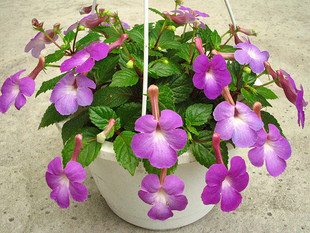
When planting from rhizomes, you can do so in April-May when the weather warms and the rhizomes begin to sprout, planting the rhizomes upright or parallel to the soil surface and covering with about 1.5 cm of soil. The growing medium needs good drainage; you can use potting soil mixed with perlite and vermiculite. The growing site needs bright indirect light; mature plants can take direct light, as long as strong direct sun is avoided. If you want the plant to grow denser (especially trailing varieties), you can pinch out the growing tips when the new shoots emerge from the soil surface and have grown their 2nd or 3rd pair of leaves, encouraging more new shoots to grow. The suitable growing temperature is about 15-21°C at night, with daytime temperatures above 21°C.
Growing methods and care precautions for Achimenes
Chinese scientific name: AchimenesAlternative name: Honghua Jihan JutaiBinomial name: Achimenes hybridaKingdom: PlantaeFamily: GesneriaceaeDistribution area: Guatemala, MexicoAchimenes, also known as Honghua Jihan Jutai, is native to Guatemala and Mexico. It likes a warm, humid environment with plenty of sunlight, is not cold-tolerant, fears frost, is not tolerant of strong direct light, and prefers loose, fertile, well-drained sandy loam. Achimenes, like its close relative gloxinia, is deeply loved by people in Europe and America.1. Achimenes
Introduction, propagation and cultivation key points of Achimenes2. Introduction
Achimenes grows 10-20 cm tall, with long, elliptical leaves and serrated edges. The flowers emerge from the leaf axils, with long tubular corollas, and the flowering period is from spring to summer. Flower colors include purple-red, scarlet, peach red or white; in full bloom it is very delicate and beautiful, and it is suitable for pot culture.Propagation
You can use sowing or the tuber-cutting method; spring is the suitable time, and the suitable germination temperature for seeds is 18-20°C.Cultivation key points
The best growing medium is humus soil or fine tree-fern fiber; sunlight should be about 60%-70%, and strong direct light must be avoided. Apply a top dressing of nitrogen, phosphorus and potassium fertilizer once a month. During winter dormancy, keep it warm and sheltered from wind. It likes warmth, and the suitable growing temperature is 15-28°C.Lycoris longituba illustrated guide: growing methods and care precautions for Lycoris longituba
Chinese scientific name: Lycoris longituba
Latin name: Lycoris longituba Y. Xu & G. J. Fan
Chinese scientific name: Lycoris longitubaLatin scientific name: Lycoris longituba Y. Xu & G. J. FanKingdom: PlantaeDivision: AngiospermsClass: MonocotyledonsOrder: LilialesFamily: AmaryllidaceaeGenus: LycorisSpecies: Lycoris longitubaNaming author and year: Y. Xu & G. J. Fan, 1974Lycoris longituba (scientific name: Lycoris longituba Y. Xu & G. J. Fan) is a herbaceous, terrestrial plant. The bulb is ovoid; the leaves are lanceolate; the umbel has 5-7 flowers, and the flowers are white; the tepal lobes have slight pale red stripes on the ventral surface and are oblong-elliptic; the stamens are slightly shorter than the tepals; the style extends beyond the tepals. It is distributed in Jiangsu Province and other places in China, and mostly grows on shady, moist hillsides.1. Morphological characteristics
Lycoris longituba is a perennial plant. The bulb is ovoid, about 4 cm in diameter. Leaves emerge in early spring; the leaves are lanceolate, about 38 cm long, generally 1.5 cm wide, up to 2.5 cm wide at the widest part, tapering and rounded at the tip, green, with a distinct pale-colored band in the middle. The flower scape is 60-80 cm tall; there are 2 involucral bracts, lanceolate, about 5 cm long, tapering at the tip, up to 1.5 cm wide at the base; the umbel has 5-7 flowers; the flowers are white, about 5 cm in diameter; the tepal lobes have slight pale red stripes on the ventral surface, are oblong-elliptic, 6-8 cm long and about 1.5 cm wide, slightly recurved at the tip, with non-wrinkled edges, and the perianth tube is 4-6 cm long; the stamens are slightly shorter than the tepals; the style extends beyond the tepals. The flowering period is July-August. It has capsules and sets few seeds.
2. Origin and habitat
It is distributed in Jiangsu Province and other places in China, and mostly grows on hillsides. The type specimen was collected in Nanjing, Jiangsu.3. Growth habits
Lycoris likes to grow in sunny, moist environments, such as shady, moist hillsides and under rocks and cliffs, but it can also tolerate semi-shade and dry environments, is slightly cold-tolerant, and has strong vitality. It has no strict requirements for soil; if the soil is fertile and well-drained, the flowers will be especially abundant.4. Propagation methods
In the natural state, Lycoris longituba sets few seeds and the germination rate is extremely low, so asexual propagation methods are generally used for multiplication.Division method
The simplest method is division: during the dormancy period or after flowering, dig up the plant, remove the offset bulbs attached near the mother bulb and plant them; they can bloom in about one to two years.
Scale induction and plant regeneration
Remove the brown outer scale skin and dry scales from the Lycoris bulb, cut off the bulb neck and root system, rinse under running water, then disinfect with ethanol and mercuric chloride solution. Divide the bulb into six equal parts, each containing 2-8 scales, and inoculate them on a medium for inducing axillary buds, or divide the bulb into two, four or eight equal parts and place them directly on an axillary bud induction medium; after axillary buds or adventitious buds are produced, transfer them to a medium for inducing bulbs; place the small bulbs that have unfolded leaves on a rooting medium to induce rooting. The regenerated plants are transplanted into commercially available potting soil.
5. Cultivation techniques
Time
Never transplant in winter or early spring after the leaves have grown. Lycoris likes a warm climate; growth is suitable when the maximum temperature does not exceed 30°C and the 10-day average temperature is 24°C. In winter, an average daily temperature above 8°C and a minimum temperature of 1°C do not affect growth.
Environment